• Welcome to the new COTI server. We've moved the Citizens to a new server. Please let us know in the COTI Website issue forum if you find any problems.
  • We, the systems administration staff, apologize for this unexpected outage of the boards. We have resolved the root cause of the problem and there should be no further disruptions.

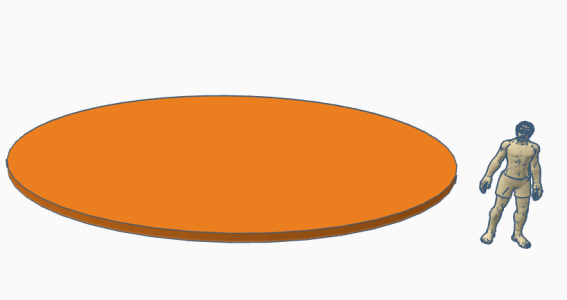
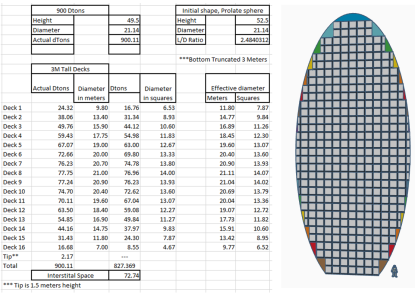
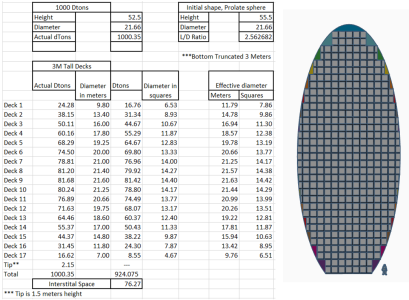
More flattened sphere tailsitters.

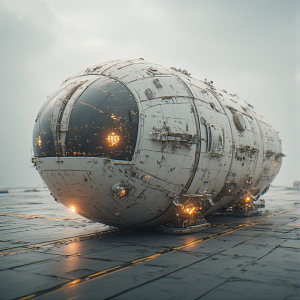
I can see that the prolate shape would fit way better for a tail sitter design
My biggest concern with the prolate sphere "form" in a tailsitter arrangement is ... ground stability in austere landing zones.

Sure, it'll work "fine" at a starport, with plenty of landing zone infrastructure ... but what about wanting to set down somewhere else (anywhere else)? Say ... an open grassy field/meadow/salt flat somewhere ... or even worse, need to make a water landing (lake or ocean, take your pick) for a wilderness refueling "scoop" session. How likely is the prolate sphere tailsitter to remain "upright" on soft ground, or while bobbing on the water surface (partially submerged)? What happens if there's any wind?

The prolate spheroid tailsitter configutation increases the ground pressure, because it's "narrow and the bottom" as well as being "tall" for its diameter. This is not an inherently stable mass distribution, because the center of mass has to be so high inside the hull.


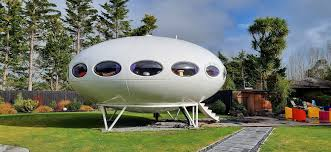
Compare and contrast that with the oblate sphereoid "low & wide" form factor, which would obviously be far more stable when touching down in unprepared landing zones.

Just something that those of us on the Life Simulator™ side of the RAW tend to think about more ... ;)
 
My biggest concern with the prolate sphere "form" in a tailsitter arrangement is ... ground stability in austere landing zones.

Compare and contrast that with the oblate sphereoid "low & wide" form factor, which would obviously be far more stable when touching down in unprepared landing zones.
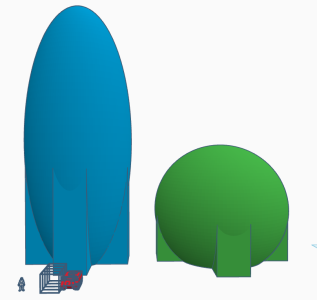
And this is why I had never imagined that form factor before. It's a workable concept with the right infrastructure (docking gantries and hardenerd surface), but it doesn't do anything a non-tailsitter 1769668214229.png or oblate 1769668269578.png form factor won't get you.
 
Thanks for the info @Grav_Moped , @Badenov , & @Spinward Flow .

In T20, flying saucer is mentioned for flattened sphere ship description. I can see that the prolate shape would fit way better for a tail sitter design and should also share the price cut the oblate shape receives.

That merchant ship in TNE said to be a flattened sphere still isn't a flattened sphere either way. But I could still be wrong somehow.
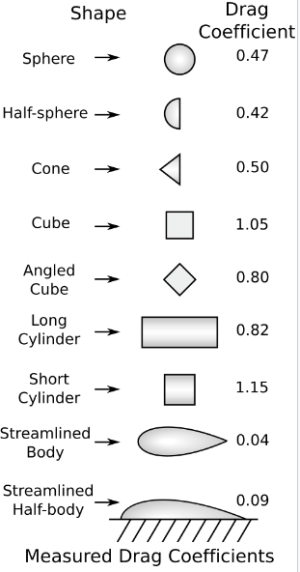
Beyond just fitting the tail sitter better, a prolate sphere should be more aerodynamic than an oblate, less frontal area and much closer to an streamlined body. I would Guess more areodyamiclly stable too. I'd think a Oblate Sphere/ Saucer would tend to want to flip.

1769933702147.png
But not nearly as Aerodynamic as Sears-Haack body. But I think landing is more about cares more about stability than aerodynamics, atleast for grav drive.
 
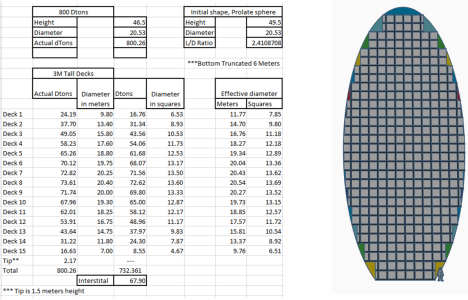
Long and narrow is relative, It would have lot of area to spread the pressure, If the whole bottom is a landing pad it would have 75 M² of area to spread the weight. I'd be more worried about stability center of mass and tilt tolerance. A set of fins like the Broadsword has would probably greatly improve the ground stability.
1769935224565.png

My biggest concern with the prolate sphere "form" in a tailsitter arrangement is ... ground stability in austere landing zones.

Sure, it'll work "fine" at a starport, with plenty of landing zone infrastructure ... but what about wanting to set down somewhere else (anywhere else)? Say ... an open grassy field/meadow/salt flat somewhere ... or even worse, need to make a water landing (lake or ocean, take your pick) for a wilderness refueling "scoop" session. How likely is the prolate sphere tailsitter to remain "upright" on soft ground, or while bobbing on the water surface (partially submerged)? What happens if there's any wind?

The prolate spheroid tailsitter configutation increases the ground pressure, because it's "narrow and the bottom" as well as being "tall" for its diameter. This is not an inherently stable mass distribution, because the center of mass has to be so high inside the hull.


Compare and contrast that with the oblate sphereoid "low & wide" form factor, which would obviously be far more stable when touching down in unprepared landing zones.

Just something that those of us on the Life Simulator™ side of the RAW tend to think about more ... ;)
 
Minor nitpick on the bit from The Expanse: the rocket's exhaust plume, even if it was not visible, should have kicked up lunar dust directly below... Granted, the virtual camera angle hid this for most of the clip, and it's much nicer cinematically this way. :)
 
Minor nitpick on the bit from The Expanse: the rocket's exhaust plume, even if it was not visible, should have kicked up lunar dust directly below... Granted, the virtual camera angle hid this for most of the clip, and it's much nicer cinematically this way. :)
It will be interesting to see what the Blue Origin lander turns up with the SCALPPS experiment, Blue Ghost already flew one, but it'll be interesting to see what a larger lander with bigger engines does.

But even with huge engines you won't get that much of a dust cloud. The dust doesn't have any air to hang in or to slow it down. When it gets blown by the exhaust plume it shoots away at high speed and keeps going, so it exits frame quickly, and disperses quickly.

It would be nice to get a view and some reading from a rover or other surface instrument to observe the effects.
Apollo 17 did get a nice shot of Apollo 17 leaving the moon with the camera on the lunar rover, something similar but with modern cameras/ resolution would be fantastic.
 
Back
Top