• Welcome to the new COTI server. We've moved the Citizens to a new server. Please let us know in the COTI Website issue forum if you find any problems.
  • We, the systems administration staff, apologize for this unexpected outage of the boards. We have resolved the root cause of the problem and there should be no further disruptions.

More flattened sphere tailsitters.

OTOH, You don't have to slice it like a pie.
For example this would be deck 4, the center deck of the 200 dTon Hull in the first post. 8 state rooms each 2.4 dTons plus 12.5d Tons of common area. Gives 31.7 dTons total, or 3.96 dTons per used per stateroom.

The loose .3 dTons could be either used on another floor for lift space, or it could be in the curvature of the wall. either way I think it's close enough. and the rooms have 2 "square" sides. So I don't think they are terribly mishapen.
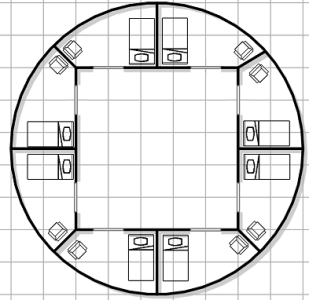
1769391271768.png
 
That works just fine for larger radii in dimensions, because the resultant "slices" have more of a trapezoidal shape to them that almost but not quite rectangular. You're also correct that the "central area" is obviously where "shared/communal spaces" ought to be located.

However, when the radius gets smaller, the "trapezoidal distortion" away from a rectangular dimension sizing increases ... until reaching a breaking point where an unacceptable fraction of the interior area becomes unusable or otherwise "wasted" space. So definitely a condition of ... we make it up in volume ... that favors the Big over the Small (or words to that effect). ;)
So the smaller decks force the geometry a bit, but you've got 10% of your hull volume x your Jump # that's just filled with fuel, so you can put all your awkward shapes there. You could even do completely square spaces and just let the surrounding uneven areas be fuel tanks. It's true that larger spaces are easier to make work, but there's all kinds of things to do with odd spaces. Got a weird corner nothing else will fit in? Stuff some survival gear from the ship's locker there. Now that's someone's ditching station.
 
My aunt, who did a little real estating, commented on a house that my uncle had renovated for rental.

That he should have placed the stairs on the outside, and used the stair well to increase square footage.

That viewpoint has always stayed with me.

You could always install an elevator on the outside, and access each floor through an airlock.
 
My aunt, who did a little real estating, commented on a house that my uncle had renovated for rental.

That he should have placed the stairs on the outside, and used the stair well to increase square footage.

That viewpoint has always stayed with me.

You could always install an elevator on the outside, and access each floor through an airlock.
I looked at a house where they had built an outside set of stairs, they converted the old stairway, inside the house, into a pantry downstairs and a linen closet upstairs.
 
Last edited:
My aunt, who did a little real estating, commented on a house that my uncle had renovated for rental.

That he should have placed the stairs on the outside, and used the stair well to increase square footage.

That viewpoint has always stayed with me.

You could always install an elevator on the outside, and access each floor through an airlock.
On houses, this is fine. On spacecraft, this increases the enclosed volume, which increases the ship's overall tonnage. What you could do, without increasing the tonnage, is to install an extendable crane that can lower a platform, stored flush against the cargo door when not in use, from one deck's external door to the next, and to the ground when you're on-planet, which is where 99% of the use will happen. Alternately, the platform is part of the deck on the highest cargo deck, it rolls outside, and gets lowered from there.

In planning for an internal cargo elevator, how often do you plan transfer bulk cargo between decks while in space or in jump? Sure, it's a logistical flex when you can do it, but if it's a 3mx3m platform and a 3m deck height, that's 27m^3 space, about 2dT, you're losing, per deck, to keep this capability, and I can't think of any situations where that would be a solution.
 
On houses, this is fine. On spacecraft, this increases the enclosed volume, which increases the ship's overall tonnage. What you could do, without increasing the tonnage, is to install an extendable crane that can lower a platform, stored flush against the cargo door when not in use, from one deck's external door to the next, and to the ground when you're on-planet, which is where 99% of the use will happen. Alternately, the platform is part of the deck on the highest cargo deck, it rolls outside, and gets lowered from there.

In planning for an internal cargo elevator, how often do you plan transfer bulk cargo between decks while in space or in jump? Sure, it's a logistical flex when you can do it, but if it's a 3mx3m platform and a 3m deck height, that's 27m^3 space, about 2dT, you're losing, per deck, to keep this capability, and I can't think of any situations where that would be a solution.
That how I picture it, more like a multi car lift.
BendPak-HD-973PX-2__29652.1759546012.jpg
 
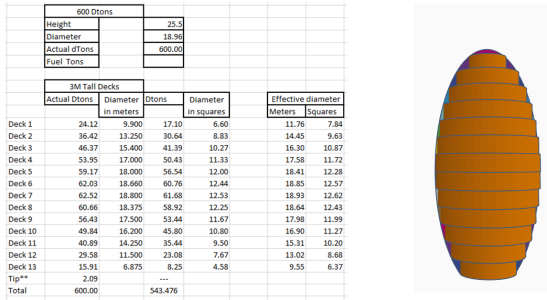
Tonight's entry, the 600 dTon hull.
I added a couple more calculations. Diameter in squares which is just the diameter of the level when drawing a deckplan for it. And Effective diameter, which is the diameter of the cylinder which would have the same volume as that level's sphere segment. It you want to semi-handwave the taper.

1769416586247.png
 
Mentioning that odd elevator reminded me.

Also, lots of exterior shots of science fiction movies, where they placed the transport cab, or elevator, on the exterior, possibly within a scaffolding, which would minimize volume.
 
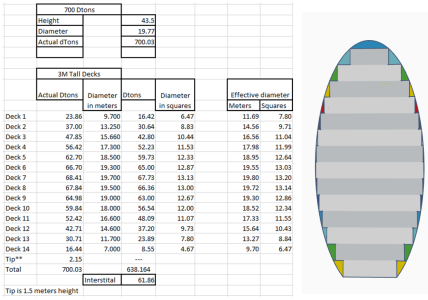
And here's the 700 Ton Hull, I am making these by stretching the hull one deck every time in increase the tonnage. That results in a slightly over tonnage hull so I reduce the diameter. The 100 dTon hull I started with a had 2:1 height to diameter ratio. Each one is truncated 6m on the bottom, so it has a nice flat bottom to land on. And each has 1.5m above the top deck.

1769504375776.png
 
I really like the designs, but all the ships in this thread look like cylindrical tail sitter hulls instead of a flattened spherical tail sitter hulls.

Sure, each deck looks like a flattened sphere, but stacked like they are in these designs, they look more like a cylinder hull.

As long as they are, even if you flattened them along the length, they'd be a flattened cylinder, not a flattened sphere.

From what I understand, a flattened sphere is a flying saucer, so a flying circle, oval, or flattened egg shape(?). I saw in TNE a ship that was supposed to be a flattened sphere that totally wasn't a flattened sphere, but it could be I am unknowledgeable of the many shapes that constitute a flattened sphere.
 
I really like the designs, but all the ships in this thread look like cylindrical tail sitter hulls instead of a flattened spherical tail sitter hulls.

Sure, each deck looks like a flattened sphere, but stacked like they are in these designs, they look more like a cylinder hull.

As long as they are, even if you flattened them along the length, they'd be a flattened cylinder, not a flattened sphere.

From what I understand, a flattened sphere is a flying saucer, so a flying circle, oval, or flattened egg shape(?). I saw in TNE a ship that was supposed to be a flattened sphere that totally wasn't a flattened sphere, but it could be I am unknowledgeable of the many shapes that constitute a flattened sphere.
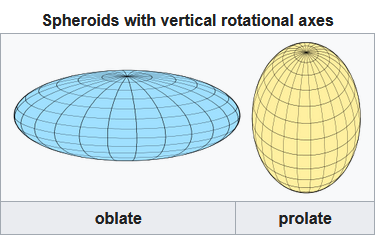
Oblate spheroids are squished soccer balls.

Prolate spheroids are soccer balls squeezed at the equator. Squeeze 'em enough and you end up with a 'needle" configuration.

Cylinders have flat ends (or maybe domed ones). They don't get to be fully streamlined under Traveller build rules, unless skinny enough to be called needle shaped.
 
Part of the problem, I think, is the specific nomenclature.

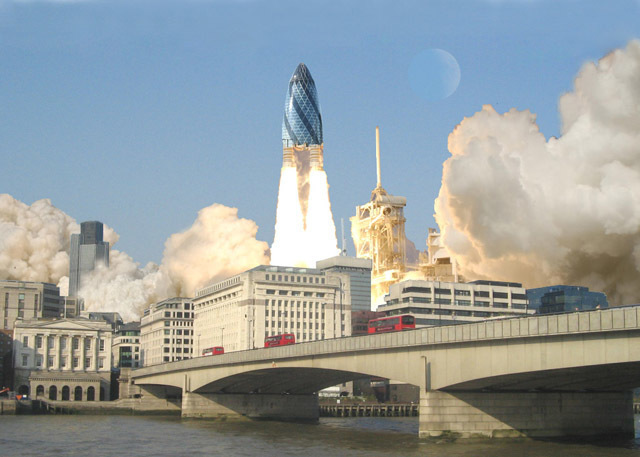
When I google 'Flattened sphere, I get this: https://en.wikipedia.org/wiki/Spheroid 1769614591377.png which contains two pics, an oblate sphereoid and a prolate sphereoid. The only reference I find to the 'Flattened Sphereoid' hull shape is CT Book 5 High Guard, and there's no accompanying pic. I had imagined it as the flattened sphereoid like this ->1769615255548.png, but normally moving horizontally, So, I had imagined the tailsitter option but oriented to move vertically rather than horizontally but otherwise the same shape. As I look at the shapes, though, I can see how the prolate sphereoid is a 'flattened sphereoid' also, just flattened around a different axis. The prolate sphereoid may even be the more correct version and I have been imagining it wrong all this time. The Prolate sphereoid mounted as shown in the pic above and launching vertically would be the shape that's been shown in the previous posts. From this, I deduce that the 'normal' configuration for the prolate sphereoid is oriented horizontally, with the decks along the long axis as done by AI because I can't find a pic that shows what I mean -> 1769616121513.png.
 
1769614591377-png.7302


My personal interpretation has always been in the direction of the oblate, rather than the prolate.
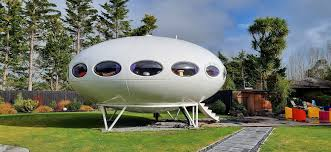
The oblate spheroid is closer to the stereotypical "flying saucer" 🛸 which makes more sense (to me).


Ironically, a "belly landing saucer" shape has more in common with "tailsitter" orientation of internal decks. Movement is also inherently VTOL (rather than CTOL airframe-ish) under maneuver power in ways that are more consistent with gravitic lift.
 
Last edited:
I really like the designs, but all the ships in this thread look like cylindrical tail sitter hulls instead of a flattened spherical tail sitter hulls.

Sure, each deck looks like a flattened sphere, but stacked like they are in these designs, they look more like a cylinder hull.

As long as they are, even if you flattened them along the length, they'd be a flattened cylinder, not a flattened sphere.

From what I understand, a flattened sphere is a flying saucer, so a flying circle, oval, or flattened egg shape(?). I saw in TNE a ship that was supposed to be a flattened sphere that totally wasn't a flattened sphere, but it could be I am unknowledgeable of the many shapes that constitute a flattened sphere.
Thanks for the info @Grav_Moped , @Badenov , & @Spinward Flow .

In T20, flying saucer is mentioned for flattened sphere ship description. I can see that the prolate shape would fit way better for a tail sitter design and should also share the price cut the oblate shape receives.

That merchant ship in TNE said to be a flattened sphere still isn't a flattened sphere either way. But I could still be wrong somehow.
 
Back
Top