• Welcome to the new COTI server. We've moved the Citizens to a new server. Please let us know in the COTI Website issue forum if you find any problems.
  • We, the systems administration staff, apologize for this unexpected outage of the boards. We have resolved the root cause of the problem and there should be no further disruptions.

Working on a flattened Sphere trader

spank

SOC-13
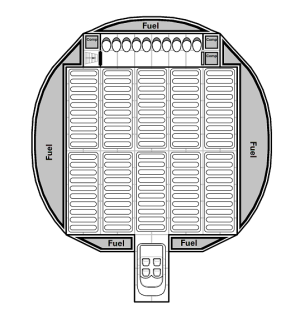
I am working on a Trader built with a flattened sphere hull, for an adventure, and I am up to making deck plans. The Flattened Sphere shape is somewhat challenging, but I think I have a good layout, It has 2 decks in the center and a single mid-deck on the outside. I'd welcome comments on the layout. Here's the mid-deck
1768544637015.png
 
Ok, here's the "more".
- IMTU, a prolate spheroid (roughly the shape of a US football) is also a "flattened sphere". See my Type S as a Tailsitter Prolate Spheroid design. Plans start at Post #75 because the originals were lost during the forum platform transition, then I re-drew them to fix minor details.
- Another take on a squished spheroid (by a strange coincidence, also one of my designs) is the 600Td J5/2G Shugushaag Distant Trader. Plans start at Post #25 due to losing the originals in the forum transition. There is also a nifty pdf of it that @Hairy Jim DeGriz made, at Post #49.
- Volume is [EDIT: 4/3 x ] pi x r1 x r2 x r3. [length x width x height]. Thanks to Another Dilbert for the correction.
- There are online calculators available. I have (pretty sad, actually, but I can try to clean them up a little) spreadsheets for calculating sections.

Notes from a similar project (merely started, didn't do anything with it):
Project: Type A Free Trader from LBB2 as an oblate spheroid tailsitter (well, belly-lander...)

Features:
Maneuver drive at bottom.
Direction of travel is on its *short* axis. (That is, it lands like a belly-lander and sort of flies like one in atmosphere; but once out of the atmosphere, it flies "up" rather than "forward".)
Cargo deck should be single height.
Bridge will mostly be on periphery of personnel deck as edge filler.

Volume should be 2700m^3

equatorial r 10.5
polar r 5.25
yields 2424.5m^3
Is 89.7% of 200Td. That's as close as it gets using reasonable fractions of 1.5m grid units.

Looks like 3 decks with waste space above and below.
Haven't done the math on how big each deck is.
 
Last edited:
It looks like this if you stick with the cubic view,

With a little radiusing it becomes semi-spheroid.
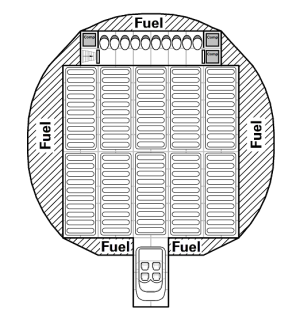
I figure alot of the fudging will come from the fuel space.
an oblate sphere with similar dimensions is 168.43 dTons, But I think it will be 2 oblate spheres with cylindrical plug
1768557073134.png

1768557934273.png


Ok, here's the "more".
- IMTU, a prolate spheroid (roughly the shape of a US football) is also a "flattened sphere". See my Type S as a Tailsitter Prolate Spheroid design. Plans start at Post #75 because the originals were lost during the forum platform transition, then I re-drew them to fix minor details.
- Another take on a squished spheroid (by a strange coincidence, also one of my designs) is the 600Td J5/2G Shugushaag Distant Trader. Plans start at Post #25 due to losing the originals in the forum transition. There is also a nifty pdf of it that @Hairy Jim DeGriz made, at Post #49.
- Volume is [EDIT: 4/3 x ] pi x r1 x r2 x r3. [length x width x height]. Thanks to Another Dilbert for the correction.
- There are online calculators available. I have (pretty sad, actually, but I can try to clean them up a little) spreadsheets for calculating sections.

Notes from a similar project (merely started, didn't do anything with it):
Project: Type A Free Trader from LBB2 as an oblate spheroid tailsitter (well, belly-lander...)

Features:
Maneuver drive at bottom.
Direction of travel is on its *short* axis. (That is, it lands like a belly-lander and sort of flies like one in atmosphere; but once out of the atmosphere, it flies "up" rather than "forward".)
Cargo deck should be single height.
Bridge will mostly be on periphery of personnel deck as edge filler.

Volume should be 2700m^3

equatorial r 10.5
polar r 5.25
yields 2424.5m^3
Is 89.7% of 200Td. That's as close as it gets using reasonable fractions of 1.5m grid units.

Looks like 3 decks with waste space above and below.
Haven't done the math on how big each deck is.
 
Last edited:
The Flattened Sphere shape is somewhat challenging
The main challenge is the "squaring the circle" factor, as far as the deck plans themselves go. :unsure:
Likewise, if you're making something intended to haul cargoes, the obvious choice is to make a "central shaft" cargo hold in the middle of a "frisbee" flying saucer shape and do ventral access/loading while on planetary surfaces. Just use the ventral bulkhead as something that can separate and use any landing gear to "raise" the rest of the hull up out of the way for a roll-on/roll-off type of access/clearance.

If you want to put a "square" cargo hold in the center, you can make the sides into hinged fold up/down ramps. So there will be ramp "walls" on the sides while the cargo hold is sealed up ... but when opened and the ship hull "lifts up" out of the way, the side ramps can all hinge to drop down on each side and you have easy ramp access from all 4 directions to the "cargo platform" that is the ventral hull bulkhead of the starship that all the cargo gets piled on top of. Not quite a Pez dispenser ... but not that different from one either. Whole thing works a bit like a freight elevator in the center of the hull.

You then wind up with "everything else" running around the periphery of the "flying saucer" hull form factor, much like how @spank has outlined above. Ideally speaking, you're going to want to have separate decks for passengers/cargo (below) and crew/engineering (above) for security/anti-hijacking reasons.
 
I did up a 200 Dton flattened sphere single deck tramp merchant. Making square interior fittings fit in a circular hull was tough, but eventually I was able to make it work, after taking into consideration many of the deck plans I've seen in some of the Traveller books.

For the rounded edges, I used diagonal lines through the squares, so 4 flat sides and 4 diagonal sides, with the engine side sticking out the back a few squares, and a little more oval front to back than perfectly round. Let me tell you, looking online for the formulas and math to make it all work almost broke my brain. Go Calculator, Go! And then making sure all 400 squares are accounted for 😿 .

I've recently been thinking of redoing the interior based on some recent threads I've read on the CotI.
 
Front section hinges up w/no floor in the cargo hold would be a good design, it would be wide open. Either way, it is great design, thanks!
 
There area a few workarounds, Traveller would consider many modern airliners to be cylinders, but most are "double bubble" designs where the fuselage is 2 cylinders.
Take the C-97 for example.

aircraft design - Did the cusp in the Boeing 377/C-97/KC ...


And it's not an outlier either
1768610413357.png
All these designs help to square the circle.

I did up a 200 Dton flattened sphere single deck tramp merchant. Making square interior fittings fit in a circular hull was tough, but eventually I was able to make it work, after taking into consideration many of the deck plans I've seen in some of the Traveller books.

For the rounded edges, I used diagonal lines through the squares, so 4 flat sides and 4 diagonal sides, with the engine side sticking out the back a few squares, and a little more oval front to back than perfectly round. Let me tell you, looking online for the formulas and math to make it all work almost broke my brain. Go Calculator, Go! And then making sure all 400 squares are accounted for 😿 .

I've recently been thinking of redoing the interior based on some recent threads I've read on the CotI.
 
And then making sure all 400 squares are accounted for 😿 .
This isn't actually necessary! If you have the overall volume within limits (+/-10%), then having each indvidual component sized "close enough" takes care of itself. Just calculate out each block and stuff compnents in. The best example of me doing that was in the "Type S as a Prolate Spheroid" design.

The drives are 15Td; the fuel tank 40Td (LBB2, you know). Total: 55Td. Put a major bulkhead halfway down the hull (divide it at the "equator") and 5Td of fuel tanks has to go above that. Calculate an end-slice that's about 15Td (I've got a spreadsheet; there's probably an online calculator that does it better) and there's the drive bay. (Pretty sure I slid a couple of extra Td of fuel (it was all as "fuel scoops") up above the equator too, to compensate for "bridge" or "stateroom" tonnage committed to the elevator shaft passing through the fuel tank.) Also pretty sure I took the entire space for the landing gear wells out of the fuel tank because by that point I figured it was down in the statistical noise range.

The other trick I use is to "correct" or scale the line-item tonnages by how much the computed actual hull size is above or below the on-paper tonnage. That is, if the hull is 10% oversize, the bridge takes 22Td of volume on the plan, staterooms are 4.4Td, etc. Reverse this if the hull is undersized, of course.
 
There area a few workarounds, Traveller would consider many modern airliners to be cylinders, but most are "double bubble" designs where the fuselage is 2 cylinders.
Take the C-97 for example.
... which was pretty much a B-29 with an additional fuselage grafted on top of the skinny original bomber fuselage. :)

That said, having the cabin and cargo hold of an airliner as mostly separate compartments rather than a single pressure hull is quite sensible.
 
Back
Top