• Welcome to the new COTI server. We've moved the Citizens to a new server. Please let us know in the COTI Website issue forum if you find any problems.
  • We, the systems administration staff, apologize for this unexpected outage of the boards. We have resolved the root cause of the problem and there should be no further disruptions.

maneuver drive limits

That is 1000 diameters from any massive body. In the Sol system, you would need to calculate 1000 Solar diameters (which takes you out to about Saturn).
Due to certain posts on this subject, I did some thinking. When travelling from one planet to another in the same system you

1. Accelerate/Thrust using up to your maximum G rating out to the planets 1,000 diameters (or the stars if within the stars 1,000 diameters).

2. Somewhere along the way you will need to start deaccelerating/dethrusting. One problem is if there is a space between the starting planets/stars 1,000 diameters and the destination planets 1,000 diameters, your acceleration & deacceleration will be 0.01 outside of any gravity wells.

3. Deaccelerate using up to your maximum G rating until you are able to safely land.

If I want to keep it simple, I just use the Distance/Time/Thrust formula as given in Traveller.

If I want to make it 'interesting', I add the Distance of the two 1,000 diameters and use the formula, then use the formula to figure out the time travelled between the two 1,000 diameter limits at 0.01 of thrust, then add the times together. If this is the wrong way to do it, please help.
 
If I want to make it 'interesting', I add the Distance of the two 1,000 diameters and use the formula, then use the formula to figure out the time travelled between the two 1,000 diameter limits at 0.01 of thrust, then add the times together. If this is the wrong way to do it, please help.

Somewhere about 2/3 down the "torch drives" page at Atomic Rockets, there's actually a formula for a journey where you "coast" in the middle. It's a spreadsheet kind of formula, if you know what I mean, but probably easy to manage after that.
 
"Looks like micro jumps' back on the menu, boys!"


flatten;crop;webp=auto;jpeg_quality=60.jpg
 
Due to certain posts on this subject, I did some thinking. When travelling from one planet to another in the same system you

1. Accelerate/Thrust using up to your maximum G rating out to the planets 1,000 diameters (or the stars if within the stars 1,000 diameters).

2. Somewhere along the way you will need to start deaccelerating/dethrusting. One problem is if there is a space between the starting planets/stars 1,000 diameters and the destination planets 1,000 diameters, your acceleration & deacceleration will be 0.01 outside of any gravity wells.

3. Deaccelerate using up to your maximum G rating until you are able to safely land.

If I want to keep it simple, I just use the Distance/Time/Thrust formula as given in Traveller.

If I want to make it 'interesting', I add the Distance of the two 1,000 diameters and use the formula, then use the formula to figure out the time travelled between the two 1,000 diameter limits at 0.01 of thrust, then add the times together. If this is the wrong way to do it, please help.


Keep in mind that your originating and destination worlds will not necessarily have the same 1000 diameter envelope, so you want to make sure that you are doing your constant accel/decel. maneuver in both gravity wells over the distance-range of the smaller of the two bodies. Otherwise, if your originating system is the larger one, you may overshoot out of the meaningful gravity envelope of the smaller destination world when your M-Drive cannot initiate soon enough after mid-point roll-over, and you find yourself with too much relative velocity upon orbital intercept with the destination world, and you have to "loop back".

But a trained pilot/astrogator will know all of this and will have the astrogation software to plot it out. In fact, he may be able to modify the trajectory somewhat and cut out some of the maneuver time by beginning the rollover within the low-efficiency maneuver regime not at its midpoint, but rather at close to its beginning or endpoint prior to the resumption of high-efficiency maneuver, depending upon the particular situation.
 
Keep in mind that your originating and destination worlds will not necessarily have the same 1000 diameter envelope
I was thinking of using a slingshot kind of maneuver using gravity to slow down when going from larger to smaller, or as you said, deaccelerating at an earlier point to make up for the smaller destination diameter envelope.

I have to say, I really need to dig into the math for this, and compare to just using the original Time/Distance/Thrust formula and see which one looks better, or more fun, or is easier to use.... (sighhhhh) choices choices.
 
"You sure about that?" :unsure:
So tireseome. So tedious. Yet I reply anyway, you'd think I'd know better.

Earth: diameter ~12000km. 1000 x 12000 =12,000,000km * 1000 =1.2×10¹⁰m.

Time to travel 1000d at 1G (10/m/s/s) = 48989s. V = 10 * 48989 = 489890 m/s, or 490 kps.

Earth -> Jupiter 588Mkm. 1/2 588Mkm = 294Mkm

294Mkm / 490kps = 600015s, / 3600 = 166 hours * 2 for the turn around and decel (they can start decelerating earlier in Jupiters 1000D, but no real point, velocity is the same, and ignoring Jupiters monstrous gravity). So, 166 * 2 =332/ 24 =13.833

Or "About 2 weeks".

This math is more accurate-ish.

Code:
(defun trip (a d)
  (let* ((d1000 (* d 1000 1000))
         (time-to-d (time-with-accel-distance a d1000))
         (v (* time-to-d a))
         (accel-distance (* 2 d1000))
         (jupiter-distance (* 588 1000000 1000))
         (cruise-distance (- jupiter-distance accel-distance))
         (total-time (+ (* 2.0 time-to-d) (/ cruise-distance v))))
    (list total-time (/ total-time 3600) (/ total-time 86400))))

Code:
CL-USER> (trip 10 12000)
(1249239.9 347.01108 14.458795)

Unfortunately, the trip back from Jupiter is no better. While there's more room to accelerate, there isn't on the receiving end, so you're stuck with Earths diameter.

 
So tireseome. So tedious. Yet I reply anyway, you'd think I'd know better.

Earth: diameter ~12000km. 1000 x 12000 =12,000,000km * 1000 =1.2×10¹⁰m.

Time to travel 1000d at 1G (10/m/s/s) = 48989s. V = 10 * 48989 = 489890 m/s, or 490 kps.

Earth -> Jupiter 588Mkm. 1/2 588Mkm = 294Mkm

294Mkm / 490kps = 600015s, / 3600 = 166 hours * 2 for the turn around and decel (they can start decelerating earlier in Jupiters 1000D, but no real point, velocity is the same, and ignoring Jupiters monstrous gravity). So, 166 * 2 =332/ 24 =13.833

Or "About 2 weeks".

This math is more accurate-ish.

Code:
(defun trip (a d)
  (let* ((d1000 (* d 1000 1000))
         (time-to-d (time-with-accel-distance a d1000))
         (v (* time-to-d a))
         (accel-distance (* 2 d1000))
         (jupiter-distance (* 588 1000000 1000))
         (cruise-distance (- jupiter-distance accel-distance))
         (total-time (+ (* 2.0 time-to-d) (/ cruise-distance v))))
    (list total-time (/ total-time 3600) (/ total-time 86400))))

Code:
CL-USER> (trip 10 12000)
(1249239.9 347.01108 14.458795)

Unfortunately, the trip back from Jupiter is no better. While there's more room to accelerate, there isn't on the receiving end, so you're stuck with Earths diameter.
Jupiter is well within 1000D of Sol. So max thrust all the way to the halfway point.
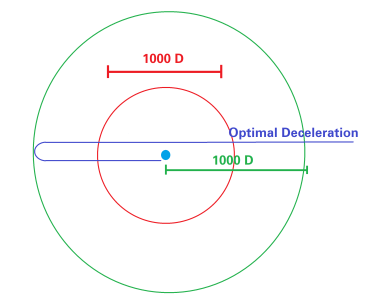
Thrust on the destination end should be based on 2000D, because you start thrusting 1000D from the planet and thrust 1000D past it. Making a sort of "J" shaped trajectory.

1770182663729.png
Of course it depends on what you mean by 1000D. Do you mean 1000D centered on the planet? Effectively a 500D radius? Or a radius arbound the object equal to 1000X the object's diameter.
 
Last edited:
I should also add that you can use the J-turn trick outbound aswell
Say you are departing Saturn, Uranus or beyond. Simply boost out to the opposite side of the 1000D limit, Turn around, and boost all the way back past the planet to the nearside of the limit.
 
I was going to mention something ... but I'm glad I don't have to tell anyone that THEY FORGOT THE STAR ... 😓

Granted, Sol is not a planet ... except in pre-Copernicus astronomy textbooks ... :rolleyes:
<irony> Of course the sun is a planet. It's just an oversized gas giant, like Jupiter, but so large that the hydrogen in the center can sustain fusion. </irony>
 
Thoughts? I'm sure in the last 50 years that this has been discussed to death, but I wouldn't know where to start looking.
T4 introduced the 1000 diameter limit; thruster plates lose most (was it 99%? I forget) generation of impulse past that point. Note that, for the Sol system, that puts jupiter well inside at 1118 R (solar radii), so 559 diameters,. Saturn, however, has issues: 2,050 to 2,070 R⊙ (Earth is just a bit past 100 solar diameters; google states 215 to 216 r, so 107.5-108 diam) - so you've 50 to 70 radii to coast. That's small enough to not be a huge impediment...
A fully thrusting profile can only accellerate for the smaller distance if there's a significant gap... so you essentially have to take a brachistochrone path to make up the lost decel window with the target's motion... the math is ugly, but the easy part is just make your course, butmove your flip point back half the coast; that is, however, not the fastest speed during the coast, so the fraction where it is is a pain to figure.
Also note: you get about 1.9× 1000 radiitarget to slow down in... by doing a capture slingshot deceleration burn. Maybe a bit more if you can leverage a major moon or two for more curve.

Note that MT TL 9 antigrav plates (as opposed to TL A thruster plates) cap at 10 diameters.

CT canon, by itself, gives no caps on it.
TNE avoided T-Plates, which says to me, "TNE RAW is an alternate universe." YMMVW.

In my advancing age, I used T20... with houseruled 1000 Diameter T-plate to 0.1% from T4...
 

Attachments

  • 1770184448193.gif
    1770184448193.gif
    43 bytes · Views: 3
  • 1770184467306.gif
    1770184467306.gif
    43 bytes · Views: 3
Interesting. Is that a thing across many of the versions?
It wasn't canon in TNE or in Classic so far as I'm aware. It came up in discussions during the time of T4, but I don't recall if it ended up in any T4 texts.
It would make in-system travel a bit slower, I think, than the standard burn-and-flip times presented in the books, but check my math:

At 1g, you'd hit the 1000d limit going about 500-ish kps, which would make a trip from Earth to Jupiter about 17 days long.
12800000m x 1000 is 12,800,000,000 meters to the cutoff limit.
At 1 g (10m to make it simpler), the time taken in sec would be the square root of that / 5: 50596 seconds.
50596 x 10 = 505960 mps, or about 506 kps. In a day, that's about 44 million km. Avg distance to Jupiter is about 765 million km.

A 2g ship could get up to 715 kps, which would get you 62 Mkm per day. That's 12 days and change.

In comparison, if you can thrust the whole way per the chart in MgT, Jupiter averages about 6 and a half days at 1g.

I would think, if time is money for a free trader, they aren't going to consider skimming a GG unless they're really desperate. Then again, when isn't a free trader desperate? Hmm...

I like the cap, and it gives the drive a little more "flavor". It also makes a lot of in-system destinations far more practical via jump.
Remember that the system's star also has a diameter and limits. For Sol 1000 diameters is about 9.25 AU - far enough that part of Saturn's orbit is within it. So in our solar system the 'inner system' where reactionless thrusters work properly is about out to Saturn, and thus using Saturn or Jupiter for refuelling might make sense. Uranus and Neptune would be your choice if you're just passing through.
 
Back
Top