• Welcome to the new COTI server. We've moved the Citizens to a new server. Please let us know in the COTI Website issue forum if you find any problems.
  • We, the systems administration staff, apologize for this unexpected outage of the boards. We have resolved the root cause of the problem and there should be no further disruptions.

maneuver drive limits

That is 1000 diameters from any massive body. In the Sol system, you would need to calculate 1000 Solar diameters (which takes you out to about Saturn).
Due to certain posts on this subject, I did some thinking. When travelling from one planet to another in the same system you

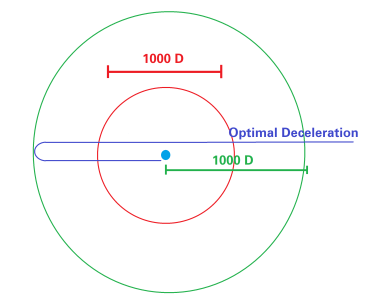
1. Accelerate/Thrust using up to your maximum G rating out to the planets 1,000 diameters (or the stars if within the stars 1,000 diameters).

2. Somewhere along the way you will need to start deaccelerating/dethrusting. One problem is if there is a space between the starting planets/stars 1,000 diameters and the destination planets 1,000 diameters, your acceleration & deacceleration will be 0.01 outside of any gravity wells.

3. Deaccelerate using up to your maximum G rating until you are able to safely land.

If I want to keep it simple, I just use the Distance/Time/Thrust formula as given in Traveller.

If I want to make it 'interesting', I add the Distance of the two 1,000 diameters and use the formula, then use the formula to figure out the time travelled between the two 1,000 diameter limits at 0.01 of thrust, then add the times together. If this is the wrong way to do it, please help.
 
If I want to make it 'interesting', I add the Distance of the two 1,000 diameters and use the formula, then use the formula to figure out the time travelled between the two 1,000 diameter limits at 0.01 of thrust, then add the times together. If this is the wrong way to do it, please help.

Somewhere about 2/3 down the "torch drives" page at Atomic Rockets, there's actually a formula for a journey where you "coast" in the middle. It's a spreadsheet kind of formula, if you know what I mean, but probably easy to manage after that.
 
"Looks like micro jumps' back on the menu, boys!"


flatten;crop;webp=auto;jpeg_quality=60.jpg
 
Earth to Jupiter under 1G for 1000 diameters, the travel time is roughly 2 weeks. You hit almost 490km/s in velocity (which is a lot).
 
Due to certain posts on this subject, I did some thinking. When travelling from one planet to another in the same system you

1. Accelerate/Thrust using up to your maximum G rating out to the planets 1,000 diameters (or the stars if within the stars 1,000 diameters).

2. Somewhere along the way you will need to start deaccelerating/dethrusting. One problem is if there is a space between the starting planets/stars 1,000 diameters and the destination planets 1,000 diameters, your acceleration & deacceleration will be 0.01 outside of any gravity wells.

3. Deaccelerate using up to your maximum G rating until you are able to safely land.

If I want to keep it simple, I just use the Distance/Time/Thrust formula as given in Traveller.

If I want to make it 'interesting', I add the Distance of the two 1,000 diameters and use the formula, then use the formula to figure out the time travelled between the two 1,000 diameter limits at 0.01 of thrust, then add the times together. If this is the wrong way to do it, please help.


Keep in mind that your originating and destination worlds will not necessarily have the same 1000 diameter envelope, so you want to make sure that you are doing your constant accel/decel. maneuver in both gravity wells over the distance-range of the smaller of the two bodies. Otherwise, if your originating system is the larger one, you may overshoot out of the meaningful gravity envelope of the smaller destination world when your M-Drive cannot initiate soon enough after mid-point roll-over, and you find yourself with too much relative velocity upon orbital intercept with the destination world, and you have to "loop back".

But a trained pilot/astrogator will know all of this and will have the astrogation software to plot it out. In fact, he may be able to modify the trajectory somewhat and cut out some of the maneuver time by beginning the rollover within the low-efficiency maneuver regime not at its midpoint, but rather at close to its beginning or endpoint prior to the resumption of high-efficiency maneuver, depending upon the particular situation.
 
Keep in mind that your originating and destination worlds will not necessarily have the same 1000 diameter envelope
I was thinking of using a slingshot kind of maneuver using gravity to slow down when going from larger to smaller, or as you said, deaccelerating at an earlier point to make up for the smaller destination diameter envelope.

I have to say, I really need to dig into the math for this, and compare to just using the original Time/Distance/Thrust formula and see which one looks better, or more fun, or is easier to use.... (sighhhhh) choices choices.
 
"You sure about that?" :unsure:
So tireseome. So tedious. Yet I reply anyway, you'd think I'd know better.

Earth: diameter ~12000km. 1000 x 12000 =12,000,000km * 1000 =1.2×10¹⁰m.

Time to travel 1000d at 1G (10/m/s/s) = 48989s. V = 10 * 48989 = 489890 m/s, or 490 kps.

Earth -> Jupiter 588Mkm. 1/2 588Mkm = 294Mkm

294Mkm / 490kps = 600015s, / 3600 = 166 hours * 2 for the turn around and decel (they can start decelerating earlier in Jupiters 1000D, but no real point, velocity is the same, and ignoring Jupiters monstrous gravity). So, 166 * 2 =332/ 24 =13.833

Or "About 2 weeks".

This math is more accurate-ish.

Code:
(defun trip (a d)
  (let* ((d1000 (* d 1000 1000))
         (time-to-d (time-with-accel-distance a d1000))
         (v (* time-to-d a))
         (accel-distance (* 2 d1000))
         (jupiter-distance (* 588 1000000 1000))
         (cruise-distance (- jupiter-distance accel-distance))
         (total-time (+ (* 2.0 time-to-d) (/ cruise-distance v))))
    (list total-time (/ total-time 3600) (/ total-time 86400))))

Code:
CL-USER> (trip 10 12000)
(1249239.9 347.01108 14.458795)

Unfortunately, the trip back from Jupiter is no better. While there's more room to accelerate, there isn't on the receiving end, so you're stuck with Earths diameter.

 
Back
Top