• Welcome to the new COTI server. We've moved the Citizens to a new server. Please let us know in the COTI Website issue forum if you find any problems.
  • We, the systems administration staff, apologize for this unexpected outage of the boards. We have resolved the root cause of the problem and there should be no further disruptions.

dton frame of reference

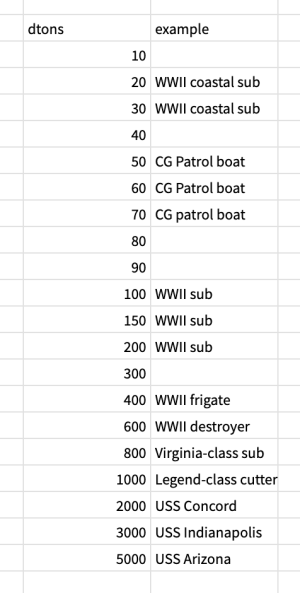
[edit: didn't format the table, so I swapped for an image]

I've seen the article in freelance traveller about tonnage and some of its examples. What I would find handy is a general guideline of what that tonnage range compares to. Has anyone ever put together a chart like this? I couldn't find one so started making my own.

I'm trying to stick with WWII ships as much as I can, since a) the size-to-class relationship changes over the TLs, and b) I like ships of this era. I'm not sure what a good example from this era would replace the 50-70 ton range of modern-ish CG patrol boats (e.g. USCGC Sea Fox).

Screenshot 2026-02-17 at 2.23.18 PM.png

Thoughts? Suggestions?
 
Something like this would make it easier to create ships in a small ship universe with something to compare them to without having to do all the math conversions and 'dtons' of research online. (yeah, I'm a little lazy, usually)

There are a number of posts on the CotI that do a comparison of ships from historically wooden to modern steel based on dtons.
 
  • Like
Reactions: ady
I think for current real-world ship displacement the below is valid. I back spaceships from 0Hr and the 3d model gives displacement, so I can convert the ships to Traveller dtons. not that there is ever enough fuel for jump-capable ships but I can wing that :)

First, 1 ton is 100 cubic feet. This is 2.831685 cubic meters, and when dividing by 13.5, gives you .2098 Traveller tons per 1 "standard" ton. So simply multiply his tonnage by .2098 and you get Traveller displacement.

dTons = 0.2098 x tonnage​

 
I think for current real-world ship displacement the below is valid. I back spaceships from 0Hr and the 3d model gives displacement, so I can convert the ships to Traveller dtons. not that there is ever enough fuel for jump-capable ships but I can wing that :)

First, 1 ton is 100 cubic feet. This is 2.831685 cubic meters, and when dividing by 13.5, gives you .2098 Traveller tons per 1 "standard" ton. So simply multiply his tonnage by .2098 and you get Traveller displacement.

dTons = 0.2098 x tonnage​


Or you can be lazy and say it's a 5:1 ratio, std tons to dtons, as a quick rule of thumb.
 
Or you can be lazy and say it's a 5:1 ratio, std tons to dtons, as a quick rule of thumb.
Yes, this is close enough for our purposes, especially since the de-metric-ized GURPS Traveller made the displacement ton equal to 500 ft3.

For comparison, the exterior dimensions of a typical CONEX container is (in feet) 8 × 8.5 × 10 (or 20 or 40), for a total displacement of 680 (or 1360 or 2720) ft3, which probably makes them eyeball-compatible with 1, 3, or 5 Traveller dtons. It's not 1, 2, and 4 because of the excess in all three sizes; it adds up...

The 30-dton module for the Modular Cutter is 18m long, round in cross-section, and has a diameter of 7.5m. Set on end, for those of you familiar with grain silos and farming, this would be about 24.5 feet across (two lanes on a typical highway) and six-to-seven stories tall, near the lower end of size for grain purchasing stations.
 
Last edited:
  • Like
Reactions: ady
First, 1 ton is 100 cubic feet. This is 2.831685 cubic meters, and when dividing by 13.5, gives you .2098 Traveller tons per 1 "standard" ton. So simply multiply his tonnage by .2098 and you get Traveller displacement.

dTons = 0.2098 x tonnage​

Yes, for the old Gross Register Tonnage (GRT), but not the current Gross Tonnage (GT) rating, where
GT = V × ( 0.2 + 0.02×log10(V) )
https://en.wikipedia.org/wiki/Gross_tonnage#Volume_from_gross_tonnage

Gross tonnage is also metric, so uses m3 and tonnes, unlike gross register tonnage which uses Imperial units.


Essentially V = K × tonnageGT, where K is in the range [3 , 5], so about
Dton ≈ [0.2 , 0.35] × tonnageGT, with 0.2 for very large ships and 0.35 for very small ships.


Example: A modern ship like M/S Viking Glory of 65.200 GT would have an enclosed volume of approximately V ≈ 3.2 × GT, or Dton ≈ 0.23 × GT ≈ 15.000 Dton.

A large yacht like Symphony of 3.000 GT would have an enclosed volume of approximately V ≈ 3.6 × GT, or Dton ≈ 0.26 × GT ≈ 770 Dton.
 
Yes, for the old Gross Register Tonnage (GRT), but not the current Gross Tonnage (GT) rating, where
GT = V × ( 0.2 + 0.02×log10(V) )
https://en.wikipedia.org/wiki/Gross_tonnage#Volume_from_gross_tonnage

Gross tonnage is also metric, so uses m3 and tonnes, unlike gross register tonnage which uses Imperial units.


Essentially V = K × tonnageGT, where K is in the range [3 , 5], so about
Dton ≈ [0.2 , 0.35] × tonnageGT, with 0.2 for very large ships and 0.35 for very small ships.


Example: A modern ship like M/S Viking Glory of 65.200 GT would have an enclosed volume of approximately V ≈ 3.2 × GT, or Dton ≈ 0.23 × GT ≈ 15.000 Dton.

A large yacht like Symphony of 3.000 GT would have an enclosed volume of approximately V ≈ 3.6 × GT, or Dton ≈ 0.26 × GT ≈ 770 Dton.

I found this online calculator to go from Gross Tonnage (GT) to m^3:


I'm sure there are others out there.
 
A gross register ton is equal to 100 cubic feet. A measurement ton is equal to 40 cubic feet. One hundred cubic feet is equal to 2.83 cubic meters. A Traveller dTon is defined as the volume required to hold one metric ton of liquid hydrogen, which equals 498.5 cubic feet. That is very close to 500 cubic feet.

I figure that a Traveller dTon is equal to 500 cubic feet, The WW2 Liberty Ship was rated at 7100 Gross Register Tons, which would equal 1420 Traveller dTons. It was rated at 11,500 measurement tons of dry cargo, which would equal 2300 Traveller dTons. The dead weight cargo rating, which is the maximum mass of the cargo which could be carried safely is 10,800 long tons of 2240 pounds. The data on the Liberty ship is taken from FM 10-13, Quartermaster Reference Data, Department of the Army, August 1950.

One long ton of balanced rations would occupy 94 cubic feet. One long ton of ammunition would occupy 40 cubic feet. Both of those are averages. Generally, the limit to cargo carrying will be based on either mass per cubic foot or volume per cubic foot. I have the data for a wide range of cargos based on mass per cubic foot, and also a wide range of vehicles based on volume per cubic foot.

Applying the Traveller dTon to warships is far more difficult. The displacement tonnage is based on salt water at 35 cubic feet per ton. That is the mass of water displaced by the hull and is equal to the mass of the ship in long tons. My rule of thumb for WW2 ships is take the displacement in long tons at standard displacement which means no fuel, ammunition, or stores, multiply by 35 and then divide by 500 to get dTons. For the Arizona, this would give 2041 dTons. However, the is just the underwater volume of the hull. For the above hull volume and the superstructure, I multiply by 2.5. For the Arizona, this would give 5100 dTons.

For more modern warships, I would determine the underwater hull volume, and the multiply by 3 due to the larger superstructure. When it comes to aircraft carriers, I have not even attempted that due to the massive amounts of internal volume for the hanger and crew quarters.
 
Applying the Traveller dTon to warships is far more difficult. The displacement tonnage is based on salt water at 35 cubic feet per ton. That is the mass of water displaced by the hull and is equal to the mass of the ship in long tons. My rule of thumb for WW2 ships is take the displacement in long tons at standard displacement which means no fuel, ammunition, or stores, multiply by 35 and then divide by 500 to get dTons. For the Arizona, this would give 2041 dTons. However, the is just the underwater volume of the hull. For the above hull volume and the superstructure, I multiply by 2.5. For the Arizona, this would give 5100 dTons.
I normally use x2 for battleships, x2.5 for WWII cruisers, and x3 for other warships.
For more modern warships, I would determine the underwater hull volume, and the multiply by 3 due to the larger superstructure. When it comes to aircraft carriers, I have not even attempted that due to the massive amounts of internal volume for the hanger and crew quarters.
Modern carriers Do carry a lot of very massy stuff, though - engines, fuel, reactors if USN. I'm not sure where that leaves them, though. I just x3 for simplicity.

As for the Liberty ships - I've seen a full load displacement of ~14,000 long tons given, and it's fairly well documented that they'd sometimes carry rather more cargo than they were rated for. 14,000 tons displacement and a x3 ratio for overall volume gives about 3,000 DTons. Using CT hulls, I'd use a 3,000 DTon hull and at about 2,400 DTons of cargo (assuming M1, J1, which is probably low for a Liberty Ship type - they had a lot of range, but as well all know adding more jump range rapidly eats into cargo capacity).

This is why I say that Book 2 ships are actually quite small.
 
For modern US Navy ships, I found a PDF online (sorry, can't remember the link) which gives the GRT or GT for every ship as registered with the US Coast Guard. The Nimitz- and Ford-class carriers work out at around 22,000 dTons.

For the Liberty ships, we know the GRT for them (as quoted in Timerover's post) so we can just divide that by 5 to get the dTons - no need to mess around with the full load displacement.
 
[edit: didn't format the table, so I swapped for an image]

I've seen the article in freelance traveller about tonnage and some of its examples. What I would find handy is a general guideline of what that tonnage range compares to. Has anyone ever put together a chart like this? I couldn't find one so started making my own.

I'm trying to stick with WWII ships as much as I can, since a) the size-to-class relationship changes over the TLs, and b) I like ships of this era. I'm not sure what a good example from this era would replace the 50-70 ton range of modern-ish CG patrol boats (e.g. USCGC Sea Fox).


View attachment 7367

Thoughts? Suggestions?
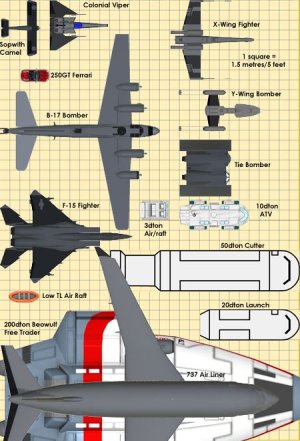
Not a list, but I did do a rough size comparison for my gaming group a while back. Not sure how accurate it is now, as many of the scifi ships have sources that state different sizes, but as a rough guide, it lets you see how big some of the Traveller ships are in comparison to real world stuff.
 

Attachments

  • 67065709_10156256207815778_7175987618209857536_n.jpg
    67065709_10156256207815778_7175987618209857536_n.jpg
    63.7 KB · Views: 12
Not a list, but I did do a rough size comparison for my gaming group a while back. Not sure how accurate it is now, as many of the scifi ships have sources that state different sizes, but as a rough guide, it lets you see how big some of the Traveller ships are in comparison to real world stuff.
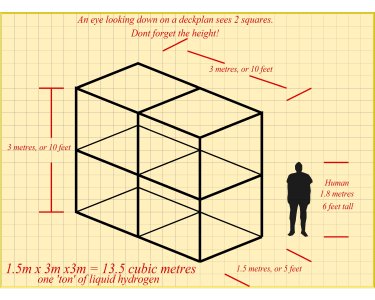
There is also this pic, a reminder of how big a 'dton' is. It's handy to remember that (as others have pointed out) a 'dton' is a futuristic standard measurement of volume, (the space a metric ton of liquid hydrogen fuel requires), not how much water a ship displaces or how heavy the ship actually is. Perhaps it should of called a different name to remove the confusion of people on pre spaceflight worlds? :)
 

Attachments

  • 1 ton.JPG
    1 ton.JPG
    1 MB · Views: 12
A couple of years ago I did an analysis of the 2020 Equasis World Fleet stats, converting the Gross Tonnage figures to dTons. The stats are organised into size ranges: Small (28-134 dTons; average 69), Medium (134-5883 dTons; average 1334), Large (5983-14012 dTons; average 8901), and Very Large (14012+ dTons; average 24463); the overall average size is 2962 dTons.

Small ships make up 46% of ships, but only 0.9% of the total tonnage; the top 3 categories (by number) are fishing vessels, tugs, and passenger vessels, top 3 by tonnage are tugs, fishing vessels, and general cargo
Medium ships make up 37.8% of ships and 16.6% of tonnage; top 3 are general cargo, oil & chem tankers, and fishing vessels; top 3 by tonnage are bulk carriers, general cargo, and oil & chem tankers
Large ships make up 10.6% of ships and 32.9% of tonnage; top 3 are bulk carriers, oil & chem tankers, and container ships; top 3 by tonnage are bulk carriers, oil & chem tankers, and container ships
Very Large ships make up 5.6 of ships and 49.6% of tonnage; top 3 (by number and tonnage - the order is the same) are oil & chem tankers, bulk carriers, and container ships.

If they want to compare against current US Navy surface ships:
Cyclone class patrol vessel - 101 dTons
Perry class frigate - 937 dTons
Arleigh Burke class destroyer - 2039 dTons
Wasp class amphibious assault ship - 12481 dTons
Nimitz class carrier - 22240 dTons
 
If they want to compare against current US Navy surface ships:
Cyclone class patrol vessel - 101 dTons
Perry class frigate - 937 dTons
Arleigh Burke class destroyer - 2039 dTons
Wasp class amphibious assault ship - 12481 dTons
Nimitz class carrier - 22240 dTons

This is a great reference! Thanks for posting.
 
Not a list, but I did do a rough size comparison for my gaming group a while back. Not sure how accurate it is now, as many of the scifi ships have sources that state different sizes, but as a rough guide, it lets you see how big some of the Traveller ships are in comparison to real world stuff.

This is really handy.
It's weird how fighters are typically depicted as little things in Traveller artwork when 10 dt is about the size of a school bus. An X wing must be no bigger than maybe 2 dt? I suppose small movie props cost less.
 
This is really handy.
It's weird how fighters are typically depicted as little things in Traveller artwork when 10 dt is about the size of a school bus. An X wing must be no bigger than maybe 2 dt? I suppose small movie props cost less.

Most of the Traveller ships are way bigger than the star citizen stuff.
 
Last edited:
when 10 dt is about the size of a school bus

I doubt that any school bus is 10 dTons - a standard 40-foot container is about 5.5 dTons (12.192 m * 2.438 m * 2.591 m = 77.015 m^3) and a 40-foot high-cube is about 6.2 dTons (12.192 m * 2.438 m * 2.908 m = 86.438 m^3).

OK, I looked up the dimensions. For a Type C (the most common) the maximum dimensions are 12.192 m (length), 2.59 m (width), 3 m (height) which gives 100.39 m^3 volume (= 7.17 dTons); for a Type D (the largest) they are 13.7 m (length), 2.59 m (width), 3 m (height) which gives 112.81 m^3 (= 8.06 dTons).
 
Back
Top