
• Welcome to the new COTI server. We've moved the Citizens to a new server. Please let us know in the COTI Website issue forum if you find any problems.
  • We, the systems administration staff, apologize for this unexpected outage of the boards. We have resolved the root cause of the problem and there should be no further disruptions.

dton frame of reference

[edit: didn't format the table, so I swapped for an image]

I've seen the article in freelance traveller about tonnage and some of its examples. What I would find handy is a general guideline of what that tonnage range compares to. Has anyone ever put together a chart like this? I couldn't find one so started making my own.

I'm trying to stick with WWII ships as much as I can, since a) the size-to-class relationship changes over the TLs, and b) I like ships of this era. I'm not sure what a good example from this era would replace the 50-70 ton range of modern-ish CG patrol boats (e.g. USCGC Sea Fox).
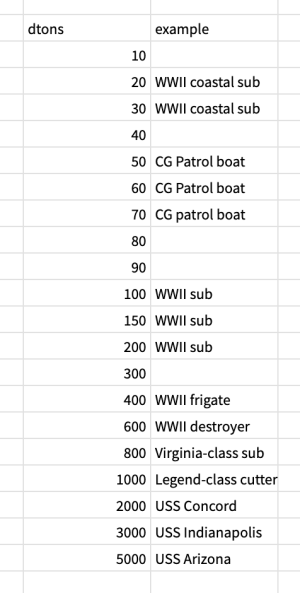

Screenshot 2026-02-17 at 2.23.18 PM.png

Thoughts? Suggestions?
 
Something like this would make it easier to create ships in a small ship universe with something to compare them to without having to do all the math conversions and 'dtons' of research online. (yeah, I'm a little lazy, usually)

There are a number of posts on the CotI that do a comparison of ships from historically wooden to modern steel based on dtons.
 
I think for current real-world ship displacement the below is valid. I back spaceships from 0Hr and the 3d model gives displacement, so I can convert the ships to Traveller dtons. not that there is ever enough fuel for jump-capable ships but I can wing that :)

First, 1 ton is 100 cubic feet. This is 2.831685 cubic meters, and when dividing by 13.5, gives you .2098 Traveller tons per 1 "standard" ton. So simply multiply his tonnage by .2098 and you get Traveller displacement.

dTons = 0.2098 x tonnage​

 
I think for current real-world ship displacement the below is valid. I back spaceships from 0Hr and the 3d model gives displacement, so I can convert the ships to Traveller dtons. not that there is ever enough fuel for jump-capable ships but I can wing that :)

First, 1 ton is 100 cubic feet. This is 2.831685 cubic meters, and when dividing by 13.5, gives you .2098 Traveller tons per 1 "standard" ton. So simply multiply his tonnage by .2098 and you get Traveller displacement.

dTons = 0.2098 x tonnage​


Or you can be lazy and say it's a 5:1 ratio, std tons to dtons, as a quick rule of thumb.
 
Or you can be lazy and say it's a 5:1 ratio, std tons to dtons, as a quick rule of thumb.
Yes, this is close enough for our purposes, especially since the de-metric-ized GURPS Traveller made the displacement ton equal to 500 ft3.

For comparison, the exterior dimensions of a typical CONEX container is (in feet) 8 × 8.5 × 10 (or 20 or 40), for a total displacement of 680 (or 1360 or 2720) ft3, which probably makes them eyeball-compatible with 1, 3, or 5 Traveller dtons. It's not 1, 2, and 4 because of the excess in all three sizes; it adds up...

The 30-dton module for the Modular Cutter is 18m long, round in cross-section, and has a diameter of 7.5m. Set on end, for those of you familiar with grain silos and farming, this would be about 24.5 feet across (two lanes on a typical highway) and six-to-seven stories tall, near the lower end of size for grain purchasing stations.
 
Last edited:
First, 1 ton is 100 cubic feet. This is 2.831685 cubic meters, and when dividing by 13.5, gives you .2098 Traveller tons per 1 "standard" ton. So simply multiply his tonnage by .2098 and you get Traveller displacement.

dTons = 0.2098 x tonnage​

Yes, for the old Gross Register Tonnage (GRT), but not the current Gross Tonnage (GT) rating, where
GT = V × ( 0.2 + 0.02×log10(V) )
https://en.wikipedia.org/wiki/Gross_tonnage#Volume_from_gross_tonnage

Gross tonnage is also metric, so uses m3 and tonnes, unlike gross register tonnage which uses Imperial units.


Essentially V = K × tonnageGT, where K is in the range [3 , 5], so about
Dton ≈ [0.2 , 0.35] × tonnageGT, with 0.2 for very large ships and 0.35 for very small ships.


Example: A modern ship like M/S Viking Glory of 65.200 GT would have an enclosed volume of approximately V ≈ 3.2 × GT, or Dton ≈ 0.23 × GT ≈ 15.000 Dton.

A large yacht like Symphony of 3.000 GT would have an enclosed volume of approximately V ≈ 3.6 × GT, or Dton ≈ 0.26 × GT ≈ 770 Dton.
 
Yes, for the old Gross Register Tonnage (GRT), but not the current Gross Tonnage (GT) rating, where
GT = V × ( 0.2 + 0.02×log10(V) )
https://en.wikipedia.org/wiki/Gross_tonnage#Volume_from_gross_tonnage

Gross tonnage is also metric, so uses m3 and tonnes, unlike gross register tonnage which uses Imperial units.


Essentially V = K × tonnageGT, where K is in the range [3 , 5], so about
Dton ≈ [0.2 , 0.35] × tonnageGT, with 0.2 for very large ships and 0.35 for very small ships.


Example: A modern ship like M/S Viking Glory of 65.200 GT would have an enclosed volume of approximately V ≈ 3.2 × GT, or Dton ≈ 0.23 × GT ≈ 15.000 Dton.

A large yacht like Symphony of 3.000 GT would have an enclosed volume of approximately V ≈ 3.6 × GT, or Dton ≈ 0.26 × GT ≈ 770 Dton.

I found this online calculator to go from Gross Tonnage (GT) to m^3:


I'm sure there are others out there.
 
Back
Top