a) We have this new sub-group category, like your subsidy group. Let's call it, I dunno, Affiliation? For now we will call it Affiliation
Affiliation works for this use case.
We're basically needing a way to discriminate "here, not there" in order to "confine" the routing to a specific set of (manually) defined possibilities.
b) The user can highlight any hexes he wants and right-click and assign them an Affiliation.
That works.
Highlighting is probably the "best use case" in this instance, because you could have something like a Tramp Merchant operation with a Home Port where annual overhaul maintenance (and thus, crew vacations) takes place as a matter of routine. So you've got an "anchor point" and everything spreads out from there, but you keep returning to the "anchor point" on a somewhat regular basis. Note that this kind of behavior also works for an interstellar patrol routine for naval assets at different levels of the hierarchy in organization, so there are military as well as commercial uses for this kind of application of mapping and navigation.
c) Users can filter on Affiliation, so any time they want they can filter to only those planets in this particular Affiliation
Correct.
Toggle on/off of the filter and rules associated with the filter then becomes the "value added" from developing this Feature Request™.

d) We can then go to the routes and instruct the auto-router to generate either a network route or a point to point rout through the Affiliated worlds.
Yes ... but ...

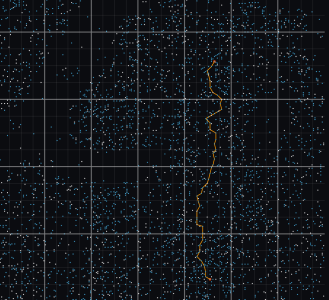
There's the precedent (which I'm making HEAVY use of in my own starship class research projects) of being able to double jump (J1+1, J2+2, J3+3, etc.) using the (main) integral fuel tankage PLUS additional fuel reserves (L-Hyd Drop Tanks, Demountable Tanks (internal or external), Collapsible Fuel Tanks). Being able to double jump thus makes it possible to use "empty hexes" as intermediate stopover points (as demonstrated on the map above

) in order to traverse a 4 parsec gap using a J2 drive performance (just add extra fuel).
Under MOST circumstances, a 6 parsec (total) range will often times wind up being the "practical maximum" when working in YTUs where 10% tonnage fraction per parsec is the rule.
Where this gets complicated, as an edge case condition, is when dealing with deep space fuel caches to get across truly LONG distances ... such as can be found in The Great Rift region (and elsewhere). There are settled worlds within The Great Rift that are 7-12 parsecs away from the nearest OTHER settled mainworld, which makes reaching those locations a matter that is logistically complicated. The
Islands Cluster in the Great Rift is an example of this, being 7-8 parsecs away from the nearest stellar system on both sides of the cluster. Consequently, the only way to reach the cluster (without misjumping) is to 2x jump.
Being able to transit 7-10 parsecs can involve a mix of internal auxiliary fuel (demountable and/or collapsible fuel tanks) and/or external auxiliary fuel (demountable, again, and/or L-hyd drop tanks) in order to attain "sufficient" multi-jump capability in order to transit such vast expanses of space.
Note that:
- A starship capable of J2+2+2 range, if adding drop tanks (and dropping them) for the first jump ... would be capable of an 8 parsec range over 4 jumps.
- A starship capable of J3+3 range, if adding drop tanks (and dropping them) for the first jump ... would be capable of a 9 parsec range over 3 jumps.
Obviously, such fuel demands will reduce the revenue tonnage capacity of the starship making those transits ... but it's
better than nothing.
Conceptually speaking, you want to be thinking of "empty" deep space hexes (whether there's a fuel cache there or not!) as a
Calibration Point in terms of their usefulness for routing algorithms. Yes, there's no star or mainworld there ... and refueling might not even be an option(!) ... but such locations CAN be used as intermediate destinations to locations "on the far side" of the "empty" deep space hex, which WOULD have a star system and mainworld (and hopefully, refueling options!).
One of my favorite examples of "you can go there, but there's no fuel available" is
Heroni/Rhylanor/Spinward Marches ... UWP: E7A0614-8
Starport: type E ... so no fuel available. LBB3.81, p10:
E Frontier installation.
Essentially a marked spot of bedrock with no fuel, facilities, or bases present.
Atmosphere: A + Hydrographics: 0 ... so no wilderness refueling on the mainworld.
Gas Giants: 0 ... so no wilderness refueling via orbital skimming either.
"This is some rescue! When you came in here, didn't you have a plan for getting out?"
- a Princess to her rescuers
Gets even better when you realize that
Heroni/Rhylanor/Spinward Marches is a part of the J1
Spinward Main ... but if you think you can "go there" in a J1 starship without 2 parsecs of fuel range ... let's just say that your "stopover" on at that location might last longer than you'd planned ...


These kinds of BYO
BF (Bring Your Own
Beer Fuel) conditions can be found elsewhere in the Spinward Marches (as well as other sectors) at some mainworlds, so being able to "jump more than once" on a full load of fuel can make a difference in a multitude of circumstances, which in turn can require some "specialized modifications" to (stock) craft in order to enable such performance.
It would be NICE if the Routing Algorithm were constructed in such a way as to enable the option for multi-jumping (2+ without refueling) in order to find the "best" routing options available when transiting the map.



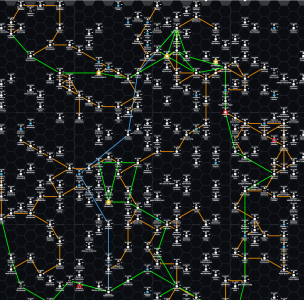


 ) is to start with Better Maps.


 encounter with a purloined Type-T Patrol ship. The Far Trader had to surrender, while my design (basically a minimally armed Fast Trader) was able to escape with a "clean pair of heels" thanks to a powerful maneuver drive (so Break Off By Acceleration was successful). That basically decided the "race" right there, since the Far Trader had to "pay a ransom" to get their ship back ... and after that, it was all over (in terms of profit margin advantages).


