Something that would be extremely handy, especially as an aid for Referees and Players would be to define a collection of worlds as a "grouping" for commercial purposes. This could be a subsidy range of "in-group" systems or it could be used to define a "preferred pathing" for a specific commercial trade route that would be getting run at regular intervals (like "trains running on time") for commercial operations.
Something that I did (years ago, now) was a Race To Profitability ... pitting a starship class I designed against a J2 Far Trader on a route through Lanth and Vilis subsectors. The starship class I'd designed was TL=D, so I needed a TL=D world in a subsidy grouping to use as the annual overhaul maintenance hub.
The "race" was a sort of Test™ in which the two designs would run the exact same route and "share" all of the dice rolls for cargo/passenger ticket opportunities, the dice rolls for speculative goods opportunities and for "random encounters" between the jump point(s) and the main world(s). So the only real/meaningful differences in "performance" over the course of the race would be the Design Details™ between the two starships, which would then produce derivative effects that could be computed in terms of profitability when calculating revenues earned versus costs incurred.
Long story short ... my design and the Far Trader were "relatively evenly matched" ... until there was a

encounter with a purloined Type-T Patrol ship. The Far Trader had to surrender, while my design (basically a minimally armed Fast Trader) was able to escape with a "clean pair of heels" thanks to a powerful maneuver drive (so Break Off By Acceleration was successful). That basically decided the "race" right there, since the Far Trader had to "pay a ransom" to get their ship back ... and after that, it was all over (in terms of profit margin advantages).
Anyway, the section of the Spinward Marches that the race took place in was here:
So the "race course" was basically THIS ... running from D'Ganzio through Vilis to Ficant, before reversing back through Vilis to D'Ganzio.
I ran the whole thing as if both starships were operating under subsidy from Vilis, and the starting and finish lines were both at D'Ganzio, with an annual overhaul maintenance payment included in the total operating costs for the race.
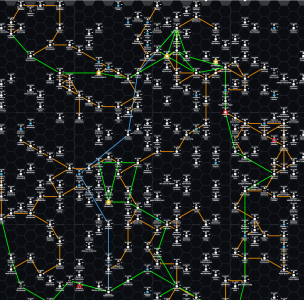
As you can see, just drawing lines on the map like this (or using a hex shading option) would make it readily apparent which worlds are included in the subsidy range, where a subsidized starship would be obligated to spend 70% of each year conducting business:
- Ficant/Vilis
- Arkadia/Vilis
- Garda-Vilis/Vilis
- Choleosti/Vilis
- Margesi/Vilis
- Vilis/Vilis
- Saurus/Vilis
- Tavonni/Vilis
- Lanth/Lanth
- D'Ganzio/Lanth
You CAN leave this subsidy group (temporarily), but you need to be conducting trade operations between these worlds during at least 70% of the time each year, and each world needs to be visited at least once per year (is how I interpret the obligations for subsidies). The above mapping exercise would simply be a part of the Business Plan submitted to the subsidizing government for approval.
However, if I was an operator with a TL=9 J2+2 capable starship that I wanted to maximize the Speculative Goods Arbitrage profit potential of ... I would want to be conducting business between these mainworlds primarily:
Why?

Because of the variety of Trade Codes.


- Nonym/Darrian: Non-agricultural, Poor.
- Dekalb/Querion: Rich, Water World.
- Thanber/Querion: Poor, Non-industrial.
- Margesi/Vilis: Agricultural, Non-industrial. Amber Zone
- Vilis/Vilis: Industrial.
- Saurus/Vilis: Agricultural, Non-industrial.
Those 6 mainworlds include ALL of the Trade Codes relevant to Speculative Goods Arbitrage in LBB2.81.
However, you need to have J2+2 (unrefueled) capability in order to reach all of those destinations without needing to enter Sword Worlds Confederation or Darrian Confederation controlled space (so empty hex transit navigation is important!).
Suffice it to say, that this specific "collection of mainworlds" would offer a remarkably robust set of Speculative Goods Arbitrage Opportunities, simply because of the diversity of Trade Codes available between these 6 worlds.
This kind of "gotta get 'em all" distribution of Trade Codes with a "reasonable" range accessible by J2(+2) is actually something of a rarity in a place like the Spinward Marches. There are others (of course), but I'll leave the exercise for finding them to the Disinterested Observer™.

I am having trouble grasping this. But I really like what I am grasping. Can you give me some examples of how this would work once it is implemented so I can get a better picture?
Hopefully the above will give you something more "end user use case" in terms of example to work with.
The above is just a "quick 'n' dirty" bit of work editing my Portolan Chart™ method of remapping the Spinward Marches from years ago using an updated color scheme. I just did a copy/cut 'n' paste + annotate with lines to create the samples provided, so to be clear, I was not using As Above So Below for this.



 ) is to start with Better Maps.