• Welcome to the new COTI server. We've moved the Citizens to a new server. Please let us know in the COTI Website issue forum if you find any problems.
  • We, the systems administration staff, apologize for this unexpected outage of the boards. We have resolved the root cause of the problem and there should be no further disruptions.

As Above So Below - Yet another Traveller System Generator

v0.7.3 is out:

1. **Mongoose Socioeconomic:** Fixed bug that did not check if Ix, Cx, or Ex could be inherited
2. **Mongoose System Expand:** Fixed bug that did not make use of T5 Stellar information and PBG
3. **Import Sector .tsv:** Fixed bug that did not capture Worlds value
4. **Generate Xboat:** Added user options on range and jump distances
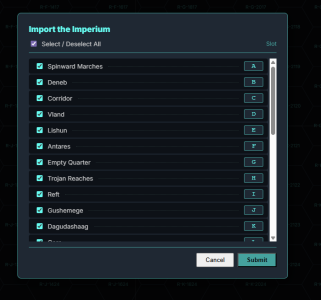
5. **Import Imperium:** Added the option to bulk import Imperial Sectors

1776016584808.png
 
v0.7.4 has been pushed into production.

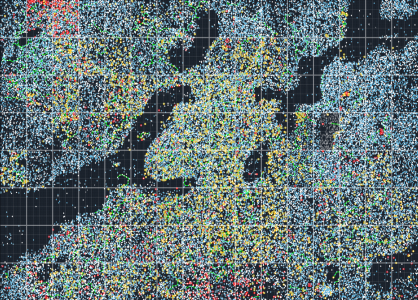
You can now try to import the entire OTU (not for the feint of heart!)

1776039081349.png
Some quick notes on Importing the Universe:
1) I have a one second wait time for each sector - so it takes a bit to load everything
2) Make sure to Save the JSON once you load it, so you never have to import it again - just load from your hard drive
3) It will be its most sluggish when zoomed out, and most responsive when zoomed in.
4) It will not work well for older or slower systems. Hell it is too frustrating for me zoomed out and I have 32GB memory.
5) This was done as a request by a user with some good system specs
6) Having all of these sectors loaded at once was not the intention of this program. I do, however, appreciate a challenge. So if you think you would enjoy working like this and have the right system for it, be my guest.

Replacing Foreven:
Want to replace any of these sectors with your own file (like Foreven)?
1) Mouse over the sector you want to replace (zoom in for smoother and better response results)
2) Press Control + S to select the Sector (you should see it highlighted)
3) Right Click->Populate->Manual Reset Clear (Note the sector # in the Clear Hex; 36 for Foreven)
4) Click the settings gear in the top right and choose Import Sector .tsv
5) Select your file - choose the sector number you noted (#36 for Foreven)

Notes on Size Limits:
1) If you do not ever expand the system generation you can operate large amounts of systems as long as it is not too frustrating to scroll. Your system specs will dictate how many sectors you can use before it is too frustrating to use (zoomed in is always better than zoomed out)

2) If you do want to expand system and socioeconomic information for each system (like I do) you will probably get to a limit of around 8 or 10 sectors before it will crash when you try to save your JSON. I have a number of options I am reviewing to expand this limit, but for now that is where we are. So if you download the Imperium and try to expand every system in every sector you will likely end up frustrated. For now you should be able to work safely with 8 or 10 sectors fully generated without too much of a problem.

Use it here: https://bartlebythecoder.github.io/traveller_magnus/hex_map.html
Full code here: https://github.com/bartlebythecoder/traveller_magnus
 
A new update this morning (v0.8).

This new version:
1) Makes it easier for slower and older systems to manage a larger amount of systems
2) Allows for the automatic plotting of routes constrained by any filter rules the user wishes to use (e.g. don't use X starports)

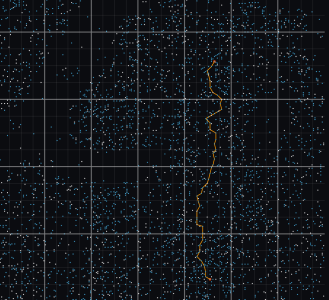
In a point to point route the path only stops at filtered systems (in this example from Terra to capital only systems with Gas Giants and pop codes >6):

1776178701329.png

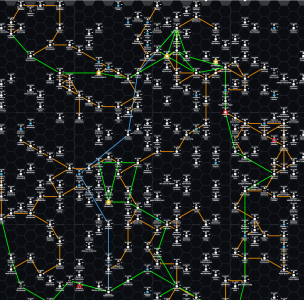
In the below homebrewed sector the green routes are xboat routes, the gold routes are automated trade routes connecting 10+ WTN worlds within a range of (I think) 6 hexes, using max Jump 2 routes to connect them. The blue route is an automated Jump 6 route going between two important worlds.

1776178887610.png

There is more I want to do with routes but this is a good start.

As always this is free and still in development so feel free to use but understand things will change and not everything may be perfect yet.

Use it here: https://bartlebythecoder.github.io/traveller_magnus/hex_map.html
Full code here: https://github.com/bartlebythecoder/traveller_magnus
 
In a point to point route the path only stops at filtered systems (in this example from Terra to capital only systems with Gas Giants and pop codes >6)
I'm kind of curious how many jumps would be involved in that route? :unsure:
The reason why I'd like to know that bit of trivia is that is gives a sense of "how much time lag" there is between those two points on the map. If you assume 24 jumps per year (standard commercial op tempo) ... how many weeks/months/years would such a journey take?

This is where the "friction" of communication lag times starts becoming the most apparent, which then translates into a sort of inertia AND centrifugal forces breakup around the fringes of an overly large polity because distant places are "too far" from the center to command & control effectively. Authorities have to be delegated (feudal style), which then sows the seeds for potential civil war when ambitions outweigh loyalties (anyone got any matches?). 🕯️


Nothing to do with mapping the stars (per se), but it is the kind of Big Picture™ insight that can be gained from having such an excellent mapping tool.

After all, one of the better ways to Collect Taxes (or conduct business, profitably ... :sneaky:) is to start with Better Maps.
Funny how that works ... :rolleyes:
 
I'm kind of curious how many jumps would be involved in that route? :unsure:
The reason why I'd like to know that bit of trivia is that is gives a sense of "how much time lag" there is between those two points on the map. If you assume 24 jumps per year (standard commercial op tempo) ... how many weeks/months/years would such a journey take?
This particular route (J-4, pop 7 or higher and always a gas giant) is 45 Jumps.
Another route someone in the Mongoose forums asked about (J-6, total pop 500m+, and always a gas giant) is 33 Jumps.
 
This particular route (J-4, pop 7 or higher and always a gas giant) is 45 Jumps.
Another route someone in the Mongoose forums asked about (J-6, total pop 500m+, and always a gas giant) is 33 Jumps.
No matter how you slice it ... that's a LONG HAUL. 🚀🪐✨
It basically means that any "round trip" communications (origin > destination > origin) are going to take over a year ... and probably 2 years (or even more!) ... and that's just the amount of time needed to make all the jumps. Any time at "the far end" of that round trip needed to make any ... decisions ... based on the contents of the communication will increase the time it takes to make a round trip (report > decide > action).

That kind of communications lag can be CRIPPLING to centralized command & control authorities, because the information you receive could be a year old at the center and can't be implemented for a year after a reply gets sent back. Meanwhile, real time on the fringes isn't stopping/waiting for the bucket brigade of message relaying via jump to resolve matters.

Seen in that light, it's surprising that the Third Imperium lasted as long as it did ... mainly via delegation of important decision making powers away from central authority.
 
No matter how you slice it ... that's a LONG HAUL. 🚀🪐✨
It basically means that any "round trip" communications (origin > destination > origin) are going to take over a year ... and probably 2 years (or even more!) ... and that's just the amount of time needed to make all the jumps. Any time at "the far end" of that round trip needed to make any ... decisions ... based on the contents of the communication will increase the time it takes to make a round trip (report > decide > action).

That kind of communications lag can be CRIPPLING to centralized command & control authorities, because the information you receive could be a year old at the center and can't be implemented for a year after a reply gets sent back. Meanwhile, real time on the fringes isn't stopping/waiting for the bucket brigade of message relaying via jump to resolve matters.

Seen in that light, it's surprising that the Third Imperium lasted as long as it did ... mainly via delegation of important decision making powers away from central authority.
That suggests the functional sector capitals are the naval depots.
 
Last edited:
Next up:

For the next few days I will be working on the v0.9 releases. These will, bit by bit, enable the editing of the expanded system details. In case you don't like what was generated or perhaps have a manual generation you want to input.

While working on that I will be thinking about how to improve the routing as I have a lot of disparate ideas I would like to get into one cohesive vision. The new routing will be part of the the v0.10 series that will follow.

Within these two series I will be adding in obsidian/markdown file exports. Likely part of v0.9 but not 100% sure yet.

Anyway, more to come.
 
Released version 0.9.3 this afternoon:
1. **Mongoose Editable System Fields:** Many Mongoose system fields now inline-editable. Edited fields are highlighted and persist in the workspace JSON. This includes the ability to add names to each world and moon.
NOTE: Some fields, like atmosphere, are still not editable and you still cannot add or delete worlds or moons. I would like to eventually allow a user completely build out a new system by hand with full control, so I still have it on the list.
2. **Corrected Stellar Generation Tables:** Star physical properties (mass, diameter, surface temperature) are now derived from accurate per-luminosity-class tables with subtype anchors, rather than a single averaged value per spectral type. Giant, dwarf, and subdwarf stars now have physically distinct and correct statistics. NOTE: White Dwarf and Brown Dwarf stars have one simple average used for their key stellar information. Thank you to @Dodo98
3. **Fixed Missing Companion Rolls for Primary Star:** Previously, only secondary stars (Close, Near, Far) received a companion roll. The primary star now also rolls for a companion, matching the full rules requirement that every star in the system gets a companion check. Thank you to @Dodo98
4. **Improved HZCO calculations**
5. **Accordion Display Polish:** Cleaned display and added atmospheric pressure to UI.
6. **Octagon Filter Symbol:** Added an octagon as a new shape option in the Advanced Filter styling panel.
7. **Gas Giant Ring Visibility:** The ring symbol on gas giants is now 2–3× thicker, making it clearly visible when zoomed out to subsector or sector scale.

1776630921345.png

Next up (v0.10.x) will center on revamping our routes/filters/customization and metadata. This will include adding borders and routes to the OTU downloads.
 
I published one more update in my v0.9 series. v0.9.3.2 was uploaded yesterday. It corrects some generation errors in the Mongoose orbit spread and hzco calculations.

It also now imports xboat routes automatically when you import the OTU or the Imperium. It takes twice as long now, so make sure to save your JSON once you import (load from a JSON is much quicker).


1776720144706.png


The next release will focus on routes. What I want to include:

Routes:
1. Allow for different specific routs with customizable colours and labels. Sure I can make the default Route #1 Green and call it Xboat, but the colour and the label should be allowed to be changed by the user
2. Add as many routes as I want
3. Routes can be automatic (using the filter rules to set them) or manual or any combination thereof (i.e. I should be able to manually change a route that was generated automatically)
4. I should be able to change the colour of each or any route later if I want to
5. I should be able to hide/unhide each route individually
6. Bring all route generation and modification into one simple menu (it is scattered right now)
7. Routes that overlap should be displayed side by side. One should never cover the other. I may actually decide on a different offset for each route #. E.g. Route #1 is always down the middle. Route #2 always to one side etc.
8. OTU routes should be downloaded into Route #1/XBoat by default.
9. Special for me: I want to be able to build routes automatically by filtering on combining WTN numbers like GURPS.

Let me know if you have any requests for updates.
 
Routes:
1. Allow for different specific routes with customizable colours and labels.
Something that would be extremely handy, especially as an aid for Referees and Players would be to define a collection of worlds as a "grouping" for commercial purposes. This could be a subsidy range of "in-group" systems or it could be used to define a "preferred pathing" for a specific commercial trade route that would be getting run at regular intervals (like "trains running on time") for commercial operations.

Being able to pull up a map of a (sub)sector and SHOW everyone (Referees and Players alike) that THIS is the subsidy range/authorized route that you're obliged to operate within (or which the campaign will just so happen to be set as a starting point? :unsure:) can be really helpful as a way of getting everyone involved oriented and thinking about possibilities, risks/rewards and so on (and so forth).

While this kind of functionality can be PARTIALLY done using shading of specific hexes with various colors (to indicate "here" and "not there"), being able to use the Route function would enable all kinds of additional functionality, such as being able to tell "how far from here to there" and what intermediate stopover points may be necessary along the way. Knowing how many jumps it would take to get from Regina/Regina/Spinward Marches to Equus/Lanth/Spinward Marches using a variety of jump numbers (including 2x jumping through empty hexes to "shortcut" across voids!) could have a lot of potential as an assistant tool for being able to make "longer" routing plots beyond the immediate next destination.

Taken to extremes, this kind of routing feature can be used to determine the "jump lag" for communications between various points on the map (including across multiple sectors, if necessary).

Being able to determine "jump lag" delay timing in communications can have implications for all kinds of things, including (but not limited to) wanted notices and bank repossession ops against assets where businesses that have started "skipping" their mortgage payments. Giving Referees (and Players) "how long" they might be able to outrun "the long arm of the law" can be a useful insight/bit of intel for all kinds of adventure seeds/patron encounters.
 
Something that would be extremely handy, especially as an aid for Referees and Players would be to define a collection of worlds as a "grouping" for commercial purposes. This could be a subsidy range of "in-group" systems or it could be used to define a "preferred pathing" for a specific commercial trade route that would be getting run at regular intervals (like "trains running on time") for commercial operations.

Being able to pull up a map of a (sub)sector and SHOW everyone (Referees and Players alike) that THIS is the subsidy range/authorized route that you're obliged to operate within (or which the campaign will just so happen to be set as a starting point? :unsure:) can be really helpful as a way of getting everyone involved oriented and thinking about possibilities, risks/rewards and so on (and so forth).

While this kind of functionality can be PARTIALLY done using shading of specific hexes with various colors (to indicate "here" and "not there"), being able to use the Route function would enable all kinds of additional functionality, such as being able to tell "how far from here to there" and what intermediate stopover points may be necessary along the way. Knowing how many jumps it would take to get from Regina/Regina/Spinward Marches to Equus/Lanth/Spinward Marches using a variety of jump numbers (including 2x jumping through empty hexes to "shortcut" across voids!) could have a lot of potential as an assistant tool for being able to make "longer" routing plots beyond the immediate next destination.

Taken to extremes, this kind of routing feature can be used to determine the "jump lag" for communications between various points on the map (including across multiple sectors, if necessary).

Being able to determine "jump lag" delay timing in communications can have implications for all kinds of things, including (but not limited to) wanted notices and bank repossession ops against assets where businesses that have started "skipping" their mortgage payments. Giving Referees (and Players) "how long" they might be able to outrun "the long arm of the law" can be a useful insight/bit of intel for all kinds of adventure seeds/patron encounters.

For hardcore types you could lay out routing by industry- raw materials flowing to manufacturing planet, and delivery of products to downstream customers.
 
Something that would be extremely handy, especially as an aid for Referees and Players would be to define a collection of worlds as a "grouping" for commercial purposes. This could be a subsidy range of "in-group" systems or it could be used to define a "preferred pathing" for a specific commercial trade route that would be getting run at regular intervals (like "trains running on time") for commercial operations.
Something that I did (years ago, now) was a Race To Profitability ... pitting a starship class I designed against a J2 Far Trader on a route through Lanth and Vilis subsectors. The starship class I'd designed was TL=D, so I needed a TL=D world in a subsidy grouping to use as the annual overhaul maintenance hub.

The "race" was a sort of Test™ in which the two designs would run the exact same route and "share" all of the dice rolls for cargo/passenger ticket opportunities, the dice rolls for speculative goods opportunities and for "random encounters" between the jump point(s) and the main world(s). So the only real/meaningful differences in "performance" over the course of the race would be the Design Details™ between the two starships, which would then produce derivative effects that could be computed in terms of profitability when calculating revenues earned versus costs incurred.

Long story short ... my design and the Far Trader were "relatively evenly matched" ... until there was a 🏴‍☠️ encounter with a purloined Type-T Patrol ship. The Far Trader had to surrender, while my design (basically a minimally armed Fast Trader) was able to escape with a "clean pair of heels" thanks to a powerful maneuver drive (so Break Off By Acceleration was successful). That basically decided the "race" right there, since the Far Trader had to "pay a ransom" to get their ship back ... and after that, it was all over (in terms of profit margin advantages).

Anyway, the section of the Spinward Marches that the race took place in was here:

qk3jK4r.jpeg


So the "race course" was basically THIS ... running from D'Ganzio through Vilis to Ficant, before reversing back through Vilis to D'Ganzio.

M7Qf1ru.jpeg


I ran the whole thing as if both starships were operating under subsidy from Vilis, and the starting and finish lines were both at D'Ganzio, with an annual overhaul maintenance payment included in the total operating costs for the race.

As you can see, just drawing lines on the map like this (or using a hex shading option) would make it readily apparent which worlds are included in the subsidy range, where a subsidized starship would be obligated to spend 70% of each year conducting business:
  1. Ficant/Vilis
  2. Arkadia/Vilis
  3. Garda-Vilis/Vilis
  4. Choleosti/Vilis
  5. Margesi/Vilis
  6. Vilis/Vilis
  7. Saurus/Vilis
  8. Tavonni/Vilis
  9. Lanth/Lanth
  10. D'Ganzio/Lanth
You CAN leave this subsidy group (temporarily), but you need to be conducting trade operations between these worlds during at least 70% of the time each year, and each world needs to be visited at least once per year (is how I interpret the obligations for subsidies). The above mapping exercise would simply be a part of the Business Plan submitted to the subsidizing government for approval.


However, if I was an operator with a TL=9 J2+2 capable starship that I wanted to maximize the Speculative Goods Arbitrage profit potential of ... I would want to be conducting business between these mainworlds primarily:

1QQsKTk.jpeg


Why? :rolleyes:
Because of the variety of Trade Codes. 💰:cool:💰
  1. Nonym/Darrian: Non-agricultural, Poor.
  2. Dekalb/Querion: Rich, Water World.
  3. Thanber/Querion: Poor, Non-industrial.
  4. Margesi/Vilis: Agricultural, Non-industrial. Amber Zone
  5. Vilis/Vilis: Industrial.
  6. Saurus/Vilis: Agricultural, Non-industrial.
Those 6 mainworlds include ALL of the Trade Codes relevant to Speculative Goods Arbitrage in LBB2.81.
However, you need to have J2+2 (unrefueled) capability in order to reach all of those destinations without needing to enter Sword Worlds Confederation or Darrian Confederation controlled space (so empty hex transit navigation is important!).

Suffice it to say, that this specific "collection of mainworlds" would offer a remarkably robust set of Speculative Goods Arbitrage Opportunities, simply because of the diversity of Trade Codes available between these 6 worlds.

This kind of "gotta get 'em all" distribution of Trade Codes with a "reasonable" range accessible by J2(+2) is actually something of a rarity in a place like the Spinward Marches. There are others (of course), but I'll leave the exercise for finding them to the Disinterested Observer™. 😅
I am having trouble grasping this. But I really like what I am grasping. Can you give me some examples of how this would work once it is implemented so I can get a better picture?
Hopefully the above will give you something more "end user use case" in terms of example to work with.
The above is just a "quick 'n' dirty" bit of work editing my Portolan Chart™ method of remapping the Spinward Marches from years ago using an updated color scheme. I just did a copy/cut 'n' paste + annotate with lines to create the samples provided, so to be clear, I was not using As Above So Below for this.

 
Back
Top