• Welcome to the new COTI server. We've moved the Citizens to a new server. Please let us know in the COTI Website issue forum if you find any problems.
  • We, the systems administration staff, apologize for this unexpected outage of the boards. We have resolved the root cause of the problem and there should be no further disruptions.

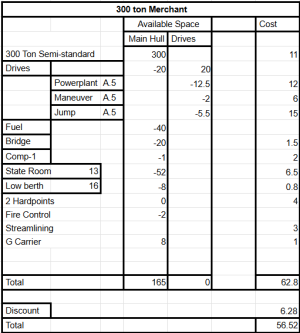
Semi-standard LBB2-ish 300 Ton Trader

spank

SOC-14 1K
This is definitely not a standard design, but it tries to come close.
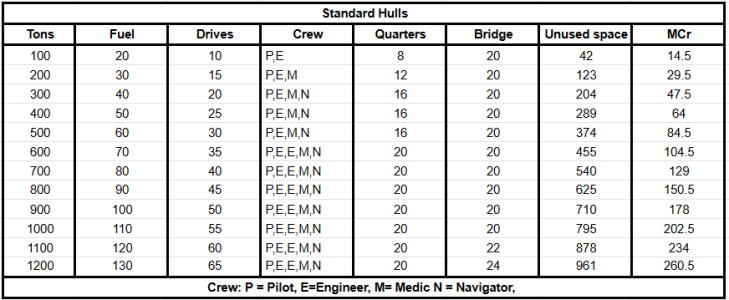
Non-standard design features include drives interpolated to be between A & B drives, and a 300 ton semi-standard hull, sized and priced to fall between 200 ton and 400 ton hulls.
1756647852092.png
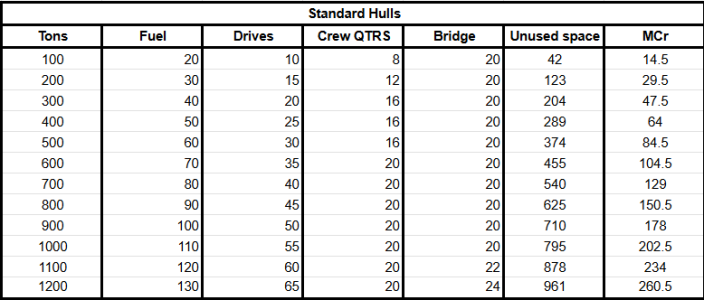
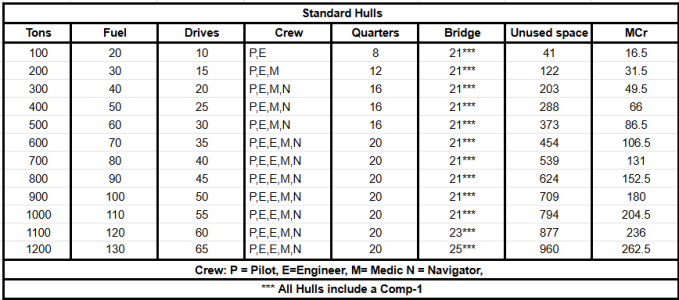
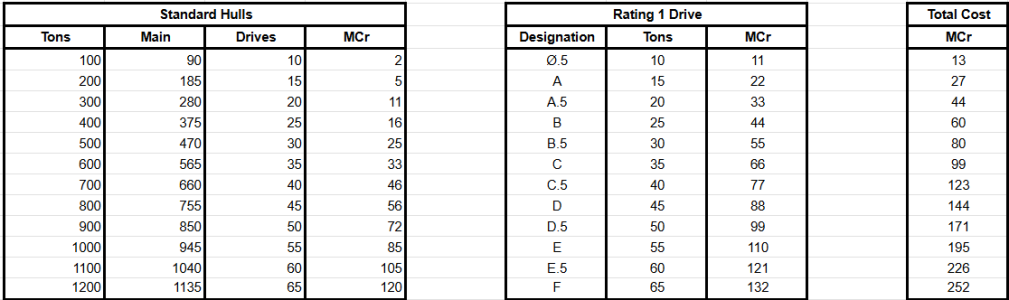
The Hull is based on an attempt to expand the standard hulls and linearize the discounts. The 100 Ton Hull and 400 ton hull have the same discounted cost as CT LBB2, and the rest fall more or less on a line passing thru these two points. The discount is roughly 7.27% per 100 tons below 1200, that gets you from 100% cost at 1200 Tons to 20% cost at 100 Tons. But it is rounded to make the MCr cost an integer. Each hull has room for a set of drives giving 1/1/1 and the rating 1 Drive table lists the cost for Drives appropriate to each hull.
1756651386125.png

A couple more things I think I could do is to add fuel for J-1/P-1, and a bridge. Then you could select a base hull for a 1/1/1 ship, and know how much hull remains and what the base cost is.
 

Attachments

  • 1756650526186.png
    1756650526186.png
    21.3 KB · Views: 1
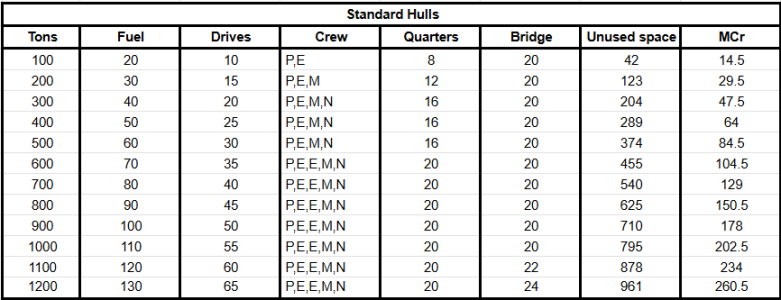
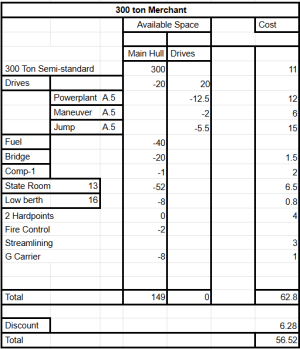
If I integrate the Bridge, Fuel and Crew quarters I come up with something like this:
1756654345011.png
Any additional crew such as Stewards, or Gunners, and any passengers will need additional Quarters
 

Attachments

  • 1756653655698.png
    1756653655698.png
    21.5 KB · Views: 2
  • 1756654144003.png
    1756654144003.png
    26.2 KB · Views: 1
A correction, the unused space should be 149 Tons, not 165 Tons—I added the space for the G-Carrier instead of subtracting it.
1756654859714.png
 
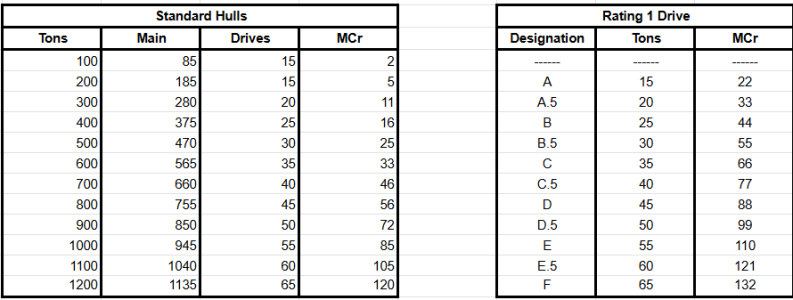
After thinking about it for a bit, I decided that the Standard Hulls should include a Comp-1, that way they are "fly-away", IE you can fly them off the lot.
1756799360554.png


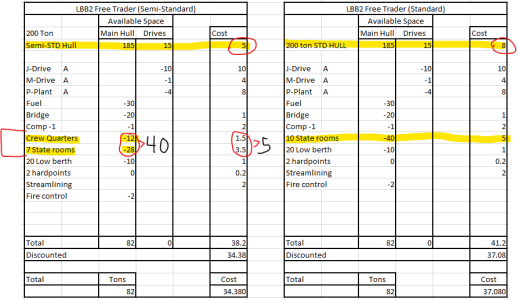
I also built out one of the 200-ton hulls for comparison with the LBB2 Standard designs, The Scout and Merchant would have smaller drives than the LBB2 designs, so they wouldn't be as directly comparable. It ended up being 3 MCr cheaper than the LBB2 Free Trader. Well, 2.7 MCr with the discount.
1756799293347.png


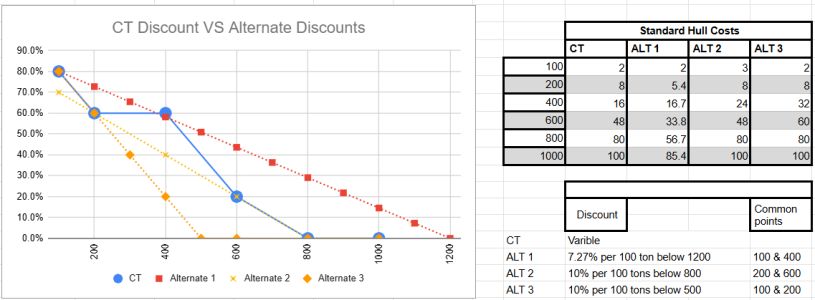
The cost difference is 100% because of the difference in hull cost, which comes from the discount schedule I developed for the hulls. My big goal was to have a linear discount from the top of the range to the bottom, and to maintain something close to CT's Standard hull discount. CT's isn't linear, but rather blocky. I chose to go with 7.27% discount per 100 Dtons below 1200 Dtons because 1) It keeps the 80% discount for the 100 Dton hull and 2) it comes very close to the 60% discount for the 400 Dton hull. A less obtrusive option would be Alternate discount schedule 2, which makes the Discount for the 400 Dton hull 40% and the 100 Dton 70%, but keeps the CT discount for 200 & 600 tons.
1756801340931.png

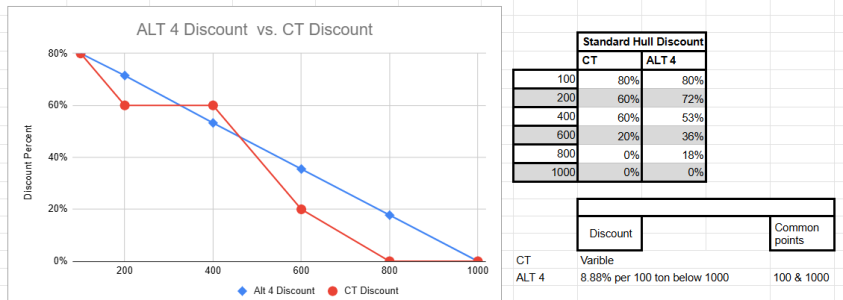
As a 4th option you could go with a discount of 8.88% per 100 Dtons below 1000 Dtons, That would get you from the CT standard 80% discount at 100 Dtons to Full price at 1000 Dtons.
1756800614384.png
 
Yeah,
After thinking for a moment, I decided to include a computer in the base cost, so the standard hull can be bought and operated as-is, rather than buying the hull and having to add additional systems before it is operational.
The idea being that you buy a hull and it's ready to go.
Or you could kit it out with additional staterooms, vehicles, ETC.
I debated on adding hardpoints and allocating space for fire control, but IDK.

The 100 Ton Hull seems interesting, It offers alot more cargo/passenger potential than the standard scout, and the cost is much more reasonable. It seems like it might even be borderland profitable.
 
The 100 Ton Hull seems interesting, It offers alot more cargo/passenger potential than the standard scout, and the cost is much more reasonable. It seems like it might even be borderland profitable.
The Type S Scout/Courier is entirely a product of LBB2 rules as written*, and is sub-optimal when re-created in almost any other set of construction rules -- including those intended to simply make LBB2 make sense.
This isn't necessarily a problem, though.
:)

-----------------------------
*Smallest available drives in the smallest available hull are good for J2/2G/Pn-2. Give it single-occupancy staterooms for the crew it should have (Pilot, Navigator, Engineer, Gunner) and an air/raft, there you go. Then rule that you don't need the whole crew if the ship's that small. Discount the standard hull by a ludicrous amount to make it affordable -- at least on the secondary market -- and there you have it.
 
Last edited:
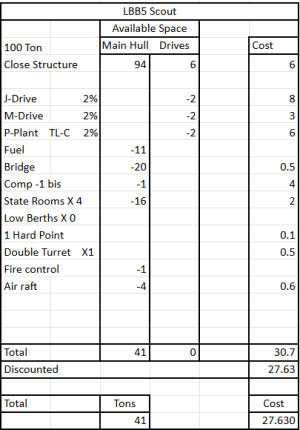
Using LBB5 it is marginally better,
Similar cost, shorter legs, but much more cargo room.
The primary space savings come from the smaller drives and (greatly) reduced fuel requirements.
1756971831067.png
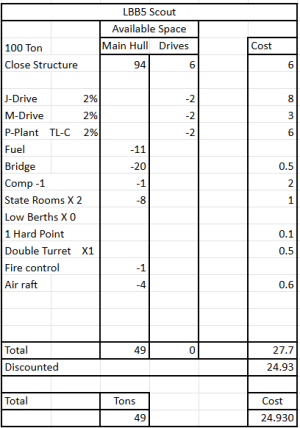
You could trim the cost more by dropping the computer to a comp-1, and doubling up on the state rooms, as they do in the seeker from Traders and Gunboats. Using a different hull configuration would reduce the cost more, but it would preclude landing and fuel skimming.
That would yield something like this:
1756971719289.png
Which compares quite favorably with the LBB2 Scout, and the Sup 7 Seeker.
1756972571082.png
With 49 Tons of cargo you come very close to being able to make the 103,875 Cr payments, But Running costs, and Maintenace costs would need to be made up from speculative cargo or side jobs. Adding some passenger capacity, or picking up a mail subsidy would improve it's profitability as well.

*Smallest available drives in the smallest available hull are good for J2/2G/Pn-2. Give it single-occupancy staterooms for the crew it should have (Pilot, Navigator, Engineer, Gunner) and an air/raft, there you go. Then rule that you don't need the whole crew if the ship's that small. Discount the standard hull by a ludicrous amount to make it affordable -- at least on the secondary market -- and there you have it.
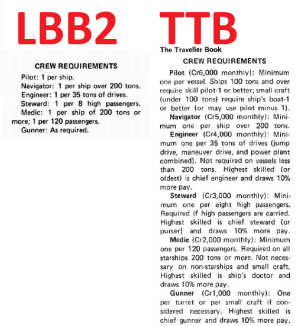
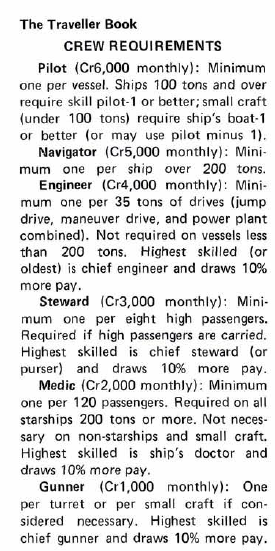
Interestingly TTB does just that, ruling that the scout only needs a crew of 1. TTB is often seen as just LBB 1-3, but it actually includes lots of little rule tweaks that other editions don't. I'd say it's CT version 1.2.
1756973855250.png
So if you're playing with TTB, your 100 ton Scout/Seeker/Trader needs only a Pilot.
 
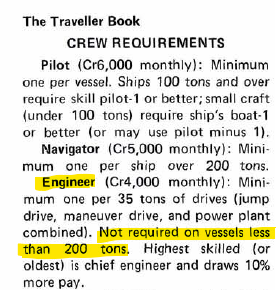
Same in LBB2. Crew requirements don't kick in until "around" the 200Td mark.
It's much easier to miss in LBB2, because it's in the crew description, on page 16, but not in the crew requirements on page 22. So it's easy to miss when building a ship, TTB has the 200 ton caveat of engineers in the crew requirements section, so it's much clearer. Heck, even LLB 2 '77 is clearer on the matter, but the caveat is ships over 100 tons, so only the Scout is excepted.

1756976811858.png
But even with the caveat the Scout's description makes it seem like an engineer is needed, "The scout/courier requires a crew of one, assuming the duties of pilot and engineer." Which, while it is a crew of one, muddies the issue by implying an engineer is needed.
 

Attachments

  • 1756976746947.png
    1756976746947.png
    204.8 KB · Views: 0
Last edited:
Note that the summary on p.22 of LBB2/81 doesn't tell you how to round (nor does p.16), so if you round down (or nearest) a Type-S or Type-A doesn't need an Engineer position anyway. You need to look at the sample ships to see clearly how it is intended to be rounded (as 'per X tons or part thereof'). One of the perils of extremely concise presentation, like the LBBs, is that vital information is often only presented once, and not always where you might expect. For example, the rule for 1,000+ ton ships' crew only appears on p.16.

TTB takes advantage of the larger format and greater word count available to be a little less concise, and is thus a bit clearer here.
 
Same for the rule about no engineers for ships under 200 tons, That's on pg 16, while the shipbuilding is on page 22-23. But I would say a type A needs an engineer, "Any ship with tonnage 200 tons or more...". But honestly, beyond the intellectual exercise of pushing the minimums bounds, I don't think omiting an engineer is a good idea.
 
Last edited:
IMTU it's a risk-tolerance issue.
Small ships put fewer lives at risk from mishaps.

Also, the Scouts wanted the loophole/exemption so they got it, but between wanting to conceal how explicitly they bent the regulations for their own ends, and commercial interests wanting to also exploit that, it got fuzzed up a bit and shifted to the 200Td region.
 
IMTU it's a risk-tolerance issue.
Small ships put fewer lives at risk from mishaps.

Also, the Scouts wanted the loophole/exemption so they got it, but between wanting to conceal how explicitly they bent the regulations for their own ends, and commercial interests wanting to also exploit that, it got fuzzed up a bit and shifted to the 200Td region.
But it is important to remember a ship without it's engineer will need to check each jump at 12+ for a misjump due to missing it's engineer, that's only 2% per jump, but after 24 jumps in a year it's going to catch up with you. A little Rote testing yields an approx 48.7% chance to fail at least 1 check in a year. That seems a little high for my taste.
 
But it is important to remember a ship without it's engineer will need to check each jump at 12+ for a misjump due to missing it's engineer, that's only 2% per jump, but after 24 jumps in a year it's going to catch up with you. A little Rote testing yields an approx 48.7% chance to fail at least 1 check in a year. That seems a little high for my taste.
Correct, except that the rules say otherwise. No, it's not consistent.

Scouts often have J-o-T skill, and maybe that combined with something like the rules for zero-level Steward skill but for engineering let them have a lower risk than the rules would seem to dictate?

This is just an IMTU justification for what the rules actually require.

The real out-of-universe reason would seem to be to allow the Type S (and later, the XBoat) to have one-person crews for game purposes (such as to accommodate very small player groups without requiring a bunch of NPCs).

The question from an in-universe perspective is whether the engineer in a Type S is really optional. That is, are Type S ships getting away with something, or are the Types A and R being forced to carry an unnecessary extra crew member or two?
 
IDK, I can buy a pilot/engineer much easier than no engineer. Especially given the 50% chance of mis-jump per year, unless the scout is specifically exempt from the Mis-jump check. The added cost is only going to be +2,250 Cr/month for a Pilot-2/Engineer-2.
1757144152622.png
 
IDK, I can buy a pilot/engineer much easier than no engineer. Especially given the 50% chance of mis-jump per year, unless the scout is specifically exempt from the Mis-jump check. The added cost is only going to be +2,250 Cr/month for a Pilot-2/Engineer-2.
View attachment 6785
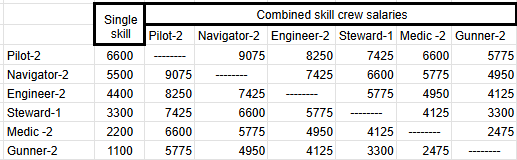
Looking at it the salary for Gunner might need adjusted, you can get a Pilot/Gunner and Navigator/Gunner cheaper than a single skilled Pilot or Gunner. And an engineer/gunner will make less than an engineer of similar skill.
 
Looking at it the salary for Gunner might need adjusted, you can get a Pilot/Gunner and Navigator/Gunner cheaper than a single skilled Pilot or Gunner. And an engineer/gunner will make less than an engineer of similar skill.
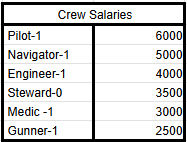
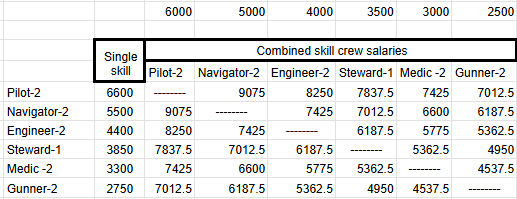
Raising the Gunner's base salary to 2500 Cr takes care of the problem, at 2000 Cr the dual skilled Pilot/Gunner would make the same as a Pilot-2, so 2500 Cr. Of course this means the Gunner makes more than the Medic so the Medic's salary goes up, and the Steward's too.
1757145546906.png
These adjustments result in the following salaries for combined skill crew members:
1757145660430.png
 
But it is important to remember a ship without it's engineer will need to check each jump at 12+ for a misjump due to missing it's engineer, that's only 2% per jump, but after 24 jumps in a year it's going to catch up with you. A little Rote testing yields an approx 48.7% chance to fail at least 1 check in a year. That seems a little high for my taste.
LBB2 '81 gives no mis-jump chance for having no engineer (p.6). It does give a breakdown chance (p.6), with any breakdown resulting in checks for each drive and the power plant. There is no indication as to what happens should that occur during jump (nor even if it can) in the passage on drive failures. The '77 rules don't mention engineers at all in this context.
 
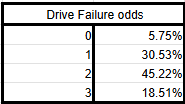
Ok, My fault, Drive failure, not Mis-Jump. But the drive failure check would actually be more severe, because it's every week, not every 2 like a jump.—Throw 7+ for each drive to determine which one fails, so 52 checks per year for failure which gives about a 75% chance of drive failure. And you check for all 3 drives, at 7+ which gives something like this:
1757155772392.png
Which means ~72% of the time you are going to have atleast 1 drive failure a year.
As far as the Jump drive specifically it does say that a jump drive or maneuver drive failure means it won't engage, and a power plant failure means you are running on batteries.

Repairs require a 10+ Engineering check, good luck with no engineer....... I'd say it's just not worth the risk. Even if you do manage to fix the drive in question, you still have to visit a Starport for permanent repair.


LBB2 '81 gives no mis-jump chance for having no engineer (p.6). It does give a breakdown chance (p.6), with any breakdown resulting in checks for each drive and the power plant. There is no indication as to what happens should that occur during jump (nor even if it can) in the passage on drive failures. The '77 rules don't mention engineers at all in this context.
 
Last edited:
Back
Top