
You are using an out of date browser. It may not display this or other websites correctly.
You should upgrade or use an alternative browser.
You should upgrade or use an alternative browser.
Why I don't overly worry about system generation
- Thread starter coliver988
- Start date
It kind of opens things up for a GM to make that one (or one more) unusual world. Because if there is at least on in RL, there just has to be one in Traveller!if it has a non-zero probability, then it exists in an infinite universe.
but yeah, we've no idea what is really out there. always neat to see these things (and since I click on these, along with cat memes, my newsfeed tends to steer that way). and to repeat the title of the thread - why I don't worry about system generation. And leaning to it is not strange enough now!

I did not know about the stellar snow line - maybe add some gravity skiing 
https://www.ecoportal.net/en/snow-discovered-around-newborn-planets/15393/
from the article: "For the first time, astronomers have witnessed the early stages of snow formation surrounding a developing star, indicating the point at which planets begin to develop an icy coating. Observations of these types allow astronomers to understand more about how gases, dust, and ices interact within the planet-forming environments of other stars"
https://www.ecoportal.net/en/snow-discovered-around-newborn-planets/15393/
from the article: "For the first time, astronomers have witnessed the early stages of snow formation surrounding a developing star, indicating the point at which planets begin to develop an icy coating. Observations of these types allow astronomers to understand more about how gases, dust, and ices interact within the planet-forming environments of other stars"
not sure if this has been posted, but a sunset similator from NASA for other worlds (youtube vid):

I did not know about the stellar snow line - maybe add some gravity skiing

Image Credit: Vintage Space Travel (Etsy vendor)
And more "retro" space tourism; this from JPL:

 www.jpl.nasa.gov
(Check out the rest of the gallery there. Good stuff.)
www.jpl.nasa.gov
(Check out the rest of the gallery there. Good stuff.)
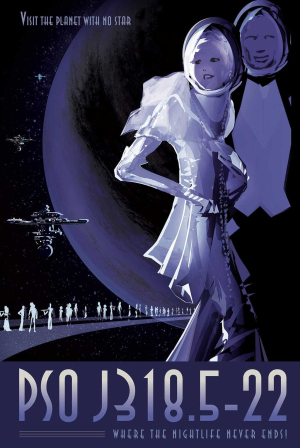
NASA JPL Visions of the Future – Space Posters
Download free retro-style NASA space travel posters depicting Mars, Europa, exoplanets, and more — each grounded in real JPL science and mission history.
Last edited:
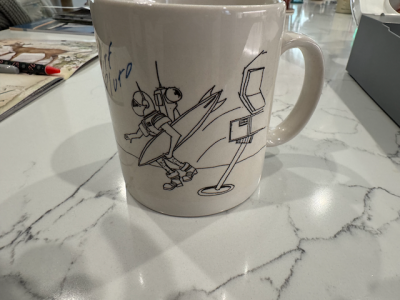
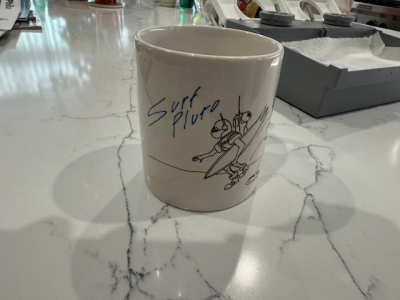
Oh boy, that Ski Pluto really takes me back. WAY back.
It was just a moment in time, at a game convention, my friends and I were just riffing on stuff. At the time, the Harmonic Convergence was the Big Deal.
And, somehow, there was some TV ad with some surfers "dudes" talking about how they can't go someplace cuz "it's got no waves". From that, we got "Pluto's got no waves".
Out of all of this, we landed on "Surf Pluto". By happenstance, there was a vendor that would put custom images on cups.
And from that, I have a "Surf Pluto" cup with an astronaut hopping out of his lunar lander, wearing a space helmet and shorts, and carrying a surfboard. One of my friends was graphically talented. I still have that cup somewhere, it must be pushing 40 years old. Always tickled me.
Good times.
It was just a moment in time, at a game convention, my friends and I were just riffing on stuff. At the time, the Harmonic Convergence was the Big Deal.
And, somehow, there was some TV ad with some surfers "dudes" talking about how they can't go someplace cuz "it's got no waves". From that, we got "Pluto's got no waves".
Out of all of this, we landed on "Surf Pluto". By happenstance, there was a vendor that would put custom images on cups.
And from that, I have a "Surf Pluto" cup with an astronaut hopping out of his lunar lander, wearing a space helmet and shorts, and carrying a surfboard. One of my friends was graphically talented. I still have that cup somewhere, it must be pushing 40 years old. Always tickled me.
Good times.

kilemall
SOC-14 5K
Should be able to do a 1km ski jump, but initial speed will be challenging.
that's no moon. Why, yes, yes it is
https://www.space.com/astronomy/exo...ve-it-could-redefine-the-word-moon-altogether
https://www.space.com/astronomy/exo...ve-it-could-redefine-the-word-moon-altogether
After reading the article & the comments after, it looks like they might have to redefine what a Brown Dwarf is, and maybe a double star system.that's no moon. Why, yes, yes it is
https://www.space.com/astronomy/exo...ve-it-could-redefine-the-word-moon-altogether
I was actually kind of excited reading the article. A huge moon like that is amazing! But now there's conflicting information or someone isn't as read up on astronomical bodies as they should be. I mean, I know about Brown Dwarfs just from reading posts on CotI!
yeah, my knowledge is based mostly on COTI and the articles that pop up. Of which I retain maybe 10% of the info.After reading the article & the comments after, it looks like they might have to redefine what a Brown Dwarf is, and maybe a double star system.
I was actually kind of excited reading the article. A huge moon like that is amazing! But now there's conflicting information or someone isn't as read up on astronomical bodies as they should be. I mean, I know about Brown Dwarfs just from reading posts on CotI!
But in the end, and the reason I started this thread, space is really, really big. and we've only a view of a tiny fraction of it. And so we can put strange things into our games because it may not be so strange after all!
https://www.cnn.com/2026/02/12/science/solar-system-inside-out-planets
"An exoplanetary system about 116 light-years from Earth could flip the script on how planets form, according to researchers who discovered it using telescopes from NASA and the European Space Agency, or ESA.
Four planets orbit LHS 1903 — a red dwarf star, the most common type of star in the universe — and are arranged in a peculiar sequence. The innermost planet is rocky, while the next two are gaseous, and then, unexpectedly, the outermost planet is also rocky.
This arrangement contradicts a pattern commonly seen across the galaxy and in our own solar system, where the rocky planets (Mercury, Venus, Earth and Mars) orbit closer to the sun and the gaseous ones (Jupiter, Saturn, Uranus and Neptune) are farther away."
"An exoplanetary system about 116 light-years from Earth could flip the script on how planets form, according to researchers who discovered it using telescopes from NASA and the European Space Agency, or ESA.
Four planets orbit LHS 1903 — a red dwarf star, the most common type of star in the universe — and are arranged in a peculiar sequence. The innermost planet is rocky, while the next two are gaseous, and then, unexpectedly, the outermost planet is also rocky.
This arrangement contradicts a pattern commonly seen across the galaxy and in our own solar system, where the rocky planets (Mercury, Venus, Earth and Mars) orbit closer to the sun and the gaseous ones (Jupiter, Saturn, Uranus and Neptune) are farther away."

Badenov
SOC-13
Well, if you count Pluto and her dwarf planet sisters, we're Rocky-gaseous-rocky also. Reading the article, they do admit Pluto exists, and point out that the remarkable bit isn't so much the order as the size of the outer rocky planet, which is pretty huge.This arrangement contradicts a pattern commonly seen across the galaxy and in our own solar system, where the rocky planets (Mercury, Venus, Earth and Mars) orbit closer to the sun and the gaseous ones (Jupiter, Saturn, Uranus and Neptune) are farther away."
Last edited:

Spinward Flow
SOC-14 5K
The notion that the Solomani Solar System was the "foundational model" that ALL other planetary systems HAD TO follow was a fallacious assumption just waiting for an avalanche of evidence to bury it under the errors hubris. The notion was only able to "hold sway" for as long as it did due to the lack of evidence to the contrary.the remarkable bit isn't so much the order as the size of the outer rocky planet

Kind of like the Flat Earth fallacy.

Empirical everyday experience (on the planetary surface) SUGGESTS that the idea is true ... but once the scope of your information extends beyond the immediate line of sight (tethered to the ground), the fallacies in the idea become impossible to ignore (except to those who are determined to cling to their blind faith more than reason based on evidence).
Once the evidence started pouring in that the Solomani Solar System was the WEIRD one that almost no other star systems "followed" ... all kinds of basic assumptions needed to be reexamined and rewritten, based on an accumulation of evidence beyond a sample size of ONE.

Badenov
SOC-13
Everyday experience of people who never look out anywhere near the horizon or look at the sun or have any reasonable grounding in science maybe. The earth was observed to be spherical back in antiquity. An ancient Greek polymath, working in Egypt around 240 BCE, actually got pretty close to the actual diameter, too. Columbus's journey wasn't remarkable because people thought he'd fall off the world, it was because people had a pretty good idea how big the world was, and going to India from the other way around was very much taking the long (and uncharted) way, and that was why people were skeptical.Kind of like the Flat Earth fallacy.
Empirical everyday experience (on the planetary surface) SUGGESTS that the idea is true ... but once the scope of your information extends beyond the immediate line of sight (tethered to the ground), the fallacies in the idea become impossible to ignore (except to those who are determined to cling to their blind faith more than reason based on evidence).
On the other hand, the most plausible assumption in the absence of other evidence is that our stellar system is typical and unremarkable. Why would one presume to think otherwise?The notion that the Solomani Solar System was the "foundational model" that ALL other planetary systems HAD TO follow was a fallacious assumption just waiting for an avalanche of evidence to bury it under the errors hubris. The notion was only able to "hold sway" for as long as it did due to the lack of evidence to the contrary.
Orbital telescopes are a relatively recent development.
Well, we seem to have had this happy congruence rocky planets, gas giants, type of star, moons, and a particular one with temperate climate, water, Oxygen/Nitrogen atmosphere, and, the happenstance of not just life, not just cells and algae, but, complex organisms and intelligent life that managed to survive an apocalyptic comet or meteor strike, not just once, but more than once.Why would one presume to think otherwise?
So, you know, that's kind of a stand out asterisk on our little bubble of space.
But we didn't know that until we could see exoplanets. Best guess before that was that there ought to be a lot of places like that (like here) out there. And that each of them went through similar processes, and some may have developed life as we know it, and some of them advanced into intelligent life as we know it. (Or, perhaps, life as we don't know it yet.) Give or take the Drake equation...Well, we seem to have had this happy congruence rocky planets, gas giants, type of star, moons, and a particular one with temperate climate, water, Oxygen/Nitrogen atmosphere, and, the happenstance of not just life, not just cells and algae, but, complex organisms and intelligent life that managed to survive an apocalyptic comet or meteor strike, not just once, but more than once.
So, you know, that's kind of a stand out asterisk on our little bubble of space.
This somewhat aligns with the Anthropic Principle (Wikipedia) which generally states that the universe has to be such that it produces us, or we wouldn't be here to observe it. (And from a solipsistic perspective, it would then not exist at all.)
Last edited:
Keep in mind the results are skewed based on what we can detect today.
Most of the exoplanets we detect are found by the gravitation affect of the planets on the stars rotation speed. this means we can more easily see high mass planets close to the star. The star also needs to be low mass.
Then we have occultation, the star light dimming as the planet passes between the star and earth. large planets against small stars are more easily detected.
In both cases we need to see several repeating sets of data showing complete orbits. We get more sets of data if the planets orbits the star every few days. For systems like Sol we would need decades or centuries of observations.
A very few planets we have directly observed. the best telescope see a pixel or two right next to start. This limits us to large planets next to dim small stars.
We are only seeing a small fraction of the planets that are out there, most of them extreme examples of large planets next to small class M stars with orbits every day or two.
I am not sure if we could even detect Jupiter orbiting the sun form 100 light years. Maybe with 60 years of data. I am certain we would not see the inner planets
Most of the exoplanets we detect are found by the gravitation affect of the planets on the stars rotation speed. this means we can more easily see high mass planets close to the star. The star also needs to be low mass.
Then we have occultation, the star light dimming as the planet passes between the star and earth. large planets against small stars are more easily detected.
In both cases we need to see several repeating sets of data showing complete orbits. We get more sets of data if the planets orbits the star every few days. For systems like Sol we would need decades or centuries of observations.
A very few planets we have directly observed. the best telescope see a pixel or two right next to start. This limits us to large planets next to dim small stars.
We are only seeing a small fraction of the planets that are out there, most of them extreme examples of large planets next to small class M stars with orbits every day or two.
I am not sure if we could even detect Jupiter orbiting the sun form 100 light years. Maybe with 60 years of data. I am certain we would not see the inner planets
Similar threads


- Replies
- 0
- Views
- 879