• Welcome to the new COTI server. We've moved the Citizens to a new server. Please let us know in the COTI Website issue forum if you find any problems.
  • We, the systems administration staff, apologize for this unexpected outage of the boards. We have resolved the root cause of the problem and there should be no further disruptions.

General What is your most common food or drink in The Third Imperium?

Here's an add on I did for food in Traveller

Food Availability and Traveller
etceteration in propitiation to the deitic principle of bandwidth
Enoki said:
There are tables and rules that go with this, but I think posting them would be difficult to do because of the formatting.
Tables and rules at https://www.freelancetraveller.com/features/rules/foodscore.html [Originally printed September 2011 issue, also translated to Spanish in Vuelo Raso N.4]
 
Actually, there are a couple of things that I think will end up being both ubiquitous and highly variable due to localization:
  1. Some sort of cereal or pseudocereal grain processed into dough, then wrapped around a protein of some sort, and cooked. Earth analogues: Dumplings, bao, wonton, samosas, shumai, gyoza, Jamaican meat patties, Cornish pastys, calzones, arguably the sandwich, etc. [Generically might be referred to as something akin to 'hand-meal' in SF]
  2. Some sort of cereal or pseudocereal grain, cooked whole (steamed or boiled), and served with boiled pulses or legumes, optionally with a spiced sauce of some sort. Earth analogues: curried dal [lentils] or rajma [kidney beans] or channa [chickpeas], various "ethnic" forms of rice-and-beans, etc.
 
Fermenting stuff could remove toxins, or make them palatable.

Going by any number of movies, or novels, humanity has an insatiable drive to produce alcohol.
 
Fermenting stuff could remove toxins, or make them palatable.

Going by any number of movies, or novels, humanity has an insatiable drive to produce alcohol.
Even since we took up agriculture we turned any grains or fruits into alcohol. You used it to sterilize water, it was a value added product (need to turn that surplus crops into more portable products) plus you could store it longer.
 
Actually, there are a couple of things that I think will end up being both ubiquitous and highly variable due to localization:
  1. Some sort of cereal or pseudocereal grain processed into dough, then wrapped around a protein of some sort, and cooked. Earth analogues: Dumplings, bao, wonton, samosas, shumai, gyoza, Jamaican meat patties, Cornish pastys, calzones, arguably the sandwich, etc. [Generically might be referred to as something akin to 'hand-meal' in SF]
  2. Some sort of cereal or pseudocereal grain, cooked whole (steamed or boiled), and served with boiled pulses or legumes, optionally with a spiced sauce of some sort. Earth analogues: curried dal [lentils] or rajma [kidney beans] or channa [chickpeas], various "ethnic" forms of rice-and-beans, etc.

Some more ideas:

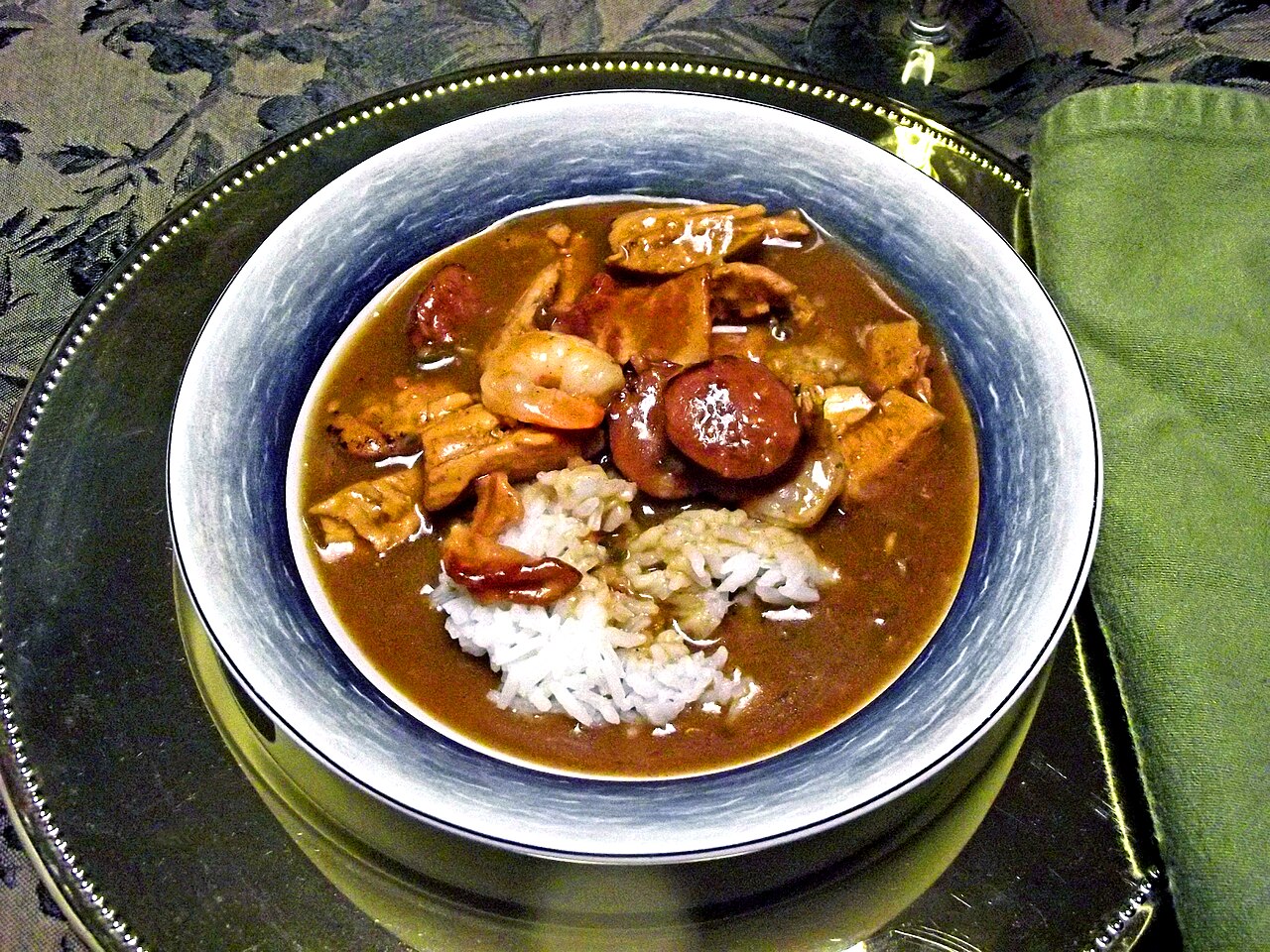
Gumbo (Louisiana Creole: Gum-bo) is a stew that is popular among the U.S. Gulf Coast community, the New Orleans stew variation being the official state cuisine of the U.S. state of Louisiana. Gumbo consists primarily of a strongly flavored stock, meat or shellfish (or sometimes both), a thickener, and the Creole "holy trinity": celery, bell peppers, and onions. Gumbo is often categorized by the type of thickener used, whether okra or filé powder (dried and ground sassafras leaves). Gumbo can be made with or without okra or filé powder.


Dirty rice is a traditional Louisiana Creole dish made from white rice which gets a "dirty" color from being cooked with small pieces of pork, beef or chicken, green bell pepper, celery, and onion, and spiced with cayenne and black pepper. Parsley and chopped green onions are common garnishes. Dirty rice is most common in the Creole regions of southern Louisiana; however, it can also be found in other areas of the American South and referenced as "chicken and rice," "Cajun rice," or "rice dressing".

https://en.wikipedia.org/wiki/Alu_chat

Alu chat (also spelled alu chaat, aloo chat, or aloo chaat) is a street food originating from the Indian subcontinent. It is popular in North India, West Bengal in Eastern India, Pakistan, and also in parts of Sylhet Division of Bangladesh. It is prepared by frying potatoes in oil and adding spices and chutney. It can also be prepared with unfried boiled potatoes and adding fruits along with spices, lime juice and chutney.


Bhel puri (also bhelpuri, bhel poori, or simply bhel) is a savoury snack and a type of chaat, commonly served as street food. It is made of puffed rice, crunchy puris, and sev, which are layered with ingredients such as potato and onion and topped with chutneys—typically a coriander leaf chutney and a tangy tamarind chutney. Combining as many as fifteen ingredients, it incorporates contrasting textures and flavours. Bhel puri is originally from Mumbai and is rooted in Gujarati cuisine. Many similar versions of puffed rice snacks exist across India, including jhalmuri, masala puri, and churumuri.

 
I am in the process of emptying the fridge and freezer, so instead of butter, fried a horse steak with one hundred fifty grammes of fresh cheese with herbs.

Surprisingly more juicy than I thought it would be.

Fresh cheese does leave skidmarks, unlike butter.
 
Gumbo (Louisiana Creole: Gum-bo) is a stew that is popular among the U.S. Gulf Coast community, the New Orleans stew variation being the official state cuisine of the U.S. state of Louisiana. Gumbo consists primarily of a strongly flavored stock, meat or shellfish (or sometimes both), a thickener, and the Creole "holy trinity": celery, bell peppers, and onions. Gumbo is often categorized by the type of thickener used, whether okra or filé powder (dried and ground sassafras leaves). Gumbo can be made with or without okra or filé powder.

Yes, stews of all sorts would also be ubiquitous and variable.

Traveller76 said:
Dirty rice is a traditional Louisiana Creole dish made from white rice which gets a "dirty" color from being cooked with small pieces of pork, beef or chicken, green bell pepper, celery, and onion, and spiced with cayenne and black pepper. Parsley and chopped green onions are common garnishes. Dirty rice is most common in the Creole regions of southern Louisiana; however, it can also be found in other areas of the American South and referenced as "chicken and rice," "Cajun rice," or "rice dressing".

cereal/pseudocereal-grains-with-protein-other-than-pulses-or-legumes is a reasonable extension of the rice-and-beans idea, and likely also to be ubiquitous and variable (consider the above, plus arroz con pollo, Korean bulgogi, biryani, Chinese pork/beef/chicken/shrimp fried rice, and so on); halfway between this and the stews above are things like paella or jambalaya (yummy!).
 

From the Article: Korean chicken brands had been expanding internationally since the early 2000s, but the cultural breakthrough came in 2014, when the Korean drama My Love from the Star became a sensation across China.
 

From the Article: Pakora (pronounced [pəˈkɔːɽa]) is a fritter originating from the Indian subcontinent. They are sold by street vendors and served in restaurants across South Asia. They often consist of vegetables such as potatoes and onions, which are coated in seasoned gram flour batter and deep-fried. Pakoras are made by coating ingredients, usually vegetables, in a spiced batter, and then deep frying them. Common varieties of pakora use onion, masoor dal (lentil), suji (semolina), chicken, arbi root and leaves, eggplant, potato, chili pepper, spinach, paneer, cauliflower, mint, plantain or baby corn.


A churro (Spanish pronunciation: [ˈtʃuro], Portuguese pronunciation: [ˈʃuʁu]) is a type of fried dough from Spanish and Portuguese cuisine, made with choux pastry dough piped into hot oil with a piping bag and large closed star tip or similar shape. They are also found in Latin American cuisine, Philippine cuisine and in other areas that have received immigration from Spanish- and Portuguese-speaking countries, especially in France and the Southwestern United States.

In Spain, churros can either be thin (and sometimes knotted) or long and thick, where they are known as porras, jeringos, or tejeringos in some regions. They are normally eaten for breakfast dipped in coffee, or in hot chocolate for an afternoon snack. There are also two slightly different snacks in Portugal, called porra and fartura, which are filled with jelly instead of the doce de leite traditional to Brazilian churro
 
Back
Top