• Welcome to the new COTI server. We've moved the Citizens to a new server. Please let us know in the COTI Website issue forum if you find any problems.
  • We, the systems administration staff, apologize for this unexpected outage of the boards. We have resolved the root cause of the problem and there should be no further disruptions.

Recreation in the Lanth system

LBB2.81, p34:
If atmospheric braking is described, then I assume LBB2 also provides stats for heat shields?
In this context, 10mm of vector length equates to -0.1G of deceleration in the vector movement system of LBB2.

Runways so long ... the curvature of the planetary surface prevents seeing the "far end" of the runway from the launch point.

So ... we're talking like 25-50 km long runways, right? :rolleyes:
Sounds legit ... :unsure:
I never said it was efficient, I said it was possible. Also I haven't run the numbers or seen your math for a 25-50km runway, so is that mathed out or speculative? My math: The space shuttle lands at 344-364kph. Presuming that's the slowest velocity at which it can remain airborne, the takeoff velocity should be the same. At 1G thrust, you reach 354 kph or 98.3 m/s at 9.83 seconds (using 10m/s^2 as 1G, which Traveller seems to accept as an approximation). That's a takeoff roll of less than 500m, so forget the 25km runway. So like you said, 1G is a gargantuan amount of thrust for a TL7 commercial vehicle - it's substantial for a jet fighter!. Commercial aircraft take off with a quarter of that, flying bricks and F-4s take off with 60% of that. Aerodynamic launch with a full 1G of thrust is going to zoom. You don't need much aerodynamic lift with that much thrust.

If we're looking at how much power you need for a tailsitter, the space shuttle launch system, with boosters and the big rocket in the tailsitter configuration, they alltogether have a thrust-to-weight of about 1.5 to 1, so about 0.5 in excess of local gravity, and that's what you'd need with 0 aerodynamic advantage.
 
This discussion occurs on roughly a biannual basis.

Basically there are three camps:

those that do not think the aerodynamics of streamlined ships provide lift

those who think streamlined ships are aerodynamic enough to generate enough lift with the ridiculous power of a 1g constant thrust engine (something the majority of military aircraft lack) and can therefore fly

those who couldn't care less
You left out camp 4:
Gravitics allow escaping.
4a: the MT solution: ships using T-Plates can push thrust to 400% for periods up to 20 minutes.
4b: The TNE/T4 solution - ContraGrav nulls 98% of local G on the frame, so a 1G ship can escape 49 G's...
 
Modern airliners don't need to withstand atmospheric entry heating @ Mach 25+ either ... :unsure:
I wonder if the need for hypersonic performance in parts of the flight envelope will have any effect on the aerodynamic shaping of starship hulls. :rolleyes:

Probably not ... 😅
No CT, MT, MgT1, nor MgT2 TL 10+ ship ever needs make a routine reëntery at Mach 25... if G's exceed Surface, they can enter at a measly 100 kpH... on a nearly vertical descent path, even.
The many hours of thrust are why... just decelerate horizontally as you descend, and use thrust to prevent significant vertical acceleration.
 
1. Can't say that I know enough about aerodynamics, though I would think that you need a specific subconfiguration from streamlined hull, blended wing body.

2. Current rules have it two times gravity well factor, divided sustained thrust minus gravity well factor, equals number of rounds to reach orbit.

3. As an example, factor/three thrust on Earth would mean that orbit is reached in two rounds.

4. And, another local gravity field factor divided by sustained thrust, to break orbit.
 
1. Can't say that I know enough about aerodynamics, though I would think that you need a specific subconfiguration from streamlined hull, blended wing body.
Most of my answers came from Google, tbh, though my job field was technically "Flight Test" before I retired. But I was in avionics and this is more of an airframes or general flight mechanics thing.

So, if there was such a subconfiguration of 'streamlined' for hulls, I would agree. The closest thing in MgT1 are Aerofins from High Guard, which cost you 5% of the ship's tonnage and give a +2 to piloting in atmosphere. So, it's a good-to-have, but it's far from de rigeur. The space shuttle lands fine, and as we mathed out, if you could cram 1G of thrust in it, it would positively leap into the air.
2. Current rules have it two times gravity well factor, divided sustained thrust minus gravity well factor, equals number of rounds to reach orbit.
Not sure where this rule comes from? But if you were in a Thrust 1 ship leaving Earth, would that be 2/(1-1)? Is that an infinite time to climb out of the grav well?
3. As an example, factor/three thrust on Earth would mean that orbit is reached in two rounds.

4. And, another local gravity field factor divided by sustained thrust, to break orbit.
Again, I'm not sure if I understand how this math is organized?
 
No CT, MT, MgT1, nor MgT2 TL 10+ ship ever needs make a routine reëntery at Mach 25... if G's exceed Surface, they can enter at a measly 100 kpH... on a nearly vertical descent path, even.
The many hours of thrust are why... just decelerate horizontally as you descend, and use thrust to prevent significant vertical acceleration.
So part of this is that Traveller is able to ignore conventional orbital mechanics complelely due to reasons at fairly low TL (Traveller Reactionless Thrusters/Grav Drives (TL 9 according to MgT1, I think it's TL10 in CT)). Space stations and ships don't fall out of the sky because they produce 1G of acceleration to counter gravity and they do this 24/7 (while they have fuel). This can also allow them to be geostationary, which is not otherwise possible in Low Orbits (160-2000km).

Modern (2026) spacecraft orbit because the amount that they move tangentially to the planet plus the vector due to gravity results in a new vector exactly tangential at the same altitude further along the orbital path. This means that there's one exact velocity for each altitude that results in a stable orbit, and it means that speeding up or slowing down will change your altitude with no up or down vector applied. This velocity, though, is on the order of 27,300kph at 160,000m altitude, which is as low as you can go and still be in Low Earth Orbit, and you need to lose this velocity before landing, which is where the atmospheric braking comes into play.

Of course ships with reactionless thrusters can just apply reverse thrust, come to rest, and float gently downward as described above, though it's a bit complicated to just float down at 1G since all your thrust is spent countering gravity and you don't have any thrust available for steering at that point, which I think is the reason people want you to have 2G thrust to fly in a 1G grav well. I agree you should not use this gentle floating down technique with a 1G ship because you'd be at the mercy of very high winds in the upper atmosphere (and lifting back up again wouldn't work), but aerodynamic lifting surfaces change this equation by providing substantial aerodynamic lift to supplement the thruster power while in atmosphere, and will allow you to exit atmosphere with enough orbital velocity to maintain an orbit the old fashioned way. Once you've achieved the altitude you want, it'd take about 45 min at 1G to kill your orbital velocity, but you'd need to spend almost all of that 1G to keep from falling.

Technically, TL7 reaction drives could land by floating down also, but you'd need to point the thrusters back in the direction of travel and have the reaction mass available, neither of which the TL9/10 Traveller Space Magic drives seem to need.
 
Ships with streamlining can generate enough thrust to fly, if they can fly then they can ultimately achieve orbital velocity.

No amount of argument will change my mind.

Modern airliners don't have hulls the equivalent of medium tanks and a magical heat transfer mechanism either.

The shuttle was able to survive the hypersonic environment... gliding with control surfaces.

Starship literally falls from orbit controlling itself with a few fins... in just the same way a brick doesn't :)

Both of which are unpowerd descents, so have to use frictional heating to get rid of kinetic energy. If you stuck a fuel tank in the shuttle bay so it could use its engines to decelerate then it wouldn't need so much frictional transfer of energy. Same with Starship, they have studied the dynamics of a powered descent from orbit, come the day when they have their refueling station in orbit.

A TL9 ship is going to have computer controlled attitude control and is powered throughout its descent, the latest Mongoose Traveller retcon is that all charted space ships have lifters that negate world gravity for free. They work on take off as well making the ship weightless so all that lovely thrust can be used to get to orbit.
 
Last edited:
You left out camp 4:
Gravitics allow escaping.
4a: the MT solution: ships using T-Plates can push thrust to 400% for periods up to 20 minutes.
4b: The TNE/T4 solution - ContraGrav nulls 98% of local G on the frame, so a 1G ship can escape 49 G's...
I fold that into the don't care category - they handwave it away, just like Mongoose Traveller now does with lifters.
 
It would be a very rare planet with a 1g gravity field and no atmosphere. The minimum for such a size is thin, and aircraft can fly perfectly well in thin atmospheres.
 
So,
@Spinward Flow, @Badenov and others..

Can we please take the "can you get off this rock" conversation elsewhere...
To, perhaps, one of the thousands of other threads discussing that?

I would love to get everyone's ideas on what they and their characters would do for fun and recreation

Please be polite and do not hyjack this thread
 
So,
@Spinward Flow, @Badenov and others..

Can we please take the "can you get off this rock" conversation elsewhere...
To, perhaps, one of the thousands of other threads discussing that?

I would love to get everyone's ideas on what they and their characters would do for fun and recreation

Please be polite and do not hyjack this thread
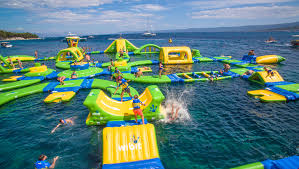
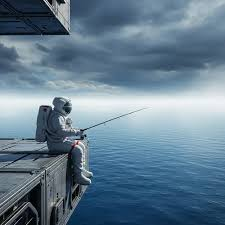
Sorry about that. On topic, I think they'd lean in to typical water activities that make use of their most abundant resource, ocean. So waterskiing/jetskiing, boating, parasailing, floating water parks (though the tainted atmosphere makes all outdoor activities difficult). And with a planet-sized ocean, I'll bet the fishing is spectacular!

Postcard1: Postcard2:
1769535036536.png'1769535683918.png

And ships' crews in port always wind up in some bar or other., so all the typical pursuits.
 
Sorry about that. On topic, I think they'd lean in to typical water activities that make use of their most abundant resource, ocean. So waterskiing/jetskiing, boating, parasailing, floating water parks (though the tainted atmosphere makes all outdoor activities difficult). And with a planet-sized ocean, I'll bet the fishing is spectacular!

Postcard1: Postcard2:
View attachment 7296'View attachment 7297

And ships' crews in port always wind up in some bar or other., so all the typical pursuits.
Love the post cards :D
I've already added a number of tech-industry leveraged "wind-based" water craft activities and races including a multi-manufacturer sponsored set of endurance races which reach out to other high-percentage liquid worlds for out-system sales (low-volume due to Lanth being "Non-Industrial") and an industry based on contracting out design and other specialists.

But, I had not added things like Parasailing and such so thank you for expanding the borders!
 
I've also added specialty "skinsuits", for safely leaving sealed spaces with less than 2 hrs air supply
These allow a person to go out into the environment without the bulk of a full vacc suit.

It is sort of like putting on a "sealed, full body bathing suit"
 
I've also added specialty "skinsuits", for safely leaving sealed spaces with less than 2 hrs air supply
These allow a person to go out into the environment without the bulk of a full vacc suit.

It is sort of like putting on a "sealed, full body bathing suit"
The TL8 Artificial Gill gives unlimited time, so that might be a better go-to? At least for the pros. Tourists with limited air have more reason to return to where they rented the gear. The TL10 Combat Environment Suit is 1000Cr, 2kg, and requires no skill to use, so that's probably a good model for your skinsuits.
 
LBB3.81, p17:
Underwater Air Tanks (TL=5) Cr800. Equivalent to oxygen tanks but designed for use underwater. Two tanks last 6 hours, weigh 5 kg. Refill: Cr20.
Artificial Gill (TL=8) Cr4000. Extracts oxygen from water to allow unlimited time submerged. Functions only on worlds with thin, standard, or dense (type 4 through 9) atmospheres. Weighs 4 kg.
Swimming Equipment (TL=3) Cr200. Includes swim fins, wet suit, face mask.

Water sports aren't going to be exclusively above the surface @ TL=B. :unsure:

With an artificial gill, you don't need SCUBA (Some Come Up Barely Alive...) tanks with pressurized air in order to swim around underwater (at least near the surface where O2 is dissolved in the water). At deeper depths, the oxygen content of Terra's oceans plummets, due to the lack of processes making/bringing O2 down to those layers of water. So kind of like how there's a "tree line" at altitude where there isn't enough atmospheric pressure for trees to survive above that line (so you get grassy tundra and lichen instead) ... you have a similar phenomenon going on below the waves once you reach appropriate depths (in the darkness, so photosynthesis "doesn't work well enough" to continue operating).

Fun part is that "how deep" that Anoxia Layer begins in the oceans tends to VARY, depending on things like current flows, temperature, salinity, etc. so there isn't going to be a uniform depth everywhere around the world where water (abruptly) transitions from oxygen: Y to oxygen: N dissolved in the water.

In the context of Artificial Gill wearers/users, this can be used as a kind of "extreme sport" flirtation with hypoxia (do NOT dive alone!).

In "gamer speak" it's a bit like swimming through the Fatigue Bar Countdown To Death in the oceans of World of Warcraft (in case that reference makes any sense to you).

Point being that the challenge is to "go beyond" the limits of what is "safe" ... and then return (without permanent injury) ... while wearing an Artificial Gill.

Not exactly the same as eating Fugu for the "flirt with death" from the poison effect, but analogous to it.
 
Back
Top