• Welcome to the new COTI server. We've moved the Citizens to a new server. Please let us know in the COTI Website issue forum if you find any problems.
  • We, the systems administration staff, apologize for this unexpected outage of the boards. We have resolved the root cause of the problem and there should be no further disruptions.

Recreation in the Lanth system

Hi All,
My players have just arrived in the Lanth system(Lanth/Spinward Marches) and the tech level is "6" where the Law level is "3"
So, the highports are "Class A" while the downwell tech is a mix of 1960's (TL 6) and Imported higher tech.

I've described it as:
Description of Lanth:

  1. The planet is slightly larger than Earth
  2. The planet is 90% covered by water, so there is one continent (Consider Australia with nothing else but scattered islands and lots and lots of water)
  3. The atmosphere has a sulfuric taint requiring masks at all times outside sealed buildings
  4. The “ambient tech” is 1960’s to 70’s, with a lot of mixed in imported advanced tech.
    So, you’ll see advanced -tech “super towers” rising more than 200 stories
  5. The street level will be mostly wheeled vehicles running on petroleum with the wealthier driving hyro-cracking electric cars
    The well off and wealthy drive grav-vehicles or more fancy vehicles
  6. Construction is often brick and mortar, frame structures, but you will also see very modern materials mixed in from time to time
So, what would your crew want to get out and do?
On the high-port, vacc suit adventures(tethered or not), spaceborne small craft, clubbing, casinos, pub crawls, tours of the solar system...
Downwell, obviously museums, planetary tours, maritime activities(Fishing, swimming, scuba, submarines, boatcraft, etc), Adventure tourism(Mountain climbing, Spelunking, parkour, etc), clubbing, casinos, pub crawls...

What would you add to this list?
Either on or off the high port, or downwell?
 
Shame I think the original TL6 version you have outline looks a lot more interesting than generic TL11 world. Traveller has always struggled with descriptions of worlds TL9+ with regards to day to day living and the tech that embiggens their lives.

Now you just have fusion power station, electric vehicles, robots, computers, comms, interwebs, drones... another Minority Report world.
 
Shame I think the original TL6 version you have outline looks a lot more interesting than generic TL11 world. Traveller has always struggled with descriptions of worlds TL9+ with regards to day to day living and the tech that embiggens their lives.

Now you just have fusion power station, electric vehicles, robots, computers, comms, interwebs, drones... another Minority Report world.
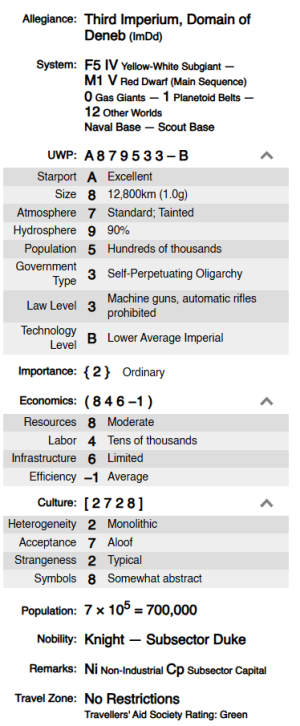
maybe. between law level and social norms, they do not have to be the same. Let's look at Lanth to keep things on track. From the TravellerMap we have the info below. We've already got a sulphuric tainted atmosphere, so probably some really brilliant sunrises & sunsets. Standard gravity for humans. It is also the subsector capital, so I would assume some large complexes for the Imperium and a lot of security around that.

The population of 700K, plus the low efficiency in economics *could* imply there is more manual work than automation despite the TL-B. Perhaps crafts of some sort, or a larger service economy: those diplomats and people visiting the sub-sector capital want hand-prepared food and all that goes with that. 700K is a large city basically, so perhaps the service workers get paid a lot more than normal and so Lanth is also known as the "Welcoming Planet". And no tipping as it is more than a living wage. Tips would be seen as rude. All sorts of possibilities for just that small bit.

As for entertainment, with that tainted atmosphere, and the leaning towards manual handling, all sorts of lower tech things: could be a big wrestling world where the Lanth Wrestling League is headquartered for the subsector. TL B and we can have huge atriums where paragliding or grav chutes are used. But we're 90% ocean: fishing. Lots of fishing. But, with the atmosphere. specialized sealed boats or submersibles. And perhaps megafauna fishing instead.

Don't let it be another "TLB vanilla planet". Even roll up stuff from Grand Census or other world rules for odd cultural things: adults can only eat with other adults of the same gender, or some other quirk. That can have all sorts of interesting possibilities.

1769435284971.png
 
Standard gravity for humans.
Which means that 1G maneuver merchant traffic is "restricted" to the highport ... not enough maneuver thrust to (reliably) reach orbit after landing at the downport. 2G maneuver merchant traffic has "unrestricted" wilderness refueling (from the ocean) available, assuming a streamlined hull configuration.
We've already got a sulphuric tainted atmosphere
Which tends to imply "appreciable levels of volcanism" ... which could mean some very ACTIVE plate tectonics at work, with "rings of fire" around undersea continental plates.

Also, expect the oceans to be tainted with sulphur, not "just" the atmosphere. Which would mean that with a (predominantly) water H2O ocean, there would be an important measurable fraction of H2O4 diluted into the ocean water that might not be ... pleasant to swim in (but great as an exfoliation treatment under controlled circumstances? 😅).

Note that the "sulfur smell" would undoubtedly GET INTO EVERYTHING ... it's just a question of degrees of "smelling like rotten eggs" sulfur smell in the air. Environmental life support scrubbers will get MOST of the sulfur smell out of the air (if decent quality), while some lower grade/in use beyond warranty scrubbers will only reduce the sulfur smell to safe/tolerable levels without eliminating it completely.

IISS on base in-joke would be that the "air outside smells better than the inside of the latest Type-S to arrive" ... 😖
The population of 700K, plus the low efficiency in economics *could* imply there is more manual work than automation despite the TL-B.
A different way to think of the issue is that there isn't enough of a "world market" to bring in HEAVY levels of automation (yet). As a Non-industrial trade coded world, "most" of the finished goods found on planet have to be imported from elsewhere (most likely Vilis/Vilis or Lunion/Lunion as the nearest Industrial trade coded worlds).

The world economy is going to be more of a "frontier outpost town" type of feeling, with plenty of that settler/homesteader vibe to it. If it helps with visualization, think "Tattooine but with an ocean" in terms of "frontier living" for the natives.

A pretty significant portion of the world economy is going to be a result of IN and IISS payrolls filtering down into local service economy work.

My personal assumption is that Non-industrial worlds have economies primarily focused on Resource Extraction, intended for (interstellar) export to bigger ("richer") markets elsewhere. With a Government: 3 (Self-perpetuating Oligarchy) that would mean that there's some local resource on Lanth which has gotten a FEW (very very few!) people VERY VERY RICH ... and they've basically "bought" their way into control of the world government. Think "company town" in the days of the Robber Barons of Guilded Age America and you'll start to get a sense of the possible wealth inequality which is keeping the rich FILTHY RICH and in control of everything (and everyone) ... because ... Cash Rules Everything Around Me™.

So there's an opportunity for a kind of "wild west moneybags running a one horse town" type of feeling to the place once you leave the downport perimeter.
so Lanth is also known as the "Welcoming Planet".
The Acceptance 7 = Aloof that is cited in the extended UWP that you posted ... suggests otherwise.
However, it could be a situation in which the MONEY (and/or resources and investment) of outsiders is welcomed on Lanth ... but immigrants, not so much. So tourism is FINE ... give us all your credits during your stay ... but do NOT overstay your visa.
Credits are accepted readily.
People who move in to stay ... will need to stay "a while" before they're accepted.
But we're 90% ocean: fishing. Lots of fishing. But, with the atmosphere. specialized sealed boats or submersibles. And perhaps megafauna fishing instead.
At TL=B, I would expect the "ocean engineering" tech base to be ... remarkably extensive ... for a Non-industrial trade coded world. This would be everything from "submersible capable gravitic vehicles" to sealed habitats submerged beneath the waves (where it's safer from storms! 🌩️) and anyone who doesn't know how to swim is "looked down upon with pity" by the locals.

Megafauna fishing isn't considered "fishing" (per se) ... but is treated more like ... HUNTING.
See Hunter career in LBB S4 for inspirations.
Oh and the rumors of a "great white" being out there in the ocean somewhere, that no one has ever caught? That's probably just a "fish story" that has grown in the (re)telling. Can't believe everything you hear, you know? :sneaky:

This would undoubtedly mean that wherever there is "pretty stuff to see" beneath the waves, there would be plenty of tourist trap hospitality for Diving Package Tours ... to rake in the credits from visitors, before sending them back to their starships (and get them off world).
Don't let it be another "TLB vanilla planet".
The only way that can happen is as a byproduct of a Lack Of Imagination™.
Because ... in fact ... there ARE NO "TL=B vanilla planets" in charted space, since each one is different. ;)
 
Last edited:
Which means that 1G maneuver merchant traffic is "restricted" to the highport ... not enough maneuver thrust to (reliably) reach orbit after landing at the downport. 2G maneuver merchant traffic has "unrestricted" wilderness refueling (from the ocean) available, assuming a streamlined hull configuration.
Where does this come from? This should apply only to non-aerodynamic craft. An aerodynamic spacecraft with 1G thrust has ample power to reach orbit, using the aerodynamic surfaces to generate lift and the thrusters to generate thrust. You will need a runway to build up velocity, but you're going to get aerodynamic lift until the atmosphere is too thin to provide it, at which point you've got enough velocity to continue to lift you to orbit. It's not speedy compared to a Thrust 6 military ship, but it will get you there. A Boeing 747 has about a 0.25 Thrust-to-weight ratio (source, Google - link was way too spammy, search was '747 thrust to weight'), meaning a 1G thrust aerodynamic craft could theoretically get airborne on a 4G world. Your max V would depend on atmospheric density, but by the time the atmosphere has thinned out enough that your wings don't provide lift, you've got enough horizontal V to reach orbit.

Now if you've got a 1G vacuum world, your aerodynamic surfaces won't give you lift there. Theoretically, you could still lift if you have wheeled landing gear and a lot of runway, but it'd be harder, and it'd require more math than I have scratch paper. Basically, you need enough horizontal displacement to surpass the amont that gravity would pull you down. There's almost certainly an optimum balance point between horizontal thrust to develop velocity and vertical thrust to directly counter gravity that would allow a 1G vacuum liftoff. It might be .1G thrust .9G to counter gravity, and then you'd need much less velocity to counter the remaining gravity.

(And then I had to go down that rabbit hole...)

The formula for orbital velocity is v = √(GM/r), where v is the velocity you need to maintain orbit, G is the gravitational constant, M is the mass of the planet, and r is the radius of the planet. So escape velocity at 1G on the Earth's surface is about 7671 m/s or over 27,000 kph. But at 0.01G, it's just over 2,700 kph and at 0.001G it's 873 kph. But, you've got less and less remaining thrust to develop enough forward V to achieve escape velocity. So it turns out that in the time it takes to develop that escape velocity, you will have had to travel about 3,000km horizontally, which is about 2/3 the width of the US on an Earth-sized planet. So, yeah, on a vacuum world the size of earth, 1G craft can't take off without very weird workarounds.
 
This discussion occurs on roughly a biannual basis.

Basically there are three camps:

those that do not think the aerodynamics of streamlined ships provide lift

those who think streamlined ships are aerodynamic enough to generate enough lift with the ridiculous power of a 1g constant thrust engine (something the majority of military aircraft lack) and can therefore fly

those who couldn't care less
 
Shame I think the original TL6 version you have outline looks a lot more interesting than generic TL11 world. Traveller has always struggled with descriptions of worlds TL9+ with regards to day to day living and the tech that embiggens their lives.

Now you just have fusion power station, electric vehicles, robots, computers, comms, interwebs, drones... another Minority Report world.
I work with each UWP to try and create a specialized world from the data.
In this case, a key item to consider is that the world's surface is 90% water covered.
So, I posit an "Australia type" lone continent with scattered (and sometimes isolated) islands with small settlements.
The cultures divide out along land-based and maritime paths, with most maritime(Surface and subsurface) sub-societies divided by Resource-recovery or Tourism. So, you have factory-trawlers pulling fish from the ocean and tourism liners and submarines.

With a population north of 700,000, they are scattered both across the continent, on and under the sea and even in subsurface mining, processing and other locations. Ironically, with fusion and modern tech, the water cracking and purification plants in under sea arcologies mean the air in underwater communities may well be better than the quality of their above-sea level counter parts. This is because there will always be some remnant sulfurous taint in the air filtered from the atmosphere. At the same time, the air underwater is cracked from the water and mixed with recovered nitrogen and trace gasses. So, there is no chance for the taint to sneak in :D
 
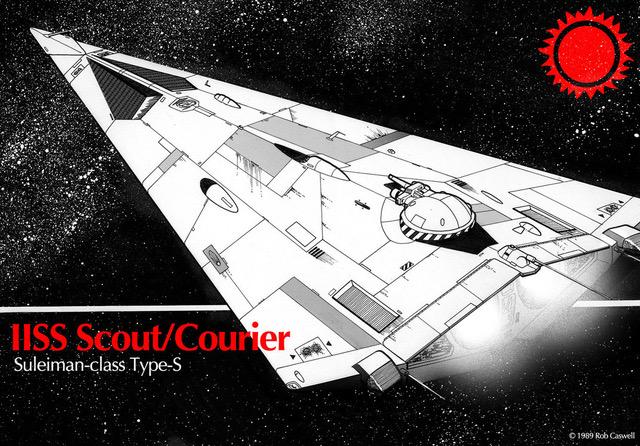
An aerodynamic spacecraft with 1G thrust has ample power to reach orbit, using the aerodynamic surfaces to generate lift and the thrusters to generate thrust.
Here's a streamlined starship.
Point to the aerodynamic surfaces that generate lift.

Trav-Suleiman-Scout-Caswell_26-April-2019a.jpg


Here's a streamlined starship (a Beowulf class Free Trader).
Point to the aerodynamic surfaces that generate lift.

Free-Trader-WH-Keith-MT-Imp-Encyclo-Pg-36_03-July-2018a.jpg


Here's a streamlined starship (an Empress Marava class Far Trader).
Point to the aerodynamic surfaces that generate lift.

Far-Trader-WH-Keith-MT-Imp-Encyclo-Pg-81_03-July-2018a.jpg


Here are some streamlined small craft.
  • 20 ton Launch
  • 30 ton Ship's Boat
  • 50 ton Cutter
Point to the aerodynamic surfaces that generate lift.

Launch-WH-Keith-MT-Imp-Encyclo-Pg-34_03-July-2018a.jpg
Ships-Boat-WH-Keith-MT-Imp-Encyclo-Pg-34_03-July-2018a.jpg
Mod-Cutter-WH-Keith-MT-Imp-Encyclo-Pg-35_03-July-2018a.jpg


Just because a hull is "streamlined" does not ipso-facto mean that hull has aerodynamic surfaces that will generate lift in (some) atmospheres.

Furthermore, not every Size: 8 (1G local gravity) world will have an Atmosphere: 6-7 (Standard, no/yes tainted) that will "conveniently" generate aerodynamic lift regardless of atmosphere UWP coding under all circumstances and contexts that make it possible to reach orbit.

Understand that even @ TL=7 on Terra, the Solomani encountered challenges getting aircraft capable of flight under "hot and high" conditions from the planetary surface in atmosphere only (never mind reaching the stratosphere or even orbit).

What IS reliable is the "thrust rating" of a maneuver drive (1G to 6G).
In order to ascend on maneuver drive thrust ONLY, you need to SUBTRACT the local gravity from the max output of a maneuver drive in order to determine the remaining fraction of maneuver thrust available to ascend from surface to orbit.
  • 1G - 1G = 0G maneuver fraction remaining to reach orbit
  • 2G - 1G = 1G maneuver fraction remaining to reach orbit
Check my math if doubts persist.

CT Striker B3, p11:
I. Grav Vehicle Maneuver Gs: A grav vehicle has Gs of acceleration equal to its thrust in tons divided by its weight, also in tons. One G is needed to keep the vehicle in the air (and if its thrust is less than one G, the vehicle cannot move); thrust in excess of one G is used for maneuver. Thus to find maneuver Gs, subtract one from the total G value.
Hence ... 1G (maneuver drive) - 1G (local gravity) = 0G Maneuver Gs = "You Are Not Going To Space Today."

This is what it looks like when you have 1G maneuver thrust pointed UP and 1G gravity pulling DOWN.

MkdyjPM.gif


Spoiler Alert: The above Real World launch by Astra Space in Alaska FAILED to reach orbit. 🤣
Guess why that might have been the result. :unsure:

Oh and for the record ... that Astra rocket had a streamlined hull configuration ... just to be thorough on the subject we're discussing.
 
Last edited:
Also, expect the oceans to be tainted with sulphur, not "just" the atmosphere. Which would mean that with a (predominantly) water H2O ocean, there would be an important measurable fraction of H2O4 diluted into the ocean water that might not be ... pleasant to swim in (but great as an exfoliation treatment under controlled circumstances? 😅).

Note that the "sulfur smell" would undoubtedly GET INTO EVERYTHING ... it's just a question of degrees of "smelling like rotten eggs" sulfur smell in the air. Environmental life support scrubbers will get MOST of the sulfur smell out of the air (if decent quality), while some lower grade/in use beyond warranty scrubbers will only reduce the sulfur smell to safe/tolerable levels without eliminating it completely.

I've been there, having spent some time playing with volcanic eruptions on Iceland :D
Swimming in the "Blue Lagoon" [which changes locations from time to time] is also an interest.
But, thanks to the geothermal society, you even get a good sulfur scent thanks to your morning shower....LOL

As you say, a Sulfur scent is part of everything.

But the Skir is amazing, as is the chance to learn bits of conversational Viking....
 
This discussion occurs on roughly a biannual basis.

Basically there are three camps:

those that do not think the aerodynamics of streamlined ships provide lift

those who think streamlined ships are aerodynamic enough to generate enough lift with the ridiculous power of a 1g constant thrust engine (something the majority of military aircraft lack) and can therefore fly

those who couldn't care less
My apologies if I'm retreading old ground, I had not imagined it would be possible for a streamlined craft not to develop some amount of lift. Maybe not as efficiently as a 747, but simply moving through an atmosphere horizontally with the bottom of the craft impacting the air generates at least some net lift, if the ship is streamlined. A tailsitter would not get this effect, obviously, as you need some amount of horizontal velocity to generate the lift, and already we're deeper into specifics than the game accounts for. But the fact of the matter is any reasonably flat surface will generate lift with enough horizontal velocity.

I agree 1G is a huge amount of power and is even in the military, generally restricted to high-performance fighter aircraft.

Here's a streamlined starship.
Point to the aerodynamic surfaces that generate lift.

Trav-Suleiman-Scout-Caswell_26-April-2019a.jpg


Here's a streamlined starship (a Beowulf class Free Trader).
Point to the aerodynamic surfaces that generate lift.
The entire flat underside of the craft generates lift. (It's shown from above, so the opposite side is the side that generates lift)
Free-Trader-WH-Keith-MT-Imp-Encyclo-Pg-36_03-July-2018a.jpg


Here's a streamlined starship (an Empress Marava class Far Trader).
Point to the aerodynamic surfaces that generate lift.
Ditto here. The entire flat bottom generates lift.
Far-Trader-WH-Keith-MT-Imp-Encyclo-Pg-81_03-July-2018a.jpg


Here are some streamlined small craft.
  • 20 ton Launch
  • 30 ton Ship's Boat
  • 50 ton Cutter
Point to the aerodynamic surfaces that generate lift.
Same. The flat undersides generate lift. This is how an F-15 flew and landed safely with one wing missing. It had enough excess thrust that the missing wing's lift was compensated for with more thrust.
Launch-WH-Keith-MT-Imp-Encyclo-Pg-34_03-July-2018a.jpg
Ships-Boat-WH-Keith-MT-Imp-Encyclo-Pg-34_03-July-2018a.jpg
Mod-Cutter-WH-Keith-MT-Imp-Encyclo-Pg-35_03-July-2018a.jpg


Just because a hull is "streamlined" does not ipso-facto mean that hull has aerodynamic surfaces that will generate lift in (some) atmospheres.
Well, it kind of does. The amount of lift may not be a huge amount, but there will be some.
Furthermore, not every Size: 8 (1G local gravity) world will have an Atmosphere: 6-7 (Standard, no/yes tainted) that will "conveniently" generate aerodynamic lift regardless of atmosphere UWP coding under all circumstances and contexts that makes it possible to reach orbit.


Understand that even @ TL=7 on Terra, the Solomani encountered challenges getting aircraft capable of flight under "hot and high" conditions from the planetary surface in atmosphere only (never mind reaching the stratosphere or even orbit).
The amount of lift is obviously subject to specifics of detail based on weather and is absolutely a case-by-case thing.
But once you get past atmosphere, you're no longer limited in velocity and can simply keep thrusting horizontally to increase your altitude. This is how spacecraft change their orbital altitude. More horizontal V pushes your orbital distance higher.
What IS reliable is the "thrust rating" of a maneuver drive (1G to 6G).
In order to ascend on maneuver drive thrust ONLY, you need to SUBTRACT the local gravity from the max output of a maneuver drive in order to determine the remaining fraction of maneuver thrust available to ascend from surface to orbit.
  • 1G - 1G = 0G maneuver fraction remaining to reach orbit
  • 2G - 1G = 1G maneuver fraction remaining to reach orbit
Check my math if doubts persist.
This math is absolutely right for a tailsitter or other craft attempting to launch from zero velocity. For an aerodynamic spacecraft with horizontal velocity, the amount of lift generated by that horizontal velocity through the atmosphere, gets added to the 1G-1G bit, and you have that small fraction to lift you up.
CT Striker B3, p11:

Hence ... 1G (maneuver drive) - 1G (local gravity) = 0G Maneuver Gs = "You Are Not Going To Space Today."

This is what it looks like when you have 1G maneuver thrust pointed UP and 1G gravity pulling DOWN.

MkdyjPM.gif


Spoiler Alert: The above Real World launch by Astra Space in Alaska FAILED to reach orbit. 🤣
Guess why that might have been the result. :unsure:
So, as I said above, tailsitters with zero velocity get no aerodynamic lift. I don't have Striker, so I can't talk to their specific assumptions.
 
The amount of lift may not be a huge amount, but there will be some.
The relevant question then becomes ... "even if there is SOME, is there ENOUGH?" ... which, broadly speaking, will tend more towards NO than YES (if for no other reasons than margins of safety for anything on the planetary surface that would rather not receive an impact from an error in judgement).
For an aerodynamic spacecraft with horizontal velocity, the amount of lift generated by that horizontal velocity through the atmosphere, gets added to the 1G-1G bit, and you have that small fraction to lift you up.
But is it ENOUGH "lift" to get you all the way to orbit? 😓
If the amount of generated lift is miniscule, you're gambling with some very expensive engineering (and possible legal responsibilities) if it winds up being the case that you're WRONG ... that the "little bit of lift" you were generating WAS(N'T) enough to get you all the way to orbit (safely).

Better to have an increased margin of safety (maneuver Gs in excess of local gravity) than to place your "hope in a wing and a prayer" (so to speak).
Because Lithobraking ... is a THING™ ... and it's not recommended as part of a flight plan. 💥
 
The relevant question then becomes ... "even if there is SOME, is there ENOUGH?" ... which, broadly speaking, will tend more towards NO than YES (if for no other reasons than margins of safety for anything on the planetary surface that would rather not receive an impact from an error in judgement).
I would not agree with this statement without seeing some numbers. If the 747 can take off with 1/4G of thrust, how un-aerodynamic can your streamlined craft be and still fly?
But is it ENOUGH "lift" to get you all the way to orbit? 😓
If the amount of generated lift is miniscule, you're gambling with some very expensive engineering (and possible legal responsibilities) if it winds up being the case that you're WRONG ... that the "little bit of lift" you were generating WAS(N'T) enough to get you all the way to orbit (safely).

Better to have an increased margin of safety (maneuver Gs in excess of local gravity) than to place your "hope in a wing and a prayer" (so to speak).
Because Lithobraking ... is a THING™ ... and it's not recommended as part of a flight plan. 💥
As above, I would assume that any actual ship skipper would know what actual combination of weather and circumstances would allow/prevent the craft from reaching orbit and not to, for instance, take off into a hurricane. As to how much lift is enough, google tells me '
"Modern airliners typically operate with a thrust-to-weight (T/W) ratio between 0.25 and 0.35 at maximum takeoff weight . This means their engine thrust is roughly 25%–35% of their total weight, enabling efficient cruising and safe takeoff performance, as wings provide lift, not direct engine thrust. " This means that aerodynamic lift is conutering the remainder of the force of gravity. So for less efficient shapes, "a streamlined teardrop (like a NACA 0012 airfoil) can achieve a Lift to Drag ratio of roughly 10:1 to 15:1, though it remains less efficient than cambered wings." (which are 18:1 to 22:1 for airliners, but a Cessna-type small aircraft typically has 9:1 to 11:1). So, while a streamlined craft doesn't necessarily have the best bang for the buck in lift performance, it's got a pretty respectable lift. So a streamlined shape does generate a fair amount of lift. If you take 10:1 for the streamlined teardrop and 20:1 for the airliner, that's about half as effective, so you'd need twice the power. That's still about half to 70% of a G to get lift in an earth-density/earth-gravity situation. That's a lot more than a wing and a prayer. So you'd still be hard pressed in unfavorable weather situations (as mentioned above), but in normal conditions, it should be pretty straightforward.

The difference between Traveller-type spacecraft and modern aircraft is that Traveller engines work fine outside atmosphere, which is the usual limitations for aircraft ceiling, so once you're past the atmosphere, your velocity is no longer limited by air resistance and you can just burn hard, and you'll increase your altitude by increasing your orbital speed.
 
In theory, factor/one manoeuvre drive will take you to orbit on any gravity well with less than Terran norm.

So if you're parked on Earth with a spacecraft so equipped, you're not going anywhere.
So this is only true if for some reason aerodynamic lift is not working. Vacuum worlds, tailsitters, and bad weather can cause this, but also high altitudes and short runways can cause problems. But for an aerodynamic ship with enough runway, lifting off with 1G thrust should not be a problem.
 
But for an aerodynamic ship with enough runway, lifting off with 1G thrust should not be a problem.
So ... by that logic, one of these should be able to "fly" just fine with 1G of thrust in the horizontal plane, right?
The aerodynamics do ALL the lifting needed to get to orbit, right? :rolleyes:

UKoFdHR.jpeg


Of course, there's always the F-4 Phantom II example ... because "with enough thrust, even a BRICK can be made to fly!" 😂

qqs4CYj.jpeg
 
Modern airliners typically operate with a thrust-to-weight (T/W) ratio between 0.25 and 0.35 at maximum takeoff weight
Modern airliners don't need to withstand atmospheric entry heating @ Mach 25+ either ... :unsure:
I wonder if the need for hypersonic performance in parts of the flight envelope will have any effect on the aerodynamic shaping of starship hulls. :rolleyes:

Probably not ... 😅
 
Modern airliners don't need to withstand atmospheric entry heating @ Mach 25+ either ... :unsure:
I wonder if the need for hypersonic performance in parts of the flight envelope will have any effect on the aerodynamic shaping of starship hulls. :rolleyes:

Probably not ... 😅
So, heat shields aren't mentioned as being needed in MgT1. I can't say for other editions. They're needed at TL7 for the shuttle because the shuttle uses atmospheric braking to reduce velocity. Since Traveller ships don't use atmosphric braking (at least not in MgT1), they presumably don't need heat shields. I suppose the thrusters provide any braking needed? The google page where I looked up shuttle performance gave a lift-to-drag figure of 1:1 for the shuttle in re-entry and the 4.5 to 1 ratio was for subsonic flight.

So ... by that logic, one of these should be able to "fly" just fine with 1G of thrust in the horizontal plane, right?
The aerodynamics do ALL the lifting needed to get to orbit, right? :rolleyes:

UKoFdHR.jpeg
The space shuttle has a Lift to Drag ratio of 4.5:1 during subsonic approach, according to google. This is pretty poor. But with 1G of thrust and enough velocity, it ought to be able to lift off, yes. The key here is with enough velocity, which means having a long enough runway to get up to speed. Airliners typically use 5,000-10,000 meter runways, but that's with a 20:1 lift-to-drag. The space shuttle, with 4.5:1, will almost certainly take longer. Almost certainly a lot longer.
Of course, there's always the F-4 Phantom II example ... because "with enough thrust, even a BRICK can be made to fly!" 😂

qqs4CYj.jpeg
Google tells me this dinosaur will take off with a thrust-to-weight of 0.58:1. So, not nearly as efficient as the airliners that only need 0.25:1, but far less than the 1G thrust a rating 1 engine provides.
 
Since Traveller ships don't use atmosphric braking (at least not in MgT1), they presumably don't need heat shields. I suppose the thrusters provide any braking needed?
LBB2.81, p34:
Atmospheric Braking: Ships passing very close to the surface of a world with a standard or dense atmosphere may slow their speed through atmospheric braking. If any portion of a ship's vector passes within 10 mm of a world's surface, that vector is reduced by 10 mm in length.
In this context, 10mm of vector length equates to -0.1G of deceleration in the vector movement system of LBB2.
The space shuttle, with 4.5:1, will almost certainly take longer. Almost certainly a lot longer.
Runways so long ... the curvature of the planetary surface prevents seeing the "far end" of the runway from the launch point.

So ... we're talking like 25-50 km long runways, right? :rolleyes:
Sounds legit ... :unsure:
 
Back
Top