• Welcome to the new COTI server. We've moved the Citizens to a new server. Please let us know in the COTI Website issue forum if you find any problems.
  • We, the systems administration staff, apologize for this unexpected outage of the boards. We have resolved the root cause of the problem and there should be no further disruptions.

Low Tech vs Interstellar societies...

4,000kg not 4 displacement tons.

Which makes it the equivalent of the 4 ton truck.
I wasn't exactly sure, but a 4- or 5-ton capacity truck is pretty serious as a load carrier. If it's military grade you're talking a seriously big vehicle. It's something few people would need on a daily basis without specialized requirements for it.
 
If you look at that gray tractor, "none" of those parts can be made locally. They all need specialty manufacturing. No one is going to pound any of those parts out at a blacksmith.

Nobody builds carburetors in their garage (not those types of garages). Can someone mate a foreign carburetor salvaged from another machine? Oh, for sure (with obvious caveats). That's a different problem. But making one out of raw materials, not so much. That requires specialty manufacturing not just for the carb body, but for the small parts, the jets, the springs. About the only thing that might be more locally available is the gaskets if you can find some suitable gasket material (but those also require specialty manufacturing -- tree bark likely won't work).

You might be able to make one with foundry that can cast the body, then machine out the holes and such, but even that it likely above a typical machinist.

Then, of course, there's the tubing...
A typical machinist can make a carburetor using standard metalworking tools in the machine shop. Hydraulics, too. And cylinders, heads...

A 1920s machine shop, in about 600 square feet, can (and did) make entire engines (see also the Wright Brothers). Not cost effectively... but there's a huge bunch between village blacksmiths and even 1880's machine shops... keeping in mind that the blacksmith was still a fixture in the 1880's, while machine shops were becoming a thing to support the industrialization... with lathes, vertical mills, belt sanders... Noting that all the tools were around by the 1830's... TL 4... 1818 for the near-modern vertical mill, thanks to Eli Whitney... His was commercially successful and allowed for standardized rifle parts...
I wasn't exactly sure, but a 4- or 5-ton capacity truck is pretty serious as a load carrier. If it's military grade you're talking a seriously big vehicle. It's something few people would need on a daily basis without specialized requirements for it.

the Deuce-and-a-half (M35 Truck, 2.5 ton capacity, road wheeled) is 48 cubic meters, masses 6.75 tons empty, and seats 3 in the cab, and upwards of 15 in the bed depending upon configuration. It has a road limit of 2.5 tons, off-road of 2 tons, cargo in bed.
 
One possibility for hydrogen is to take the infrastructure with you.

You pour in water into the tank, it's connected to a micro fuel processor, and creates just enough hydrogen to feed the engine(s).
 
One possibility for hydrogen is to take the infrastructure with you.

You pour in water into the tank, it's connected to a micro fuel processor, and creates just enough hydrogen to feed the engine(s).
So ... fuel scoops + unrefined fuel + fuel processing ... just add fusion power plant? :unsure:
 
Re the air raft in every garage, not necessarily.

I look at the CT air raft as less a personal car and more a personal helicopter. Expeditionary cargo truck tool.

Ground cars wouldn’t be gone, just perhaps low cost cheap transport for low density local areas. Our TL10 planet could then have a grav bus/plane like service for transport between regions, just like air for us now.

Another factor is greater wealth production due to technology. Just the increases built into the higher TL per capita strongly suggests ability to afford more.

Couple that with something like the general drop in prices as per most versions, we do eventually get to a Jetsons personal grav level.

10% drop in price per TL for the Cr600000 air raft, by TL 13 we are talking Cr300000. Thats a minimalist CT tech cost drop for a range of 10-15%, the MgT2 drops for computer tech are much more drastic. Still not middle class but accessible to small businesses. I believe MgT has a lower starting price on grav so even more ubiquitous.
 
You have to account for inflation, between mid Seventies, and half a century later, the mid Twenties.

Which would be about times seven, I reckon, when looking at given costs.
 
Where can I get a LBB:2 ship with Z drives built?

According to LBB:2 any type A starport can build a ship with any drive from A to Z.

Does the local world TL affect this? No, not under LBB:2 rules.

So how does that A class starport get a model 7 computer ans type Z drives when the local world is TL6? Doe it manufacture them, does it import them? Who knows, we are not told.

We are told any type A starport can build any ship with any drive A to Z.
That's not what the tables and text in LBB3 (pp.14-15 & p.17) say. At the very least they tell us that low TL worlds are importing pre-built drives and computers. More likely in my experience the Referee will interpret this as meaning that a low TL A starport can't build a ship with those big drives unless they're specially imported by the PCs, if then.
 
I wasn't exactly sure, but a 4- or 5-ton capacity truck is pretty serious as a load carrier. If it's military grade you're talking a seriously big vehicle. It's something few people would need on a daily basis without specialized requirements for it.
As a rule of thumb, a military truck that's not on-road only (i.e. it's at least somewhat off-road capable) will be rated at about half the load it can reasonably carry when on-road (in terms of weight - some might run out of space for low-density loads). Loading them up that much and going off-road, well you might get away with it, or you might end up with a snapped shaft and going nowhere.

So, a '4-ton' truck is definitely a pretty hefty beast if it's an off-road model.
 
That's not what the tables and text in LBB3 (pp.14-15 & p.17) say. At the very least they tell us that low TL worlds are importing pre-built drives and computers. More likely in my experience the Referee will interpret this as meaning that a low TL A starport can't build a ship with those big drives unless they're specially imported by the PCs, if then.
LBB:3 does not matter for ship building. Pick up LBB:2 and find a reference to local world TL - there isn't.

"Shipyards: Any class A starport has a shipyard capable of starship construction
located adjacent to it.
Any class A or B starport has a shipyard capable of constructing
non-starships. In most circumstances, shipyards are quite willing to construct
and sell ships at standard prices. In some locations (throw 11+ to occur) a local government
will prohibit the construction of military or armed vessels."

"3. Routine Maintenance. Annually, a starship should be given a complete overhaul
in order to insure that it is kept in good working order. Such maintenance costs
0.1% (1/1000th) of the cash price of the ship, and requires two weeks at a class A or B
starport."

There are many worlds in canon that don't have the TL to construct drives, and yet have type A starports and can build ships.
Similarly there are a lot more worlds with type B starports and a TL less than 9 yet they can perform annual maintainable.

"Space ships are constructed and sold at shipyards throughout the galaxy. Any
class A starport has a shipyard which can build any kind of ship, including a starship
with jump drives; any class B starport can build a small craft and ships which do
not have jump drives.
The military procures vessels through these yards, corporations
buy their commercial vessels from these shipyards, and private individuals
can purchase ships that they have designed through them as well. The major restriction
on the purchase of ships is money
."

A change to the local world TL being a factor would require minimum world TL based on starport class of 9, and that is not how the system works, or the removal over every A and B class port from a world TL8 or less.

 
Last edited:
Riverine traffic being the obvious initial transport route, though making rivers navigable might become expensive.

Canals aren't going to get built, because there would be less expensive options.
 
You have to account for inflation, between mid Seventies, and half a century later, the mid Twenties.

Which would be about times seven, I reckon, when looking at given costs.
Depends on measure, I usually go with percentage of economy per measuring worth.
 
I tend to think there's a lot hidden, that doesn't get measured until a decade later, and won't be understood until a generation later.

In our case, the basket of goods measured over a period of time, which would include services.
 
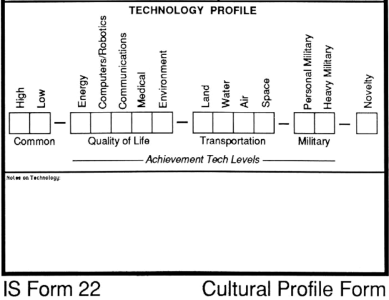
From MegaTraveller, Referee's Manual, p.21:
View attachment 7431
View attachment 7433

Seeing as this is not a CT-only thread...
From the Traveller Wiki entry for Tech Level:

“Technology is the ability to use tools to make other tools. Technology Level, or Tech Level and commonly abbreviated TL, is a measure of technological capability and sophistication. A world's tech level is the degree of technological expertise, and thus the capabilities of local industry.

The Tech Level of a world determines the type, quality, and sophistication of the products commonly available on a world in urban areas or near the starport. Large areas of the world away from the starport or away from large population centers may be one or even two Tech Levels lower.

Tech Level also indicates the general ability of local technology to repair or maintain items which have failed or malfunctioned.”
 
While it looks like we have plenty of options, at the present, to somehow get from point Ay to point Bee, we tend to have to figure out if we're getting the maximum bang for our buck.

In Traveller, once you have basic fusion reactors at technological level eight, it sort of doesn't matter at the macro scale, since cheap and abundant power becomes available.

How that's utilized at the micro end, might be a tad more tricky.

Conversion of matter into a more energy digestible form, that relies on cheap, in our case, basically free, power, is more of a matter which is more convenient.

Battery technology might not be available that can get a certain mileage out of a given investment, so the choice might be hydrogen, ethanol, or algae derived forms of transportable power.

As a reflection of the present, more efficient means to squeeze out energy from current resources.
 
Think about Atmosphere: A-C type worlds with Fluid Oceans that are not composed of H2O, but from other molecular substances.
Well, I guess much will depend on what are those fluid oceans made of. Hydrogen may be taken from other soruces than water, for what I know...

And, in any case, I guess in those not-friendly worlds most people live in domes, and personal transport is less needed than mass transport, where pure electrical means are less an issue, so I mostly think on friendly ones, where people roams free on the atmosphere with personal (utilitarian) means.

Hydrogen is NOT quick to refuel. It's also ridiculously expensive (in the real world).
Take your usual petroleum fuel price and multiply it by 6-10x (or more!) and that's the typical hydrogen refueling station price.

But, as you say yourlef above in the post, with ample and cheap power and better superdense materials for storage, this will no longer be the case.
Zaragoza, Spain you say?

Yes
You no longer need to make an overnight stay in Zaragoza at a (low power) destination charger before completing your road trip between Barcelona and Madrid. Simply plan for a 30 minutes (or less) charging session at the Supercharger station (get out of the vehicle, stretch your legs, use the water closet, get a drink, etc.) before resuming your journey. So ... 6-8 hours in an electric vehicle too.

Well, you can really have a good lunch in Zaragoza, as food is good there ;) ...

Nonetheless, unless this has also improved, those quick charges burn the batteries quite faster than slow ones, and they are the most expensive part of your car...
Fuel Cells have their niche roles, including Air Independent Propulsion (AIP) in non-nuclear power submarines(!) while submerged ... but they aren't a panacea and they aren't "best in slot" for every single use case where you need power. However, those use cases tend to be in "challenging environments" (such as in space or submerged in the ocean) rather than in terrestrial vehicles (cars, busses, trains, etc.).

Well, I see it the opposite way: once those problems are solved, fuel cells are the default for small power plants (car, motorcycle, small to medium planes, etc.) in friendly planets, while batteries are the alternative when they may have problems (including non-friendly plantets, though they will use colosed environments and so less such personal transport). Both have issues, but I see easier to solve and probably cheaper...

By the way, may I ask you a favor? Try to avoid using so many acronyms, as they make reading it slower for those of us not used to them (not to tell if English is not your native language, as it's my case).
 
The trouble is that right now (in the real world)

I trust you knowledge in current real world, but here we're also talking about Travller universe, and that's what I mean when I talk about superdense materials and cheap power to produce Hydrogen...

As I said before, your information/knowledge on this subject is out of date.

I already warned you this might be the case...

With modern (last 5 years?) battery management systems, quick charging no longer imposes a "penalty" on battery life ... which is basically what you're asserting.

And yet, I'm warned by people who (unlike me) claims to know about the issue not to recharge batteries too often if I want them to last...

And as for the question of "how soon will autonomous driving become a reality?" ... well ... the answer is ... SOON™ ...

From the engineering point of view, maybe, from the legal one, I'm not so sure...
 
An alternative to hydrogen for portable fuel is ammonia, specifically anhydrous ammonia. In terms of Traveller, you can get this almost directly from many gas giants as it's already present in the atmosphere. That means it takes little energy other than to collect and filter it to make it into a fuel.
 
If you look at that gray tractor, "none" of those parts can be made locally. They all need specialty manufacturing. No one is going to pound any of those parts out at a blacksmith.

Nobody builds carburetors in their garage (not those types of garages). Can someone mate a foreign carburetor salvaged from another machine? Oh, for sure (with obvious caveats). That's a different problem. But making one out of raw materials, not so much. That requires specialty manufacturing not just for the carb body, but for the small parts, the jets, the springs. About the only thing that might be more locally available is the gaskets if you can find some suitable gasket material (but those also require specialty manufacturing -- tree bark likely won't work).

You might be able to make one with foundry that can cast the body, then machine out the holes and such, but even that it likely above a typical machinist.

Then, of course, there's the tubing...
Showing my age here. I saw this when it was first broadcast. We all know gaskets are easily available from common kitchen supplies:
 
hate to jump in, but:

Technological level also indicates the general ability of local technology to repair or maintain items which have failed or malfunctioned.

reading between the lines, that could support the supposition of higher TL around the port. It does not say absolute ability. Why I like the latter world building stuff (outside of CT so not directly applicable) where TLs for specific industries can vary a bit.

Anyway, I feel the use of general implies there can be some variety.
Am I the only person here who uses extended TLs from DGP's Grand Census?

1773431020235.png
 
Back
Top