Same.That'd be great if they were compatible, but HG and LBB2 are two different animals. Between the two I prefer LBB2.
But Marc seems to prefer Bk 5...

Same.That'd be great if they were compatible, but HG and LBB2 are two different animals. Between the two I prefer LBB2.
IN THE US: You can't copyright a table of formula output; if you have non-formulaic entries, you can copyright the table.I think that the inconsistencies in the drive table in Book 2 '81 are intentional (except possibly the 2000-DTon 'J' entry). Somebody sat down and re-did the table between '77 and '81, and they chose those numbers. They were obvious informed by a pattern, but chose to break it, for whatever reason(s).
Among other reason I believe this, ex-GDW staff have said that they'd often publish tables that had an entry that didn't quite match the rest (rounded the 'wrong' way, or the like) so that they could more easily prove someone had plagiarised their work. They were not 'purists' when it came to formulas in their games, so if they wanted better performance for large ships than the formula suggested, the formula lost.

I found where I'd gone over this before -- it starts about the 11th page of my Gypsy Queen Fast Merchant (199Td, J2/6G/Pn7, LBB2) thread.From the work I've done a type Z drive "should" cap out at 4800 dTons, if you're projecting the drive table to be a strictly linear progression.
View attachment 7620
At the top you have a drive table based on the idea that each drive's potential increases by 200 for each 5 dTons the drive increase in size.
the red highlights indicates where the table deviates from CT. As you can see everything above type "X" deviates from the paradigm.
Don't get me wrong there's nothing wrong with that, except that size and cost-wise these drive follow the usual progression. So they end up being vastly more effective cost and size wise.
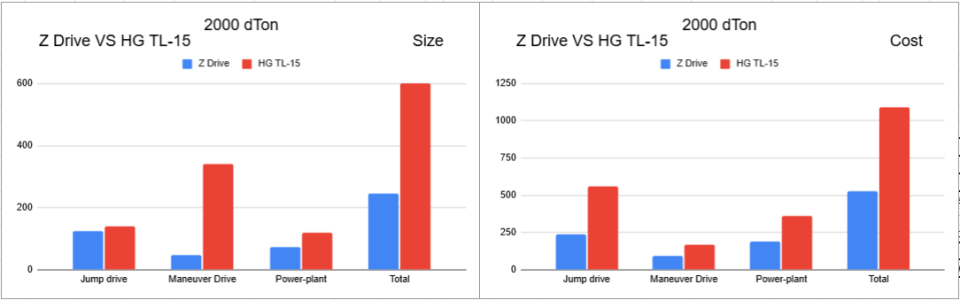
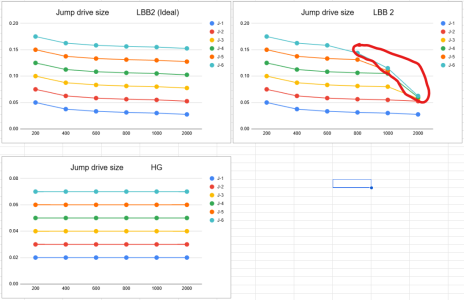
Take the type Z drive, in a 2000 dTon hull it gives performance 6, but is only 125 dTons for J-6 or 6.25% of the ship's volume. Compare this with 20% for a 100 dTons ship, 17.5% for a 200 dTon ship, 16.25% for a 400 dTon ship, and 15.625% for a 800 dTon ship. The cost savings are equally out of line. A type Z drive in a 2000 dTon hull is stupidly broken.
I understand they were trying to give some engine options for the larger ships, but they should have increased the price and size to be "correct" for the performance given. For a type Z drive to give that level of performance it would need a potential of 12,000. Which would give the performance you project, but the cost and size would need to be much higher.
View attachment 7619
... and this is why it may have seemed reasonable to stuff bonus performance into the last 4 (TL-15) drives. There wasn't going to be anything else "interesting" in that part of the table.So you would have basically the bottom 4 rows of the table being identical, with the last one being all dashes. Wasted space.

High Guard is not the same paradigm as LBB:2, the similarity and mixing within the setting causes a lot of contradictions and needless hanwacery.I'll just point out that they did fix the thing - they changed it in High Guard, and the jump drive size formula from HG remained current in MT, TNE, T4, T20, and GT at the least (I don't have a copy of Hero Traveller to check, and don't feel like trying to work out what T5 is saying).
Different iteration had their differences, Minimum size for jump engines differs across editions, minimum hull size differs in some cases, amount of fuel required, the need for an equal sized power plant that sort of thing.Then MgT1 went back to LBB2 (but not exactly) with HG percentages for large ships, which seemed like a step backwards to me.
MgT2 uses fixed percentages, HG-style, but rather bigger ones (2.5% x Jn + 5 DTons, rather than HG's 1% x (Jn+1)). At least it's consistent across ship size.
I feel like this was a solved problem for over 25 years, and then for some reason it was decided to unsolve it, and then sort of solve it again.
This can not have been intentional.No, what I am saying is people are arguing for something the authors intended, it was no mistake hence they did not change the table despite having multiple opportunities to do so.
There is no error in the drive tables, they are exactly as the author intended.
Those engines are TL15, the best engines in the game, hence their superior performance.
Every few years someone thinks they have rediscoverd a secret formula - did so my self about twenty years ago - but there is no evidence at all the drive tables were ever any more than a look up table with numbers made up by the authors to fit the pattern they wanted, no formula involved, and no mistakes as far as they were concerned.
One day I would like to ask Marc if he can tell us what went so wrong with the HG release, There are issues with HG77 but most could have been fixed without the complete re-write.Or lighting HG '79 on fire, and giving away the entire HG '80 supplement in JTAS..."for free".
Yes, I think it is intentional and that you are making the same mistake I did and others have done in thinking tha patterns I see could be fixed in my ideal version of the drive table. The author's obviously intende the TL15 drives to be superior to tje lower TL drives. Your analysis, similar to the one I hid decades ago, is looking for linear profression where the authors intended scale efficiency and a non linear progression...<snip>
And you think this is intentional?
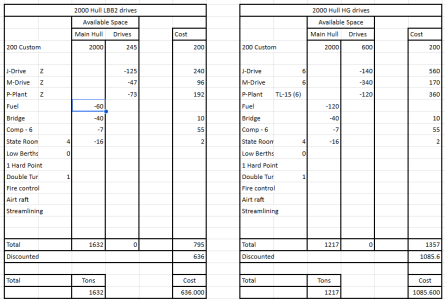
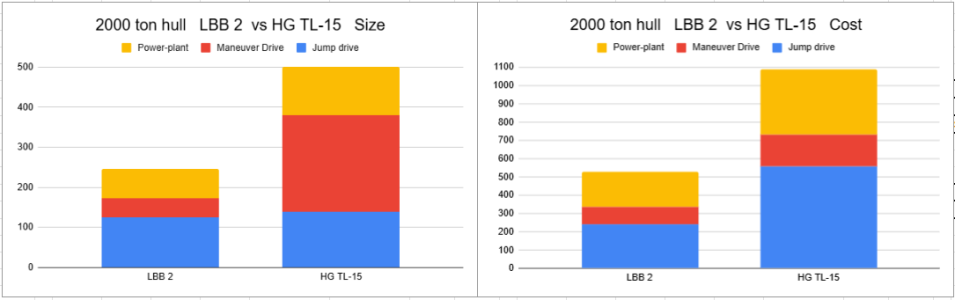
Stuffing bonus performance into it is one thing, but there's nothing to indicate the drives are TL-15, infact they far exceed TL-15 performance size and cost wise. And neither Jump Drives nor Maneuver drives get smaller or cheaper at higher TLs. Powerplants do get cheaper, but only because they get smaller, and the TL-15 powerplants in High Guard are nowhere near as small or cheap. All together they are substantially cheaper and smaller than a HG equivalent.... and this is why it may have seemed reasonable to stuff bonus performance into the last 4 (TL-15) drives. There wasn't going to be anything else "interesting" in that part of the table.
What says these drives are TL-15? Where? In which book? In what Errata?Yes, I think it is intentional and that you are making the same mistake I did and others have done in thinking tha patterns I see could be fixed in my ideal version of the drive table. The author's obviously intende the TL15 drives to be superior to tje lower TL drives. Your analysis, similar to the one I hid decades ago, is looking for linear profression where the authors intended scale efficiency and a non linear progression...