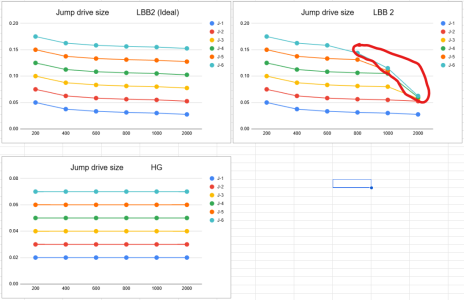
From the work I've done a type Z drive "should" cap out at 4800 dTons, if you're projecting the drive table to be a strictly linear progression.
View attachment 7620
At the top you have a drive table based on the idea that each drive's potential increases by 200 for each 5 dTons the drive increase in size.
the red highlights indicates where the table deviates from CT. As you can see everything above type "X" deviates from the paradigm.
Don't get me wrong there's nothing wrong with that, except that size and cost-wise these drive follow the usual progression. So they end up being vastly more effective cost and size wise.
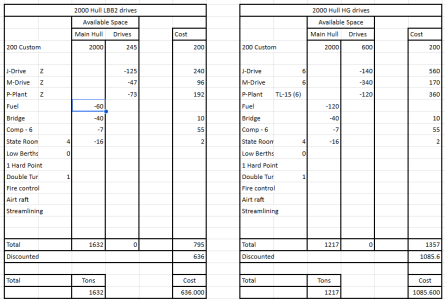
Take the type Z drive, in a 2000 dTon hull it gives performance 6, but is only 125 dTons for J-6 or 6.25% of the ship's volume. Compare this with 20% for a 100 dTons ship, 17.5% for a 200 dTon ship, 16.25% for a 400 dTon ship, and 15.625% for a 800 dTon ship. The cost savings are equally out of line. A type Z drive in a 2000 dTon hull is stupidly broken.
I understand they were trying to give some engine options for the larger ships, but they should have increased the price and size to be "correct" for the performance given. For a type Z drive to give that level of performance it would need a potential of 12,000. Which would give the performance you project, but the cost and size would need to be much higher.
View attachment 7619