

Black Vulmea
SOC-12
Alternate title: Playing With Myself . . . IN SPAAACE! :hehe:
About seven or eight months ago, I started playing a solo "classic" Traveller Beltstrike campaign. Beltstrike is a module for running asteroid mining in a system in the Spinward Marches, but I've been using Judges Guild's Gateway Quadrant of four sectors - Ley, Maranatha-Alkahest, Glimmerdrift Reaches, and Crucis Margin - as my Traveller setting for something like two decades now. I'm fond of the JG Traveller stuff for a number of reasons, not least among which they were officially de-canonized by GDW so anyone who wants to argue Charted Space lore with me can pound sand - the final authorities are Dave Sering and me, and no one else.
Mostly I like the JG sectors because they're free of the deep layers of cruft that accumulated around the Marches, and the Imperium, in the forty-plus years since they were released. The JG books feel raw and unexploited - virgin territory, as it were - and I like the Imperium and the regions beyond that they describe.
The Setting
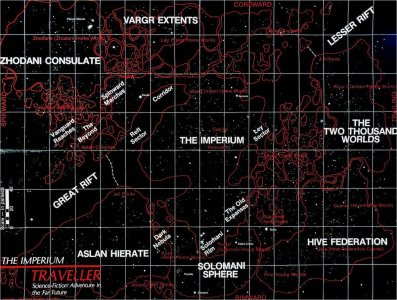
Like the Spinward Marches, which appeared in print a year before Ley Sector, each subsector is a list of mainworld UWPs with a brief bit of history and current events; they also contain short lists of rumors and encounters, and more detailed descriptions of a handful of worlds. GDW's Beltstrike is set in the Bowman belt, beyond the spinward border of the Third Imperium; for my campaign, I chose the Reaginworld belt - C000422 B As Ni, for you Traveller fans - sitting just inside the trailing border of Ley Sector, on the edge of the Lesser Rift.
The belt is a demarchy, a participatory democracy inspired by Joan D. Vinge's 1978 novel The Outcasts of Heaven Belt; I threw in a double heaping tablespoon of HBO's Deadwood for good measure, and a pinch of ancient Athens for flavor. To make a participatory democracy in which every decision of note requires a vote of the whole electorate work, the demarchy has a sophisticated communications system which allows those who "wear the sash" - members of the electorate wear a steel-grey sash - to be polled anywhere in the belt. There are temporary committees, filled by lot each year, which oversee various contractors who perform the actual services of government on behalf of the demarchy. Justice is administered by miners' juries, assembled once again by lot; beyond fairly strict regulations governing mining claims, much of what passes for law is based on custom.
A pair of industrial worlds are found two and three parsecs away from the belt respectively, providing a ready market for ore; it would seem like these two worlds would quickly swamp the belt to control its resources, but both are only recently classified, by the Second Survey, as Hi In and both planets have enough resources in their own inner and outer systems presently to make control of the belt a can to be kicked down the road for the moment. The belt primary is a flare star, but its flares are not particularly intense; during the early centuries of the Imperium, prospectors and pirates alike played up the intensity of the flares to discourage nosy travellers. About a hundred years ago, a university in a nearby system set up an observatory in the inner system which predicts flares and provides warnings; flares are more of a nuisance than a hazard, provided one takes proper safeguards.
The belt itself fills the inner orbits of the system, thanks to the inward migration of a large gas giant disrupting early planet formation. It's dense and compact, with only one dwarf planet, Reagin's World, site of the largest station and the system's class C starport.
The Characters
I described Ree and Lishda elsewhere, so I won't belabor them here. Lish is on detached duty, giving her access to a scout/courier, which the couple used to travel to the belt, doing some small scale trading along the way, and prospect asteroids.
The plan was to use asteroid mining as a means of raising a stake to buy a small freighter, do some trading among with Riftworlds after a few years - Lishda worked in IISS Operations for most of her career, developing a credible business sense in the process.
They have succeeded wildly beyond their expectations . . . and mine . . .
The Adventure . . . So Far . . .
The first part of the campaign involved travelling seven jumps to reach the belt from the base where Lish was stationed in her last years in the Scouts. This was mostly uneventful, save for one lucrative small cargo of protective suits which netted them a few million credits, giving them a substantial stake; they were well equipped when they finally arrived and started prosepcting.
They made a couple of small strikes, avoided serious injury to themselves or their ship, and then stumbled on the rock that changed their lives - and the scope and direction of my campaign. Lish was ready to sell the claim and buy a big freighter - frankly, I was too - but Ree balked at the idea of selling the claim to a big corporation which would lock up the ore until some schedule in an office in another star system a dozen parsecs away decided it was time to exploit it. He grew up rough and poor and he feels a sense of responsibility about these things. I found it hard to argue with his point of view, as I played through it in my head.
So instead of game of prospecting, I now had a campaign of mining.
They recruited a small team of miners, bought a shelter to house them, and spent ten weeks mining ore - they sold some in the belt starport, transported the rest to one of those industrial worlds. Then they came back and did it again, with a bigger team, and again with a bigger team, increasing their profits with each ten-week contract.
In between contracts, Lish used the credits they earned to buy trade goods on those industrial worlds and ship them; when the opportunity came up to buy six displacement tons of platinum ("refined precious metal"), she had nowhere near enough credits on hand, but using the mine as collateral, she obtained a loan, bought the platinum, then sold it for a sector duke's ransom, leaving her enough to put down payments on three long-legged trading ships which should be completed in a couple of in-game years.
They've faced barroom brawls, pickpockets, Solomani racial purists, and a hostile miner they fired for stirring up trouble. They fought claimjumpers, once at their own mine, once defending another belter's claim; when that belter died, they hired his daughter, took her with them to visit other worlds, and plan to put her through school so she can make something of herself. They aided a stricken freighter. They were recruited by the Imperial Navy to act as bait to draw out pirates, critically damaging one boat and driving off another when the destroyer escort that was supposed to be shadowing them was too far away to protect them. Ree joined the rescue service and was part of a team that discovered a plague ship. They learned they were targeted along with other mining operations in the belt by a sector-wide consortium seeking to control the belt's resources for the future. They're presently dealing with a news service correspondent who's trying to paint them as offbelt agents for a megacorp or maybe the Imperium itself. Their modular habitat will be done in a few weeks, giving them an actual station of their own, and the mill ship for processing PGMs - platinum group metals - will be ready soon . . . then they'll start selling their very own precious metal. They've made friends and rivals, and they're well on their way to becoming patrons, rather than looking for them.
They plan to stand for citizenship soon.
Behind the Screen
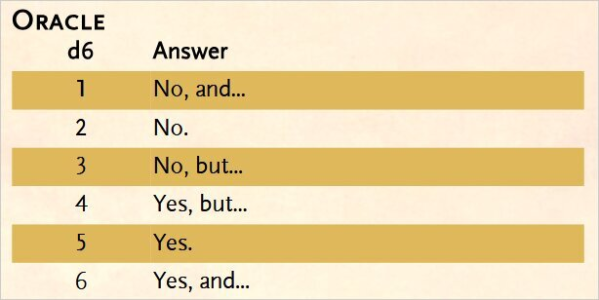
In another post, I'll get into the rules, the oracle I'm bouncing ideas off of, what actually playing looks like, and a very brief meditation on adventure gaming and playing the endgame FIRST . . . and then what happens next.
About seven or eight months ago, I started playing a solo "classic" Traveller Beltstrike campaign. Beltstrike is a module for running asteroid mining in a system in the Spinward Marches, but I've been using Judges Guild's Gateway Quadrant of four sectors - Ley, Maranatha-Alkahest, Glimmerdrift Reaches, and Crucis Margin - as my Traveller setting for something like two decades now. I'm fond of the JG Traveller stuff for a number of reasons, not least among which they were officially de-canonized by GDW so anyone who wants to argue Charted Space lore with me can pound sand - the final authorities are Dave Sering and me, and no one else.
Mostly I like the JG sectors because they're free of the deep layers of cruft that accumulated around the Marches, and the Imperium, in the forty-plus years since they were released. The JG books feel raw and unexploited - virgin territory, as it were - and I like the Imperium and the regions beyond that they describe.
The Setting
Like the Spinward Marches, which appeared in print a year before Ley Sector, each subsector is a list of mainworld UWPs with a brief bit of history and current events; they also contain short lists of rumors and encounters, and more detailed descriptions of a handful of worlds. GDW's Beltstrike is set in the Bowman belt, beyond the spinward border of the Third Imperium; for my campaign, I chose the Reaginworld belt - C000422 B As Ni, for you Traveller fans - sitting just inside the trailing border of Ley Sector, on the edge of the Lesser Rift.
The belt is a demarchy, a participatory democracy inspired by Joan D. Vinge's 1978 novel The Outcasts of Heaven Belt; I threw in a double heaping tablespoon of HBO's Deadwood for good measure, and a pinch of ancient Athens for flavor. To make a participatory democracy in which every decision of note requires a vote of the whole electorate work, the demarchy has a sophisticated communications system which allows those who "wear the sash" - members of the electorate wear a steel-grey sash - to be polled anywhere in the belt. There are temporary committees, filled by lot each year, which oversee various contractors who perform the actual services of government on behalf of the demarchy. Justice is administered by miners' juries, assembled once again by lot; beyond fairly strict regulations governing mining claims, much of what passes for law is based on custom.
A pair of industrial worlds are found two and three parsecs away from the belt respectively, providing a ready market for ore; it would seem like these two worlds would quickly swamp the belt to control its resources, but both are only recently classified, by the Second Survey, as Hi In and both planets have enough resources in their own inner and outer systems presently to make control of the belt a can to be kicked down the road for the moment. The belt primary is a flare star, but its flares are not particularly intense; during the early centuries of the Imperium, prospectors and pirates alike played up the intensity of the flares to discourage nosy travellers. About a hundred years ago, a university in a nearby system set up an observatory in the inner system which predicts flares and provides warnings; flares are more of a nuisance than a hazard, provided one takes proper safeguards.
The belt itself fills the inner orbits of the system, thanks to the inward migration of a large gas giant disrupting early planet formation. It's dense and compact, with only one dwarf planet, Reagin's World, site of the largest station and the system's class C starport.
The Characters
I described Ree and Lishda elsewhere, so I won't belabor them here. Lish is on detached duty, giving her access to a scout/courier, which the couple used to travel to the belt, doing some small scale trading along the way, and prospect asteroids.
The plan was to use asteroid mining as a means of raising a stake to buy a small freighter, do some trading among with Riftworlds after a few years - Lishda worked in IISS Operations for most of her career, developing a credible business sense in the process.
They have succeeded wildly beyond their expectations . . . and mine . . .
The Adventure . . . So Far . . .
The first part of the campaign involved travelling seven jumps to reach the belt from the base where Lish was stationed in her last years in the Scouts. This was mostly uneventful, save for one lucrative small cargo of protective suits which netted them a few million credits, giving them a substantial stake; they were well equipped when they finally arrived and started prosepcting.
They made a couple of small strikes, avoided serious injury to themselves or their ship, and then stumbled on the rock that changed their lives - and the scope and direction of my campaign. Lish was ready to sell the claim and buy a big freighter - frankly, I was too - but Ree balked at the idea of selling the claim to a big corporation which would lock up the ore until some schedule in an office in another star system a dozen parsecs away decided it was time to exploit it. He grew up rough and poor and he feels a sense of responsibility about these things. I found it hard to argue with his point of view, as I played through it in my head.
So instead of game of prospecting, I now had a campaign of mining.
They recruited a small team of miners, bought a shelter to house them, and spent ten weeks mining ore - they sold some in the belt starport, transported the rest to one of those industrial worlds. Then they came back and did it again, with a bigger team, and again with a bigger team, increasing their profits with each ten-week contract.
In between contracts, Lish used the credits they earned to buy trade goods on those industrial worlds and ship them; when the opportunity came up to buy six displacement tons of platinum ("refined precious metal"), she had nowhere near enough credits on hand, but using the mine as collateral, she obtained a loan, bought the platinum, then sold it for a sector duke's ransom, leaving her enough to put down payments on three long-legged trading ships which should be completed in a couple of in-game years.
They've faced barroom brawls, pickpockets, Solomani racial purists, and a hostile miner they fired for stirring up trouble. They fought claimjumpers, once at their own mine, once defending another belter's claim; when that belter died, they hired his daughter, took her with them to visit other worlds, and plan to put her through school so she can make something of herself. They aided a stricken freighter. They were recruited by the Imperial Navy to act as bait to draw out pirates, critically damaging one boat and driving off another when the destroyer escort that was supposed to be shadowing them was too far away to protect them. Ree joined the rescue service and was part of a team that discovered a plague ship. They learned they were targeted along with other mining operations in the belt by a sector-wide consortium seeking to control the belt's resources for the future. They're presently dealing with a news service correspondent who's trying to paint them as offbelt agents for a megacorp or maybe the Imperium itself. Their modular habitat will be done in a few weeks, giving them an actual station of their own, and the mill ship for processing PGMs - platinum group metals - will be ready soon . . . then they'll start selling their very own precious metal. They've made friends and rivals, and they're well on their way to becoming patrons, rather than looking for them.
They plan to stand for citizenship soon.
Behind the Screen
In another post, I'll get into the rules, the oracle I'm bouncing ideas off of, what actually playing looks like, and a very brief meditation on adventure gaming and playing the endgame FIRST . . . and then what happens next.


 detector is pretty good after all these years at discerning the difference between stuff that's important to Actual Play and stuff that's just me wanking around with the setting. Whatever I write as prep, even if I'm creating background at the 4000 m level, should have direct implications for what the adventurers experience during the game. Here's an example from years back of what that looks like for me when I start from the top down: given


