• Welcome to the new COTI server. We've moved the Citizens to a new server. Please let us know in the COTI Website issue forum if you find any problems.
  • We, the systems administration staff, apologize for this unexpected outage of the boards. We have resolved the root cause of the problem and there should be no further disruptions.

Making heads and tails out of Imperial nobility

Letter of Patent (Title)

Charter (Powers and Rights)

Sovereignty (Ave Imperator)

So your Patent is your title, the Charter is the narrow confines of your exclusive Rights or Priviledges, and Sovereingty is from where your authority is derived and can be revoked.

So as you can see, being Noble is not expansive universal power. Your influence (position, the value of your vote, the quantity of votes you can command, the infrastructure you administer) is not completely in line with your Title. Your Daddy can be a Baront (Letter of Patent) with a Charter to establish and operate a Bank, your Daddy is the Right Honourable (Surname), and you are The Honourable (Surname). Until the Title and Charter are transferred (typically post mortem) as the son, people are polite, but know you can't do a damn thing.
 
The canonical lesser barons hold their power for their moot vote, not for rulership. They acquire wealth from graft (legal bribes), influence peddling, and for whatever their fief produces.

IMTU, I give the nobles one perquisite not in canon: interstellar charters require a nobleman's sponsorship, and they get a 1% stake for it. Part of ship registry is paying the noble; he gets his chunk, and the IISS gets an equivalent chunk, as does the navy. All nicely handled by the yard

Further, most of the main fiefs are the starport, IMTU. Gives some teeth to the extrality zone. And income. And visibility. And an excuse to have supremely armed huscarles to augment port security.
 
No one has brought up The Traveller Adventure yet.

The Marquis of Aramis owns and rules the only city on Aramis.

A Tukera baron owned Lewis, but had to sell of some land to pay debts. They now want the land back.

"Lewis was, indeed, entirely owned by the Tukeras for quite some time, but, about 150 years ago, a Tukera baron in need of funds was forced to sell off some of the family lands to outside settlers. This community flourished for quite some time; recently, the family has been attempting to
recover those lands and the ownership of the world. After several unsuccessful efforts to force the independent settlers to sell out, Tukera interests at Court (with the support of Marquis of Aramis) have managed to have the planet interdicted.
A special access dispensation allows family members to come and go as they please, but all trade and outside contact has been cut off, isolating the settlers. So far they have shown an amazing degree of self-sufficiency, but the Tukera family still believes that the increasing hardships
of this isolation will eventually compel them to give up and sell their land."

So yes, canon supports Imperial nobles owning and governing worlds.
 
Last edited:
No one has brought up The Traveller Adventure yet.

The Marquis of Aramis owns and rules the only city on Aramis.

A Tukera baron owned Lewis, but had to sell of some land to pay debts. They now want the land back.

"Lewis was, indeed, entirely owned by the Tukeras for quite some time, but, about 150 years ago, a Tukera baron in need of funds was forced to sell off some of the family lands to outside settlers. This community flourished for quite some time; recently, the family has been attempting to
recover those lands and the ownership of the world. After several unsuccessful efforts to force the independent settlers to sell out, Tukera interests at Court (with the support of Marquis of Aramis) have managed to have the planet interdicted.
A special access dispensation allows family members to come and go as they please, but all trade and outside contact has been cut off, isolating the settlers. So far they have shown an amazing degree of self-sufficiency, but the Tukera family still believes that the increasing hardships
of this isolation will eventually compel them to give up and sell their land."

So yes, canon supports Imperial nobles owning and governing worlds.

True. But the question is, how prevalent is it, relatively speaking, in the post "proto-Imperium"? Is it the norm for fief-holding nobility, or is this just an example of a small handful of one-offs in which personal property was acquired through the normal means of private land purchase?

Or is the prevalence somewhere in between?
 
The Traveller Adventure is not proto-Imperium, it post dates the changes of Library Data and The Traveller Book that redefined the Imperium.
It doesn't provide any similar information for any other worlds, which can be read either as most or only a tiny few. Given that the one Archduchy is noted in Atlas as being a paersonal feifdom of seven worlds, I suspect strongly that planet as fief is pretty rare; it's worth noting other sources don't mention this peculiarity of Aramis, either. It's not called out in S3, nor in FFC.

Behind the Claw dials back the ownership:
Behind the Claw said:
The population is contained in the tunnel city of Leedor, which is the personal fief of the marquis of Aramis. The main occupation is governmental bureaucracy for the subsector and technicians in the starport, naval base and scout base.
Just the tunnel city. All the population, but just the city. It does note the government as a technocracy "headed by the marquis of Aramis." Not a direct government by the marquis. Subtle distinctions between being head of government and being an absolute ruler.

Just another of many "Exemplars of the abnormal" that are common in CT. Beltstrike is another exemplar of abnormality. Heck, given the world gen rules, so is Tarsus.
 

Royal Charter​

A royal charter is a legal instrument granted by the sovereign, usually on advice from the Privy Council, that gives an organization legal personality and defines its powers and constitution. It is about the body that receives it, not about whether someone is noble.

Noble title​

A noble or peerage title is a separate system of status and rank, usually inherited or granted to a person, not created by a charter. So a person born into nobility typically inherits or uses a title by right or courtesy, rather than “getting” a charter.

Courtesy titles​

Courtesy titles are used by some children or heirs of peers, but they are not substantive peerages. The title is used socially by custom, while the actual peer still holds the real title.

Coat of arms​

A coat of arms is also separate from a royal charter. Arms are granted under the Crown’s heraldic authority, and can be held by individuals, families, or organizations; they do not require noble rank.college-of-arms+2

Simple rule​

  • Noble title = rank/status of a person.
  • Royal charter = legal grant to an institution.
  • Courtesy title = traditional style used by relatives of a peer.
  • Coat of arms = heraldic emblem granted under heraldic authority.privycouncil.independent+3
If you want, I can next give you a one-page “medieval-to-modern” explanation of how these all relate in the UK system.
 
  • Courtesy title = traditional style used by relatives of a peer.

But note that the Imperial System is more similar to certain European Systems (like Ancien Regime France or Old Germany or Tsarist Russia) in this regard, rather than the UK System. ALL children of Nobles in the Imperium use a title derived from the level of the parent at one level lower, and are considered noble themselves, (presumably as part of the honor or legacy nobility). They are not "commoners" (i.e. Gentry - the equivalent of gentlemen thru baronets) with courtesy titles . Imperial Knights and Baronets are Nobles, but not Peers, and not Imperial Gentry (though some may argue that Unlanded Knights & Nobles overlap with Imperial Gentry).

In fact, the Imperial Baronet enjoys a closer relationship to the Imperial Baron in many ways than to the Knights & Gentry, and Imperial Barons may also in fact not always be Peers, depending on the source of their title (Archduke or Emperor), and the nature of any enfeoffment they hold. The eight "Baronages" of the Imperium (Imperial and Archducal, including both Baronets & Barons, and used slightly differently from Medieval usage) are not comprised of Nobles who are automatically Peers. Of the eight, ONLY the Imperial Baronage has Peers among its membership among those at the Baronial level, and generally only those who are Landed.

In the Imperium, "Peer" does not equal "Noble", just as it often did not in France or Germany or Spain. The younger son of an Imperial Landed Viscount may be refered to as a Marquis. He is Noble. It is not a substantive title - it is an Honor title and courtesy title. He is not a Peer.
 
Last edited:

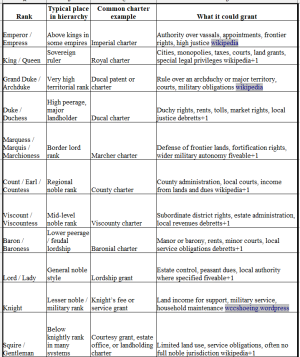
BTW, Your table is missing "Lord Marcher", similar in function to the continental Margrave/Markgraf/Marquis, but more fluid in precedence and predating the 1378 introduction of the British Peerage title "Marquess" as a reward by Kings for Earls when they did not wish to make them a Duke (a newly introduced prestige title for Royal-relatives at the time).
 
Responsibilities, powers and perquisites.

A lot depends on the actual percentage of the population who have inherited titles, at any one time.

Too many, and the distributed pie slice starts looking rather thin.


iu
 
Responsibilities, powers and perquisites.

A lot depends on the actual percentage of the population who have inherited titles, at any one time.

Too many, and the distributed pie slice starts looking rather thin.
Note that familial titles are not heritable (see library data essay on nobles), so don't generationally accrue, unless accompanied by a lesser title.
Essentially, family "honor titles" are not by patent, and reward nobles are non-heritable patents. So only the titled patents are perpetual.

One other thing about Marquis Aramis.. the title holder is also a megacorporate heir, holding an important amount of Tukera lines as personal stock, probably more as title-held stock. He's also holding the subsector capital and may be the defacto acting duke. Tho' for a capital, it's quite remote to the majority of worlds in the subsector. I can't check at the moment for total authority... but subsector titles are the start of the 3I power.
 
For the Third Imperium, it really looks feudal.

Techno feudal.

You have sort of two needs coming together.

The need of the State for capable and loyal administrators.

And capable administrators who want to be recognized and rewarded, and get a headstart for their progeny.

The administrators get a stake in the existing system, and become perpetuators of it.

And need the requisite resources to do so.
 
Back
Top