• Welcome to the new COTI server. We've moved the Citizens to a new server. Please let us know in the COTI Website issue forum if you find any problems.
  • We, the systems administration staff, apologize for this unexpected outage of the boards. We have resolved the root cause of the problem and there should be no further disruptions.

Evaluation of Kinunir colonial cruiser on the MONGOOSE High Guard Update 2022

Even so, if you have 7 targets to detect (targets that, without gravitics, give a high IR image), you have nearly 7 times the probablility to detect at least one than if you have a single one...

Jump capsules are right in Heinlein's word, where there are no gravitics, but, IMHO, gravitics give you quite better options.
But the gravitics themselves are detectable, and require power (also that's detectable as well). However, compared to aerobraking that's fairly low signature, especially if the opposition on the ground isn't very high tech, and thus doesn't have good gravitic sensors.

Note that if you use gravitics (or anything else) to remove orbital velocity so you can fall down nice and quietly, you need about 15 minutes at 1-G, or equivalent, to get rid of your velocity (more if you'd like the option of the launching ship not having to actually drop to orbital velocity, but rather be able to be a quick fly-by). Depending on rules set, that may not be trivial, and thus you might end up with something not unlike a drop capsule anyway, especially once you add stealth, a bit of armour, 15+ minutes of life support and cooling, and so on.

This is not to say that I think it's a good idea. The Portable Re-entry Kit as a piece of emergency equipment is one thing, with higher TL versions having more grav and less "I really hope the ablative foam set right", but using it or drop capsules for actual opposed drops strikes me as unlikely to do more than leave your assault troops splattered around in little dents in the landscape. And if the drop is not opposed, you can just ride down in a nice comfy shuttle.
 
"Grav Belt (TL12) Cr100,000, negligible weight if on; 10 kg if turned off. Personal anti-gravity transportation using a single null-gravity module and a personal harness. Performance is similar in speed and range to the air/raft."

So what are we told about speed and range for the air/raft:

"TL8 - An air/raft (grav belt) can cruise at 100 kph (but is extremely subject to wind effects), with some capability of higher speed to about 120 kph. An air/raft (grav belt) can reach orbit in several hours (number of hours equal to planetary size digit in the UPP"
that is speed and capability taken care of, if it can reach orbit it can descend from orbit.
How about duration?
"Range in time or distance on a world is effectively unlimited, requiring refueling from a ship's power plant every ten weeks or so."

So I don't think the TL12 has any difficulty in doing what the TL8 air/raft does for performance and duration.
It's something I've always thought was interesting - CT in the original LBBs had grav craft immediately replace all else at TL8, and gave them great endurance (ten weeks doing anything they were capable of in 1981, 'unlimited' in 1977). Then they got chopped back constantly - '81 already cuts back endurance from 'unlimited' to 'ten weeks'. Book 4 (1978, so shortly after the original LBBs were published) puts military replacement of ground vehicles with grav back to TL10, with limited user of air/rafts at TL8-9. Striker further cuts endurance - at TL8 a 4 ton grav vehicle capable of 120 kph needs 0.144 Tons of fuel per hour (and 1.16 tons of grav modules and MHD plant), if it carried nothing but fuel (no chassis, no seats, just lifters, power plant, and fuel) it could fly for about 20 hours. One that could carry four people and four tons of cargo wouldn't manage more than about 6 hours. Batteries are good for about 1.4 hours at TL8, 4.55 hours at TL12. Fusion's out for air/rafts until TL13 due to minimum plant size.

MegaTraveller just goes straight to TL15, gives even air/rafts a fusion plant, and gets 60 days endurance. It's probably not doable at TL12, but TL12 batteries might get you 12-14 days duration, so not too bad (still nothing like ten weeks, though). MT says grav belts have 4 hours power at TL12, 8 hours at TL15 (and gives them vastly higher maximum speed than an air/raft - 300 kph).

TNE has TL10 air/rafts with ~14 hours endurance, TL12 models with about the same, and TL15 models with 100 hours of thrust and a month of power (and a cheaper model with only 46 hours of propellant for thrust), but they can do up to 300 kph. Grav belts have 2 hours duration, and 300 kph maximum speed (they weigh a lot when turned off, too).

T20 says '1 week' for duration. Grav belts get 4 weeks endurance, and 120 kph maximum speed (as does the air/raft).

GURPS Traveller gives us a (Traveller)TL15 air/raft with 10 years power and 160 miles per hour top speed (~200 kph). The base book doesn't list grav belts, so I looked at GURPS 3e Ultra-Tech. A grav belt would be available from (Traveller)TL9 onwards, but it'd require a lot of batteries to get half-decent endurance.

MgT2 doesn't give endurance, but we can work back from the given speeds and ranges. For an air/raft (TL8) this gives 7.5 hours at 200 kph, and 3.33 hours at 300 kph. A grav belt is good for 200 kph and 4 hours at TL12, 12 hours at TL15.

Overall, aside from GT, post-LBB versions nerf air/raft endurance a little or a lot, probably largely as a side-effect of using design sequences intended to disallow grav tanks with infinite endurance at ridiculous speeds.

 
If there is a sensor that can detect gravitics based tech - null grav modules, lifters, artificial gravity, acceleration compensation, m-drives - I have never seen it defined as such that I can recall.
 
If there is a sensor that can detect gravitics based tech - null grav modules, lifters, artificial gravity, acceleration compensation, m-drives - I have never seen it defined as such that I can recall.

I always assumed the mass detectors did but I don’t know that it’s explicitly RAW.

The assumption is based on the concept that gravitics is inherently interacting/interfering with detectable gravity waves. Therefore not only do you ‘see’ something happening, but enough gathering of data will identify it as artificial in origin.
 
Last edited:
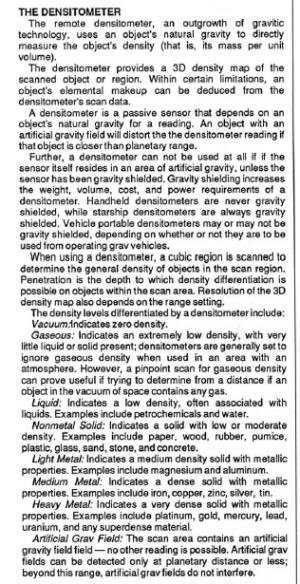
I guess the game that better secribes Densiometers is MT, not sure if they are even described or used in other versions (I'm petty sure not in CT).

In RM (page 87) their use in space combat is described to pinpoint the target, but not to detect it, so (IMHO) hinting they are directionaland not used in this way.

In SOM (page 19) they are better defined, and it's told they can have some problems due to artificial gravities, mostly if they are on one such fields, but, again, des not talk as them to be usable to detect gravitic tech devices.
 
So it doesn't detect gravitics, it is scrambled by them.

There is a definite gap in the sensor market for something that can detect gravitics - that is the technology based on the artificial "gravity" that the null grav module is the first to utilise.
 
So it doesn't detect gravitics, it is scrambled by them.
Sounds like it can detect them to me. It can't, perhaps, distinguish between a grav belt and an air raft, but it can detect that something is there (being that there's not a lot of gravitic anomalies in nature, it's probably an OK indicator that something "high tech" is "over there".
 
Back
Top