• Welcome to the new COTI server. We've moved the Citizens to a new server. Please let us know in the COTI Website issue forum if you find any problems.
  • We, the systems administration staff, apologize for this unexpected outage of the boards. We have resolved the root cause of the problem and there should be no further disruptions.

Evaluation of Kinunir colonial cruiser on the MONGOOSE High Guard Update 2022

Or use smaller small craft as G/Carrrier replacements. They can do anything the G/Carriers can do, but in space too.

You could squeeze in three of something like these:
Skärmavbild 2026-03-22 kl. 22.46.41.png
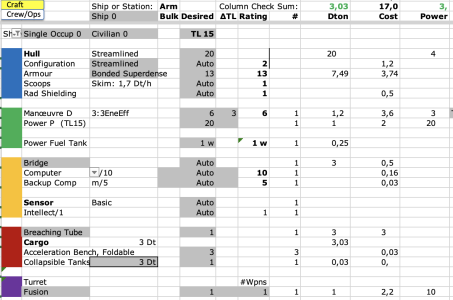
20 Dt, 6 G, Armour 13, big fusion gun.
Accel Benches for 12 people, Breaching Tube for boardings.
Crew: Two in a bridge.
 
The mistake to make here is the idea that the specialization of roles is so complete as to EXCLUDE being able to perform other roles. Just because your squad specializes in mechanized maneuver doesn't mean that you completely "forget" what to do during a boarding operation or an orbital drop by capsule. Instead, you've got 3 squads of "grunts" and each squad has specialists in it for each of the 3 roles, divided up by squad. It's a little bit like have a squad of instructors/experts in each role, who can then share their training/expertise/experience with the other squads who specialize in different tactical contexts. That way, you've always got "3 squads of marines" at your disposal AND 1 of those squads is always a specialist in whatever you need doing (so they take point on whatever the mission is).

It's actually a reasonably elegant solution to the question of how to organize a small detachment of marines aboard ship who can provide "infantry support" regardless of the situational context. You just need to recognize what you're looking at.
Except that the squads also only have the equipment for their specialist role (I would assume plus general light infantry kit) - there's only one squad's worth of battle dress and FGMPs, only one squad's worth of drop capsules, and only one squad's worth of grav lift vehicle capacity.

The TO of the platoon is not very different from the 'standard' in LBB4 (which pre-dates A1, by the way), and is also similar to that shown in LBB7 - the main difference is in having a larger command 'section' and having the liaison that stays on the ship part of the troops' TO.
 
Last edited:
I think we can all agree that Adventure One is a bit of an odd duck with a number of questionable bits.

That said, actually all the Marines on Kinunir regardless of squad are said to have Combat Rifleman skill regardless of whatever other particular skills they have. So, they can all act together as a standard rifle platoon if desired and so equipped.

We're told their arms room has 12 PGMP-13s, 12 ACRs, 24 auto pistols, 24 snub pistols, 12 SMGs, 3 LMGs, 3 laser carbines and 2 RAM auto-GLs.
 
  • Like
Reactions: ady
I can't even verbalize how stupid having the entire command element in a single vehicle is.
Command vehicles have been used since ww2 and are still popular in many armies today.. It could be an armoured air/raft packed with advanced sensors, meson com gear, ECM, battle computers. etc, carrying stuff that is to heavy for battledress to have?
 
Except that the squads also only have the equipment for their specialist role (I would assume plus general light infantry kit) - there's only one squad's worth of battle dress and FGMPs, only one squad's worth of drop capsules, and only one squad's worth of grav lift vehicle capacity.

The TO of the platoon is not very different from the 'standard' in LBB4 (which pre-dates A1, by the way), and is also similar to that shown in LBB7 - the main difference is in having a larger command 'section' and having the liaison that stays on the ship part of the troops' TO.
It could be that the battledress and weapons listed are what is the basic standard load. The Kinunir had a cargo bay, that could be used to carry additional gear, armor and weapons, especially if a particular mission is in mind.
 
Command vehicles have been used since ww2 and are still popular in many armies today.. It could be an armoured air/raft packed with advanced sensors, meson com gear, ECM, battle computers. etc, carrying stuff that is to heavy for battledress to have?
I understand the need for a command vehicle and I understand the need for additional equipment. What I don't understand is why the entire command team would travel together.
 
The command squad is not every officer and NCO, the latter are distributed to the fire teams.

The command squad is usually the CO, a comms specialist, and two body guards/gofers. The one described in A:1 has many peculiarities.

It is notiicable that there are far more officers than a platoon would usually require - A:1 has a CO and then an officer for each section - it is also rather too well stocked with senior NCOs. Is this a typical Marine platoon or is it a special forces detachment?

"Normally" a section has a section leader, one of whom is the platoon senior NCO, each section will then have an NCO, and each 4 man squad a junior NCO.
 
Last edited:
Command vehicles have been used since ww2 and are still popular in many armies today..
Story back in the Warsaw Pact days, as I'm told, was US Army doctrine was when you see the armored column coming down the road, kill the tank with all the antennas on it first.
 
What I don't understand is why the entire command team would travel together.
The 4 person air/raft makes it possible for the leadership to mobilize by gravitics independently from the GCarrier.
It's not that they're REQUIRED to travel together ... but that if they NEED to travel together, they CAN.
In the end, I don't really understand the meaning of "a trio of modified ship’s boats that could serve all roles". I'll just decide not to worry about it.
What it means is a (false!) assumption that replacing:
  • 1x 35 ton Pinnace
  • 1x 8 ton GCarrier
  • 1x 4 ton Air/Raft
  • 5x 1 ton Jump Capsule Launch Tubes (includes 1x Jump Capsule each)
  • 10x 0.5 ton additional Jump Capsules
    • = (35*1.3)+8+4+(1*5)+(10*0.5) = 67.5 tons combined displacement
With 3x 30 ton Ship's Boats (90 tons combined displacement) is both "a better option" and one which incurs no downstream secondary effects elsewhere in the overall starship design spreadsheet.

First, the tonnage equivalency is wrong.
67.5 does not equal 90.

Second, eliminating the Jump Capsule Launch Tubes removes the option of deploying infantry to world surfaces without detection.
Spoiler alert ... a (stock) 30 ton Ship's Boat lacks the signature reduction necessary to slip past sensor networks. 🤫
Jump Capsules for infantry, particularly when high tech (TL=F) cannot even be detected by the launching craft.

LBB A1, p29:
Capsules: The jump capsules on A Deck are intended for assault on a planetary surface as the ship maintains a high orbit for its own protection; the ship also provides fire support for the capsules as they descend, and after the battle begins. Each capsule weighs about 2 tons, and can carry one jump trooper. It is capable of limited maneuver as it descends; after making a relatively soft landing, it breaks open to release the individual inside, and self-destructs.
Capsules contain a large variety of electronic anti-detection equipment, and the chance that one will be detected while entering atmosphere is almost zero; if properly manipulated, the capsule cannot even be detected by its launching ship.

So the Jump Capsules are a way to stealthily insert an infantry squad "quietly" without detection (covering fire from the launching craft is optional with regards to timing). It's like the ultimate "paratrooper" deployment ... except the craft you're departing from IS IN ORBIT rather than flying in atmosphere.
I'll just decide not to worry about it.
Good choice. (y)
 
The command squad is not every officer and NCO, the latter are distributed to the fire teams.

The command squad is usually the CO, a comms specialist, and two body guards/gofers. The one described in A:1 has many peculiarities.

It is notiicable that there are far more officers than a platoon would usually require - A:1 has a CO and then an officer for each section - it is also rather too well stocked with senior NCOs. Is this a typical Marine platoon or is it a special forces detachment?

"Normally" a section has a section leader, one of whom is the platoon senior NCO, each section will then have an NCO, and each 4 man squad a junior NCO.

I would assume marine special forces. One riot one Kininur. Or VIP extraction/small raid or ortillery spotting.
 
The command squad is not every officer and NCO, the latter are distributed to the fire teams.

The command squad is usually the CO, a comms specialist, and two body guards/gofers. The one described in A:1 has many peculiarities.

It is notiicable that there are far more officers than a platoon would usually require - A:1 has a CO and then an officer for each section - it is also rather too well stocked with senior NCOs. Is this a typical Marine platoon or is it a special forces detachment?

"Normally" a section has a section leader, one of whom is the platoon senior NCO, each section will then have an NCO, and each 4 man squad a junior NCO.
A normal Commonwealth infantry structure today for light infantry (i.e. no organic vehicles) has an Platoon OC (Officer Commanding), generally a Lieutenant.

Then there's a 'command section' which is the Platoon Sergeant (usually a Sergeant), medic, signaler/runner, and any extra runners, clerks and other extras. Any attached 'dets' such as mortar teams, support MG dets, etc. get plugged in here as well. The Platoon Sergeant is nominally in charge of this, but they're often split up and under direct control of the OC (the sig), running round on their own initiative (the medic), or attached to other sections (any MG dets).

And then we have the meat of the unit: The rifle sections. There are three, of 8-12 (usually ideally 10) soldiers. Each section (in a 'model' unit) might consist of (this is typical of the NZ Army, in the 1990s):

Section Commander - Corporal
Section 2IC - Lance Corporal
Lead Scout
Cover Scout (also grenadier)
Signaler (assuming radios too heavy for the section commander to carry it themselves)
Gunner
Assistant Gunner (may be the 2IC if it's a LMG/SAW)
Riflemen 1+

A larger or smaller section has a greater or lesser number of riflemen. In the event of a contact, the section breaks into a 'support group' of: 2IC, machinegun, and scouts. The rest, under the commander is the 'assault group'. Support provides support fire, the assault group does just that (and gives cover should the MG, etc. need to move).

When the platoon is on the march, generally one section leads, followed by the OC and sig/runner, then another section, then the platoon sergeant, medic, and other extras, and then finally the last section. However, the platoon sergeant is likely to move around the formation, keeping an eye on things, and in particular probably actually marches close to a radio if there's nowhere else they need to be.

Obviously, better comms will change this somewhat, and a motorised or mechanised unit will also change things around. Most of the changes will be dictated by how many soldiers can fit in each vehicle. If the G-carriers fit 10, and that's how big the section's dismounted strength is, there can't be ride-alongs, and the command section is probably all going to be in one vehicle (ideally a 4th G-carrier). If, on the other hand, there's room for ride-alongs, the OC and driver, clerk/runner, etc. might be in an air/raft, while the platoon sergeant goes with which section he things he'll be most useful with.

Note that if the unit is professional and well-trained, losing the platoon sergeant and OC at once won't be a huge problem in terms of command and control. For lesser units, it might be (but the kind of armies in which it would be tend not to have well-trained NCOs, so losing the OC and not the platoon sergeant might not help them much).

 
Never mind that the Adventure One Marine platoon bears no relationship or resemblance to the JTAS #12 Imperial Marine platoon done by LKW.

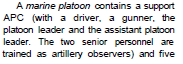
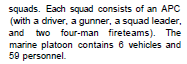
View attachment 7482
View attachment 7483
Well, now you get to decide if the earlier source (LBB A1, published 1979) remains correct and canon in the face of a later (1981) source, when that later source is a journal. How authoritative is a JTAS article, compared to an 'adventure'?

One thing that's consistent - that the CO and 2IC are in the same vehicle.
 
The larger issue would be if the Kinunir class is actually relevant in terms of overall ship design.

I wouldn't waste a complete platoon of Marines on it.
 
Back
Top