The command squad is not every officer and NCO, the latter are distributed to the fire teams.
The command squad is usually the CO, a comms specialist, and two body guards/gofers. The one described in A:1 has many peculiarities.
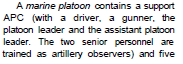
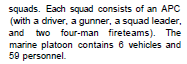
It is notiicable that there are far more officers than a platoon would usually require - A:1 has a CO and then an officer for each section - it is also rather too well stocked with senior NCOs. Is this a typical Marine platoon or is it a special forces detachment?
"Normally" a section has a section leader, one of whom is the platoon senior NCO, each section will then have an NCO, and each 4 man squad a junior NCO.
A normal Commonwealth infantry structure today for light infantry (i.e. no organic vehicles) has an Platoon OC (Officer Commanding), generally a Lieutenant.
Then there's a 'command section' which is the Platoon Sergeant (usually a Sergeant), medic, signaler/runner, and any extra runners, clerks and other extras. Any attached 'dets' such as mortar teams, support MG dets, etc. get plugged in here as well. The Platoon Sergeant is nominally in charge of this, but they're often split up and under direct control of the OC (the sig), running round on their own initiative (the medic), or attached to other sections (any MG dets).
And then we have the meat of the unit: The rifle sections. There are three, of 8-12 (usually ideally 10) soldiers. Each section (in a 'model' unit) might consist of (this is typical of the NZ Army, in the 1990s):
Section Commander - Corporal
Section 2IC - Lance Corporal
Lead Scout
Cover Scout (also grenadier)
Signaler (assuming radios too heavy for the section commander to carry it themselves)
Gunner
Assistant Gunner (may be the 2IC if it's a LMG/SAW)
Riflemen 1+
A larger or smaller section has a greater or lesser number of riflemen. In the event of a contact, the section breaks into a 'support group' of: 2IC, machinegun, and scouts. The rest, under the commander is the 'assault group'. Support provides support fire, the assault group does just that (and gives cover should the MG, etc. need to move).
When the platoon is on the march, generally one section leads, followed by the OC and sig/runner, then another section, then the platoon sergeant, medic, and other extras, and then finally the last section. However, the platoon sergeant is likely to move around the formation, keeping an eye on things, and in particular probably actually marches close to a radio if there's nowhere else they need to be.
Obviously, better comms will change this somewhat, and a motorised or mechanised unit will also change things around. Most of the changes will be dictated by how many soldiers can fit in each vehicle. If the G-carriers fit 10, and that's how big the section's dismounted strength is, there can't be ride-alongs, and the command section is probably all going to be in one vehicle (ideally a 4th G-carrier). If, on the other hand, there's room for ride-alongs, the OC and driver, clerk/runner, etc. might be in an air/raft, while the platoon sergeant goes with which section he things he'll be most useful with.
Note that if the unit is professional and well-trained, losing the platoon sergeant and OC at once won't be a huge problem in terms of command and control. For lesser units, it might be (but the kind of armies in which it would be tend not to have well-trained NCOs, so losing the OC and not the platoon sergeant might not help them much).