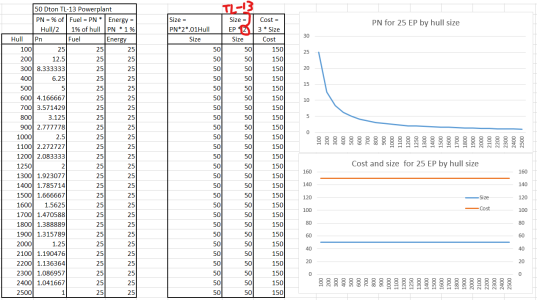
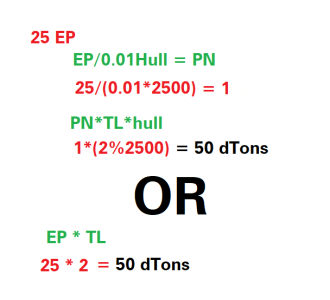
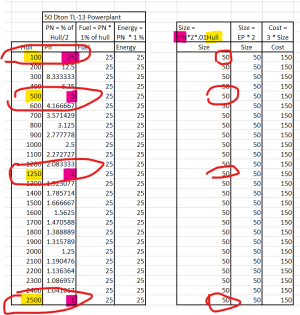
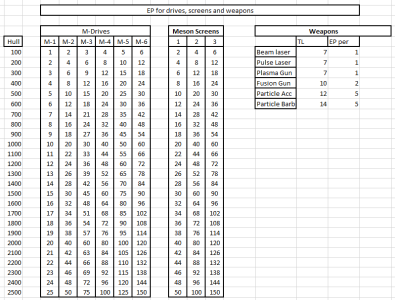
This is actually the system that I use (nowadays) for calculating particulars of starship construction.
Old way:
- Work out what fraction of hull tonnage = what USP code number for drives
- LIMIT yourself to ONLY those USP code integer breakpoints as the ONLY possible "answers" available
- Play TETRIS with that limited set of options to assemble what you want/need
New way:
- Work out what you want/need FIRST
- "Reverse engineer" your way to determining what sizing of drives will deliver the performance you're needing
- AFTER determining your drive tonnages ... work out what USP code value that computes to, dropping fractions to produce integer values
Simplest example of this is if you need EP=10 in a 300 ton big craft ... because 10 doesn't divide by 3 "neatly" no matter how much you try.
Regardless of tech level ... a power plant generating 10 EP in a 300 ton hull produces a USP code for the power plant of "3" ... and an annotation of "EP=10" in the notations of the stat block.
For purposes of combat damage results, here's how that would "degrade" if damage hits to power plant are taken in a 300 ton big craft that can generate EP=10:
- Pn -0: EP=10
- Pn -1: EP=6 (lose 4 EP off maximum)
- Pn -2: EP=3 (lose 3 EP more off maximum)
- Pn -3: EP=0 (power plant can no longer generate any EP)
In other words, the "drive performance when damaged" is limited to the minimum allowed by (reduced by damage) USP code factors.
It's actually SIMPLER to run the math in this direction (what do you need, work out the "drop fractions" USP coding at the end) rather than the original way (determine USP coding FIRST, work with what that gives you exclusively). It streamlines a lot of issues and makes the "downstream determinations" a LOT simpler to work with.
Best of all, using a "work out the USP coding later on" methodology makes it SO MUCH EASIER to calculate things like how drive performance modifies under variable loading of displacement tonnage (such as L-Hyd Drop Tanks).

If you KNOW (ahead of time, because you're planning ahead) that you're going to be building a 400 ton craft that need to be capable of mounting 100 tons of external load (drop tanks, demountable tanks, sub-craft, whatever...) then it becomes very simple to determine "I need this much drive tonnage to reach THAT performance code at these two tonnage displacement thresholds" ... and then you can simply use the "bigger" of the two requirements to get what you need, rather than trying to "resize the hull" to make everything fit in ways that work out EXACTLY for the USP coding required by the two tonnage displacement options.
It requires "doing the math backwards" from how it has traditionally been ordered (USP code first, drive sizes derive from that choice of code) and it opens up a wider range of possible options (work out needed drive sizes for desired performance first, calculate USP codes after).
It goes without saying that this "doing the math backwards" has proven very useful in my own Pondering Starship Evolution thread, since it meant that I didn't need to be "limited" to exact integer results for USP coding. I could work out "tonnage ranges" in which drive performance codes computed out to integer values ... and then work from there.
LBB2.81 standard Drive-D (TL=9):
- Code: 1 @ 401-800 tons
- Code: 2 @ 267-400 tons
- Code: 3 @ 200-266 tons
- Code: 4 @ 161-200 tons
- Code: 5 @ 134-160 tons
- Code: 6 @ 115-133 tons
Those ranges of (combined) tonnages producing what USP code performance output can then be used to determine things like external load limits for different (main) hull sizes.

- If I've got a 279 ton starship hull with D/D/D drives ... that falls into the Code: 2 performance range.
- If I add 121 tons of external load to the 279 ton starship hull with D/D/D drives ... 279+121=400 (combined) tons ... and still falls into the Code: 2 performance range.
- But if I added 122 tons of external load to the 279 ton starship hull with D/D/D drives ... 279+122=401 (combined) tons ... and would therefore drop into the Code: 1 performance range.
LBB2.81 standard Drive-H (TL=A):
- Code: 1 @ 801-1600 tons
- Code: 2 @ 534-800 tons
- Code: 3 @ 400-533 tons
- Code: 4 @ 321-400 tons
- Code: 5 @ 267-320 tons
- Code: 6 @ 229-266 tons
Those ranges of (combined) tonnages producing what USP code performance output can then be used to determine things like external load limits for different (main) hull sizes.
- If I've got a 409 ton starship hull with H/H/H drives ... that falls into the Code: 3 performance range.
- If I add 121 tons of external load to the 409 ton starship hull with H/H/H drives ... 409+121=530 (combined) tons ... and still falls into the Code: 3 performance range.
- But if I added 125 tons of external load to the 409 ton starship hull with H/H/H drives ... 409+125=534 (combined) tons ... and would therefore drop into the Code: 2 performance range.
This same computational determinism can be done with any external loads (drop tanks, demountable tanks, sub-craft, etc.) and opens up a wider range of possibilities for starship construction than just "multiples of 100 tons ONLY" when designing classes.