• Welcome to the new COTI server. We've moved the Citizens to a new server. Please let us know in the COTI Website issue forum if you find any problems.
  • We, the systems administration staff, apologize for this unexpected outage of the boards. We have resolved the root cause of the problem and there should be no further disruptions.

Considering alternate world generation

To me it would be more straight forward to have a powerplant that is X size, makes X amount EP, and uses X amount of fuel.
LBB5.80 actually DOES this ... but you need to reverse engineer the math (kind of like how I did with CT Beltstrike) in order to realize it.

Under LBB5.80 construction rules, no matter the tonnage and/or code number of the power plant ... the (construction) minimum fuel requirement for the power plant is going to be 1 ton of fuel per EP the power plant can generate. This is true at all tech levels.

Small craft can go below this limit, but still have a 1 ton of fuel lower bound minimum requirement.
The modification for small craft (because they can't jump) is that they need to be capable of 24 hours (1 day) of endurance, minimum (CT Errata, p15).
 
Last edited:
LBB5.80 actually DOES this ... but you need to reverse engineer the math (kind of like how I did with CT Beltstrike) in order to realize it.

Under LBB5.80 construction rules, no matter the tonnage and/or code number of the power plant ... the (construction) minimum fuel requirement for the power plant is going to be 1 ton of fuel per EP the power plant can generate. This is true at all tech levels.

Small craft can go below this limit, but still have a 1 ton of fuel lower bound minimum requirement.
The modification for small craft (because they can't jump) is that they need to be capable of 24 hours (1 day) of endurance, minimum (CT Errata, p15).
It does, and it doesn't. The construction process obfuscates it. And building a ship sometimes becomes a bit of a trial and error process. For example if you are building toward a goal, say you want a ship with a with a Meson gun or Particle Accelerator, you know you need 500 or 1000 EP, but It's not immediately apparent what size powerplant you need to support it. But with a list of drives showing EP output or a Formula to figure drive size and cost directly from EP output it is much more straight forward.

Using HG you have to factor in Hull size, which is IMHO largely irrrelevant for Powerplant output, and you have to go thru PN to get to size and cost. And PN is largely irrelevant afterwards. Size can be calculated more directly as 1 ton per EP (times TL modifier) and cost can be calculated from size.

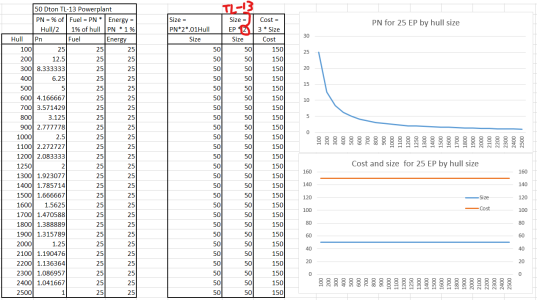
Considering the theoretical 25 EP powerplant from before, the PN varies by Hull size, but the the Size and Cost is always the same. As you can see size and cost are the same either way you calculate them, but it's faster and simpler to cut out the PN and Hull and work directly from the EP.


1772002215544.png
 
It does, and it doesn't. The construction process obfuscates it. And building a ship sometimes becomes a bit of a trial and error process. For example if you are building toward a goal, say you want a ship with a with a Meson gun or Particle Accelerator, you know you need 500 or 1000 EP, but It's not immediately apparent what size powerplant you need to support it. But with a list of drives showing EP output or a Formula to figure drive size and cost directly from EP output it is much more straight forward.
There's an easier way than guessing at power plant ratings.

You can basically run the calculations backwards to get your required power plant rating rather than using an estimated rating to determine your power available. You sum up your power requirements (simple addition - screens, computer, weapons, etc) and add the power required by your desired agility (0.01 x Hull tonnage x Agility) and that's your required power. Then your power plant rating is power required/(0.01 x Hull tonnage). Tonnage comes from your power plant rating normally, and then cost from your tonnage. And you can round up or retain fractions as you like, though the fractional values are lost in the USP. You could do this manually, of course, but I'm not that old school. And a spreadsheet program does the math for you, and lets you duplicate a sheet for a ship, then change a few particulars and get a modified spreadsheet that you can keep separately.
 
There's an easier way than guessing at power plant ratings.

You can basically run the calculations backwards to get your required power plant rating rather than using an estimated rating to determine your power available. You sum up your power requirements (simple addition - screens, computer, weapons, etc) and add the power required by your desired agility (0.01 x Hull tonnage x Agility) and that's your required power. Then your power plant rating is power required/(0.01 x Hull tonnage). Tonnage comes from your power plant rating normally, and then cost from your tonnage. And you can round up or retain fractions as you like, though the fractional values are lost in the USP. You could do this manually, of course, but I'm not that old school. And a spreadsheet program does the math for you, and lets you duplicate a sheet for a ship, then change a few particulars and get a modified spreadsheet that you can keep separately.

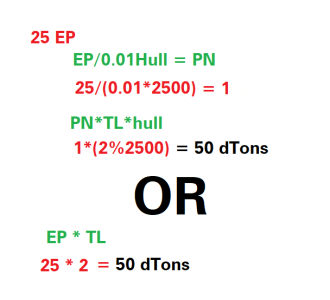
But running the calculation backward is so much easier if you cut out the HULL and PN calculation which are largely irrelevant to Power plants.
That's what I was showing with the example, for a 2500 dton ship on one hand you can calculate the PN as 25EP = 25/(hull/100) = PN 1 and then Drive size as PN 1 = 1 * (.02*2500) = 50 dTons. And on the other hand you can calculate the drive size directly from the EP as EP * TL modifier or 25 *2 = 50

1772008033379.png
Essentially you are dividing by 0.1hull to get PN and then multiplying by .01Hull again later to get the size of the drive, easier to omit the hull entirely and skip the intermediate step of calculating PN.

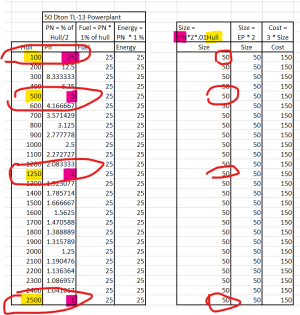
For any ship with 25 EP the drive is always going to be the same size—regardless of PN, and regardless of Hull size.
Back to the example, all these ships are different sizes and have different PNs but when using the same size drive they end up with the same number of EPs.

Because the result for size will always be the same regardless of hull size it is much easier, much simpler to calculate the drive size base sole off of EPs.

EP * TL modifier is very simple and does not need a spreadsheet.

1772009362577.png
 
But running the calculation backward is so much easier if you cut out the HULL and PN calculation which are largely irrelevant to Power plants.
That's what I was showing with the example, for a 2500 dton ship on one hand you can calculate the PN as 25EP = 25/(hull/100) = PN 1 and then Drive size as PN 1 = 1 * (.02*2500) = 50 dTons. And on the other hand you can calculate the drive size directly from the EP as EP * TL modifier or 25 *2 = 50
I think we're both running the same calculations? I've just recorded my intermediate steps, like PN. And as I said, I plan my ships on a spreadsheet, so I don't need simpler math, it just needs to get the answers. I can see that you can derive Power Plant mass from EP requirement directly by Mass of Power Plant = EP reqmt x TL PP mass multiplier, eliminating the PN, but I need the PN for the USP so I need the number anyhow. My M drive tonnages are an IF() statement, if drive rating is 1, MDrive percentage is 2%, if drive rating is 2, MDrive percentage is 5%, etc. I just enter my desired thrust number and agility rating (and Hull Size, Jump Number, etc) and numbers fall out. My MDrive formula then crunches out the percentage times the hull size for MDrive tonnage. Jump Drive, bridge size, armor, everything is calculated by the spreadsheet and I can see if everything fits, how much cargo space is left, and so on.
 
Because the result for size will always be the same regardless of hull size it is much easier, much simpler to calculate the drive size base sole off of EPs.

EP * TL modifier is very simple and does not need a spreadsheet.
This is actually the system that I use (nowadays) for calculating particulars of starship construction.

Old way:
  • Work out what fraction of hull tonnage = what USP code number for drives
  • LIMIT yourself to ONLY those USP code integer breakpoints as the ONLY possible "answers" available
  • Play TETRIS with that limited set of options to assemble what you want/need
New way:
  • Work out what you want/need FIRST
  • "Reverse engineer" your way to determining what sizing of drives will deliver the performance you're needing
  • AFTER determining your drive tonnages ... work out what USP code value that computes to, dropping fractions to produce integer values
Simplest example of this is if you need EP=10 in a 300 ton big craft ... because 10 doesn't divide by 3 "neatly" no matter how much you try.
Regardless of tech level ... a power plant generating 10 EP in a 300 ton hull produces a USP code for the power plant of "3" ... and an annotation of "EP=10" in the notations of the stat block.

For purposes of combat damage results, here's how that would "degrade" if damage hits to power plant are taken in a 300 ton big craft that can generate EP=10:
  • Pn -0: EP=10
  • Pn -1: EP=6 (lose 4 EP off maximum)
  • Pn -2: EP=3 (lose 3 EP more off maximum)
  • Pn -3: EP=0 (power plant can no longer generate any EP)
In other words, the "drive performance when damaged" is limited to the minimum allowed by (reduced by damage) USP code factors.


It's actually SIMPLER to run the math in this direction (what do you need, work out the "drop fractions" USP coding at the end) rather than the original way (determine USP coding FIRST, work with what that gives you exclusively). It streamlines a lot of issues and makes the "downstream determinations" a LOT simpler to work with.

Best of all, using a "work out the USP coding later on" methodology makes it SO MUCH EASIER to calculate things like how drive performance modifies under variable loading of displacement tonnage (such as L-Hyd Drop Tanks). 😮‍💨

If you KNOW (ahead of time, because you're planning ahead) that you're going to be building a 400 ton craft that need to be capable of mounting 100 tons of external load (drop tanks, demountable tanks, sub-craft, whatever...) then it becomes very simple to determine "I need this much drive tonnage to reach THAT performance code at these two tonnage displacement thresholds" ... and then you can simply use the "bigger" of the two requirements to get what you need, rather than trying to "resize the hull" to make everything fit in ways that work out EXACTLY for the USP coding required by the two tonnage displacement options.

It requires "doing the math backwards" from how it has traditionally been ordered (USP code first, drive sizes derive from that choice of code) and it opens up a wider range of possible options (work out needed drive sizes for desired performance first, calculate USP codes after).

It goes without saying that this "doing the math backwards" has proven very useful in my own Pondering Starship Evolution thread, since it meant that I didn't need to be "limited" to exact integer results for USP coding. I could work out "tonnage ranges" in which drive performance codes computed out to integer values ... and then work from there.


LBB2.81 standard Drive-D (TL=9):
  • Code: 1 @ 401-800 tons
  • Code: 2 @ 267-400 tons
  • Code: 3 @ 200-266 tons
  • Code: 4 @ 161-200 tons
  • Code: 5 @ 134-160 tons
  • Code: 6 @ 115-133 tons
Those ranges of (combined) tonnages producing what USP code performance output can then be used to determine things like external load limits for different (main) hull sizes. 💡
  • If I've got a 279 ton starship hull with D/D/D drives ... that falls into the Code: 2 performance range.
  • If I add 121 tons of external load to the 279 ton starship hull with D/D/D drives ... 279+121=400 (combined) tons ... and still falls into the Code: 2 performance range.
  • But if I added 122 tons of external load to the 279 ton starship hull with D/D/D drives ... 279+122=401 (combined) tons ... and would therefore drop into the Code: 1 performance range.


LBB2.81 standard Drive-H (TL=A):
  • Code: 1 @ 801-1600 tons
  • Code: 2 @ 534-800 tons
  • Code: 3 @ 400-533 tons
  • Code: 4 @ 321-400 tons
  • Code: 5 @ 267-320 tons
  • Code: 6 @ 229-266 tons
Those ranges of (combined) tonnages producing what USP code performance output can then be used to determine things like external load limits for different (main) hull sizes. 💡
  • If I've got a 409 ton starship hull with H/H/H drives ... that falls into the Code: 3 performance range.
  • If I add 121 tons of external load to the 409 ton starship hull with H/H/H drives ... 409+121=530 (combined) tons ... and still falls into the Code: 3 performance range.
  • But if I added 125 tons of external load to the 409 ton starship hull with H/H/H drives ... 409+125=534 (combined) tons ... and would therefore drop into the Code: 2 performance range.


This same computational determinism can be done with any external loads (drop tanks, demountable tanks, sub-craft, etc.) and opens up a wider range of possibilities for starship construction than just "multiples of 100 tons ONLY" when designing classes.

 
PN on the USP still has it's problems, especially when it come to damage. It over-values a powerplant hit on large ships when compared to small ships. The 2500 ton ship will in the example above can only take one powerplant hit before it's completely disabled. A 500 Ton ship can take 5 hits and a 200 ton Ship can take 12 hit on the power plant. It's the same power plant in each case, but the effect is greatly magnified on larger ships.


I think we're both running the same calculations? I've just recorded my intermediate steps, like PN. And as I said, I plan my ships on a spreadsheet, so I don't need simpler math, it just needs to get the answers. I can see that you can derive Power Plant mass from EP requirement directly by Mass of Power Plant = EP reqmt x TL PP mass multiplier, eliminating the PN, but I need the PN for the USP so I need the number anyhow. My M drive tonnages are an IF() statement, if drive rating is 1, MDrive percentage is 2%, if drive rating is 2, MDrive percentage is 5%, etc. I just enter my desired thrust number and agility rating (and Hull Size, Jump Number, etc) and numbers fall out. My MDrive formula then crunches out the percentage times the hull size for MDrive tonnage. Jump Drive, bridge size, armor, everything is calculated by the spreadsheet and I can see if everything fits, how much cargo space is left, and so on.
 
Bottom up math is often more useful.
That's part of the reason I like Book 2 better than HG, It's easier to get to what you want, and to see how changes in ship's size will effect performance. That, and I'm a sucker for charts.

This is actually the system that I use (nowadays) for calculating particulars of starship construction.

Old way:
  • Work out what fraction of hull tonnage = what USP code number for drives
  • LIMIT yourself to ONLY those USP code integer breakpoints as the ONLY possible "answers" available
  • Play TETRIS with that limited set of options to assemble what you want/need
New way:
  • Work out what you want/need FIRST
  • "Reverse engineer" your way to determining what sizing of drives will deliver the performance you're needing
  • AFTER determining your drive tonnages ... work out what USP code value that computes to, dropping fractions to produce integer values
Simplest example of this is if you need EP=10 in a 300 ton big craft ... because 10 doesn't divide by 3 "neatly" no matter how much you try.
Regardless of tech level ... a power plant generating 10 EP in a 300 ton hull produces a USP code for the power plant of "3" ... and an annotation of "EP=10" in the notations of the stat block.

For purposes of combat damage results, here's how that would "degrade" if damage hits to power plant are taken in a 300 ton big craft that can generate EP=10:
  • Pn -0: EP=10
  • Pn -1: EP=6 (lose 4 EP off maximum)
  • Pn -2: EP=3 (lose 3 EP more off maximum)
  • Pn -3: EP=0 (power plant can no longer generate any EP)
In other words, the "drive performance when damaged" is limited to the minimum allowed by (reduced by damage) USP code factors.


It's actually SIMPLER to run the math in this direction (what do you need, work out the "drop fractions" USP coding at the end) rather than the original way (determine USP coding FIRST, work with what that gives you exclusively). It streamlines a lot of issues and makes the "downstream determinations" a LOT simpler to work with.

Best of all, using a "work out the USP coding later on" methodology makes it SO MUCH EASIER to calculate things like how drive performance modifies under variable loading of displacement tonnage (such as L-Hyd Drop Tanks). 😮‍💨

If you KNOW (ahead of time, because you're planning ahead) that you're going to be building a 400 ton craft that need to be capable of mounting 100 tons of external load (drop tanks, demountable tanks, sub-craft, whatever...) then it becomes very simple to determine "I need this much drive tonnage to reach THAT performance code at these two tonnage displacement thresholds" ... and then you can simply use the "bigger" of the two requirements to get what you need, rather than trying to "resize the hull" to make everything fit in ways that work out EXACTLY for the USP coding required by the two tonnage displacement options.

It requires "doing the math backwards" from how it has traditionally been ordered (USP code first, drive sizes derive from that choice of code) and it opens up a wider range of possible options (work out needed drive sizes for desired performance first, calculate USP codes after).

It goes without saying that this "doing the math backwards" has proven very useful in my own Pondering Starship Evolution thread, since it meant that I didn't need to be "limited" to exact integer results for USP coding. I could work out "tonnage ranges" in which drive performance codes computed out to integer values ... and then work from there.


LBB2.81 standard Drive-D (TL=9):
  • Code: 1 @ 401-800 tons
  • Code: 2 @ 267-400 tons
  • Code: 3 @ 200-266 tons
  • Code: 4 @ 161-200 tons
  • Code: 5 @ 134-160 tons
  • Code: 6 @ 115-133 tons
Those ranges of (combined) tonnages producing what USP code performance output can then be used to determine things like external load limits for different (main) hull sizes. 💡
  • If I've got a 279 ton starship hull with D/D/D drives ... that falls into the Code: 2 performance range.
  • If I add 121 tons of external load to the 279 ton starship hull with D/D/D drives ... 279+121=400 (combined) tons ... and still falls into the Code: 2 performance range.
  • But if I added 122 tons of external load to the 279 ton starship hull with D/D/D drives ... 279+122=401 (combined) tons ... and would therefore drop into the Code: 1 performance range.


LBB2.81 standard Drive-H (TL=A):
  • Code: 1 @ 801-1600 tons
  • Code: 2 @ 534-800 tons
  • Code: 3 @ 400-533 tons
  • Code: 4 @ 321-400 tons
  • Code: 5 @ 267-320 tons
  • Code: 6 @ 229-266 tons
Those ranges of (combined) tonnages producing what USP code performance output can then be used to determine things like external load limits for different (main) hull sizes. 💡
  • If I've got a 409 ton starship hull with H/H/H drives ... that falls into the Code: 3 performance range.
  • If I add 121 tons of external load to the 409 ton starship hull with H/H/H drives ... 409+121=530 (combined) tons ... and still falls into the Code: 3 performance range.
  • But if I added 125 tons of external load to the 409 ton starship hull with H/H/H drives ... 409+125=534 (combined) tons ... and would therefore drop into the Code: 2 performance range.


This same computational determinism can be done with any external loads (drop tanks, demountable tanks, sub-craft, etc.) and opens up a wider range of possibilities for starship construction than just "multiples of 100 tons ONLY" when designing classes.
 
PN on the USP still has it's problems, especially when it come to damage. It over-values a powerplant hit on large ships when compared to small ships. The 2500 ton ship will in the example above can only take one powerplant hit before it's completely disabled. A 500 Ton ship can take 5 hits and a 200 ton Ship can take 12 hit on the power plant. It's the same power plant in each case, but the effect is greatly magnified on larger ships.
So, I see where you're going with this, and my numbers agree when I calculate some example systems, but it seems to mainly play out at low thrust rating/agility. This makes sense to me, in that a power plant with barely enough power to light the lights and run things on a much larger ship is more easily reduced to being ineffective, since only a small hit is needed to knock it below the threshhold of providing minimum power. There is no provision for reducing power to parts of the ship, akin to Jump Dimming, so that full power can be allocated somewhere else. This is what would happen in a RL power plant casualty, where low-priority systems would be deactivated to reduce the load and provide power where its most needed. I was not clear on how your system solves this?
 
So, I see where you're going with this, and my numbers agree when I calculate some example systems, but it seems to mainly play out at low thrust rating/agility. This makes sense to me, in that a power plant with barely enough power to light the lights and run things on a much larger ship is more easily reduced to being ineffective, since only a small hit is needed to knock it below the threshhold of providing minimum power. There is no provision for reducing power to parts of the ship, akin to Jump Dimming, so that full power can be allocated somewhere else. This is what would happen in a RL power plant casualty, where low-priority systems would be deactivated to reduce the load and provide power where its most needed. I was not clear on how your system solves this?
For me the problem comes in that the power plant is considered completely disabled after the USP is reduced to 0, which could be 1 hit for low powered ships, and it does make sense that the powerplant might not make enough power for maneuvering after a single hit. But it does not make sense that it would not have enough power for even a single a turret or barbette while a much smaller ship could continue just fine.

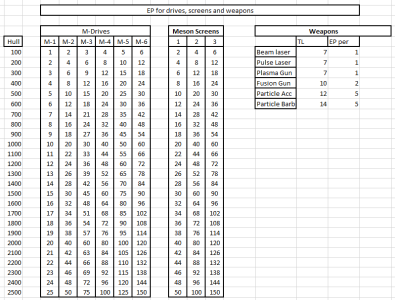
Switching to tracking EPs instead of Pn means you can prioritize which system is powered. If you have 25 EP and you know how many EPs are required for M-1,M-2,M-3 etc you can decided how much to spend on maneuvering and how much on weapons. Additionally in situations where your power plant is degraded you can store power in your (non powerplant) capacitors until you have enough to spend on things that are more expensive than your generation potential.

For example if you have a 1300 dTon ship with the 50 dTon, 25 EP powerplant from the previous example. You have a PN of 1.92 (presumably 1 on the USP) a single hit would disable it's powerplant, however if you're tracking EP you would only need 13 EP for M-1. So a single hit wouldn't completely knock you out of the fight, just limit your options. You could still charge up capacitors in order to maneuver or raise screens, you just couldn't do it every turn.

Presumably you'd knock out either a fixed amount, say 5 EP per hit or 1d6 per hit.

1772085192323.png
 
For me the problem comes in that the power plant is considered completely disabled after the USP is reduced to 0, which could be 1 hit for low powered ships, and it does make sense that the powerplant might not make enough power for maneuvering after a single hit. But it does not make sense that it would not have enough power for even a single a turret or barbette while a much smaller ship could continue just fine.
For a given value of 'just fine'. Keeping in mind you'll need power for the computer as well, or all your weapons are useless.
Switching to tracking EPs instead of Pn means you can prioritize which system is powered. If you have 25 EP and you know how many EPs are required for M-1,M-2,M-3 etc you can decided how much to spend on maneuvering and how much on weapons. Additionally in situations where your power plant is degraded you can store power in your (non powerplant) capacitors until you have enough to spend on things that are more expensive than your generation potential.
This makes good sense, but how many EPs per PP hit? Since your EP increases by size, taking a fixed mid-range value will make PP hits disastrously more devastating to small ships and much less damaging to larger ships. I don't think there's a really fair way to do it that doesn't feel like just nerfing PP hits for larger ships.

The only things that can even hit a power plant are Meson Guns and Spinal Particle Beams (only if your target is unarmored), so that's kind of a very corner case in any event. I personally feel like a PN 1.75 ship with no armor that gets hit with a spinal particle beam, or a meson weapon, shouldn't expect an easy time. Those are serious military weapons, and ought to mangle a ship with a 1.92 PN.
For example if you have a 1300 dTon ship with the 50 dTon, 25 EP powerplant from the previous example. You have a PN of 1.92 (presumably 1 on the USP) a single hit would disable it's powerplant, however if you're tracking EP you would only need 13 EP for M-1. So a single hit wouldn't completely knock you out of the fight, just limit your options. You could still charge up capacitors in order to maneuver or raise screens, you just couldn't do it every turn.
If you retain fractions, a PN 1.92 should, after a PP hit, have a PN of 0.92. Not enough to generate Thrust 1, but you can recalc your EP with PN of 0.92 and power up the systems up to that amount.

On to the elephant in the room: a ship with a starting PN of 1.92 facing something with a Spinal Particle or any sort Meson Gun is a small puff of vapor waiting to happen. No amount of nerfing the rules is going to save them. Forget the PP hits, a spinal particle or meson gun vs a 500-ton ship is going to generate size-based crits that are going to obliterate that target before they can recalculate their EP anyhow.
Presumably you'd knock out either a fixed amount, say 5 EP per hit or 1d6 per hit.
5EP per hit is 1PN at 500T, right? It's 5PN at 100T. That would inconvenience tiny player ships, and military behemoths at 20,000 tons wouldn't even notice.
 
Note in the above commentary there is talk of a type S with drop tanks so it can do 2J2, but the type S is a 2J2 as designed. It has 40 tonns of fuel per LBB 2 (1981) page 19, LBB2 (1977) page 18, & MT Imperial Encyclopedia page 80. So ?????
MT's tech paradigms, while grounded in CT sources, are best thought of as a separate reality from CT... and from TNE, and from T4, and TNE from CT and T4, as well, and T4 from CT, too.

Hell, CT is really three different settings by how one treats the Bk2/Bk5 divide... The pure Bk2 universe, the pure Bk 5 (no Bk2 drives), and the official hybrid universe...
Bk2 vs Bk5 JDrives:
Bk 2 JD 5Td + (Jn × 2.5% Hull) (approximate; bigger sizes get minor boosts)
Bk 5 JD (1 + Jn) × 1% (exact)
Bk2 MD (Mn × 2% Hull) -1Td (approx, again, size efficiencies)
Bk5 MD non-linear percentage
Bk2 PP (Pn × 1.5% hull)+1Td (again, size efficiencies)
Bk5 PP (Pn × (1 to 4 by TL) %) hull.

You cannot fairly compare MT designs to CT Designs, due to the differences in PP rules, and the JFuel rates. It's possible in Mt to build a viable 2j4 or 3j3 ship. (I've done both.)
Bk2 cannot get 2j4, but can in theory get 2j3. Nothing USEFUL on it, as it's 4.5% JD, 4.5% PP, 60% J fuel at 4 weeks... so it can't carry all 30% PP Fuel, but can sneak by at 3 weeks for 22.5%... not a legal to operate ship (required 4 weeks), but it's a logical extrapolation; if being a stickler, it's 1j3+1j2.

MT uses Bk5 JD and MD rates, but reduced fuel for both by TL 14... not as reduced on the PP as TNE... so a J4 drive is 5% hull, and uses 25% hull for 1j4, so can fit 2j4 in 55% of hull and still have a useful (if small, after crew) payload.

TNE makes the MT monthly fuel rate into an annual fuel rate.

Sanity says the various editions are various separate, highly parallel, universes described.
Marc once told the inner circle that each edition was a different historian's view of the actual OTU.
 
For a given value of 'just fine'. Keeping in mind you'll need power for the computer as well, or all your weapons are useless.

This makes good sense, but how many EPs per PP hit? Since your EP increases by size, taking a fixed mid-range value will make PP hits disastrously more devastating to small ships and much less damaging to larger ships. I don't think there's a really fair way to do it that doesn't feel like just nerfing PP hits for larger ships.

The only things that can even hit a power plant are Meson Guns and Spinal Particle Beams (only if your target is unarmored), so that's kind of a very corner case in any event. I personally feel like a PN 1.75 ship with no armor that gets hit with a spinal particle beam, or a meson weapon, shouldn't expect an easy time. Those are serious military weapons, and ought to mangle a ship with a 1.92 PN.

If you retain fractions, a PN 1.92 should, after a PP hit, have a PN of 0.92. Not enough to generate Thrust 1, but you can recalc your EP with PN of 0.92 and power up the systems up to that amount.

On to the elephant in the room: a ship with a starting PN of 1.92 facing something with a Spinal Particle or any sort Meson Gun is a small puff of vapor waiting to happen. No amount of nerfing the rules is going to save them. Forget the PP hits, a spinal particle or meson gun vs a 500-ton ship is going to generate size-based crits that are going to obliterate that target before they can recalculate their EP anyhow.

5EP per hit is 1PN at 500T, right? It's 5PN at 100T. That would inconvenience tiny player ships, and military behemoths at 20,000 tons wouldn't even notice.
Part of my logic is that smaller ships should not be able to absorb more hits than large ships. But with PN as a metric for damage capacity a smaller ship with the same reactor will take more hits than a large ship with the same reactor and the same number of hits as the larger ship with a larger reactor.

You are right a small ship should be very hurt by a meson cannon, and a large ship less so. But as is using PN, if you hit a 100 dTons ship with a giant reactor it will absorb 25 hits to that reactor before it's knocked out. A large ship with the same reactor will take far fewer hits, of course that larger ship is underpowered , but if it's has a larger reactor giving it the same PN as the smaller ship it's still loosing far more EP after each hit.

A 500 ton ship with a PN of 25 is losing 5 EP per hit, a 100 Ton ship with a PN of 25 will lose only 1 EP, and with a 50,000 ton you are losing 500 EP. At one end of the scale your knocking out enough power for a spinal mount offline and the other a single laser turret. This is exactly the opposite of what should happen. The small ship should turn into a puff of smoke, and the large ship should plenty of reserve power, but the effects are reversed.

If you damage the Ship's EP instead if PN the results are more inline with what I would think they should be. If the 100 dTon ship loses 5 EP that's 20% of it's total if the 50,000 dTon ship loses 5 dTon ship loses 5 EP that's 0.04% of it's total.

Admittedly the number of EP should be higher perhaps 5,000 or 1d6*1000.
 
Additionally in situations where your power plant is degraded you can store power in your (non powerplant) capacitors until you have enough to spend on things that are more expensive than your generation potential.
Except, that's not true. 😭

LBB5.80, p42 (bolding added for emphasis):
Stored energy may be removed from the capacitors by using it to power the ship. Energy may only leave the ship, however, when the black globe is off (or during the off intervals of its flicker). During a turn, a ship may dispose of its energy from its capacitors equal to the number of points generated by its power plant, minus 10% for every 10% of flicker rate of the black globe screen. For example, if a ship's black globe screen is operating at 60% and its power plant has an output of 1000 EP, 400 EP may be removed from the ship's capacitors that turn.
Capacitors can only be used to provide up the number of EPs the power plant can generate.
A power plant that is capable of generating EP=0 (because it's been damaged/destroyed) CANNOT be "replaced" by jump capacitors.

A power plant that has been forced to shut down due to a lack of fuel (all fuel gone/lost) CAN be "replaced" (temporarily) by jump capacitors as an EP source for systems, because the power plant itself has not been damaged (just starved of fuel).

Point being that if your power plant EP generation is "degraded" due to damage ... you can't "backfill" the lost generation capacity with jump capacitors.

The power plant installed into craft isn't "just the boiler room" ... it's also the power distribution network throughout the craft, routing power to the necessary systems. In real world terms, it's not just the generator plant ... it's also the transmission network of power lines.

If you reduce the capacity of the GRID to generate and/or transmit power, the "result" is the same for the end user, regardless of where the fault lies.

If the power lines between "you" and the generator are cut, it doesn't matter how much power the generator is delivering ... none of that power is going to reach "you" the end user because the lines are broken.

If the generator trips offline, but there's battery backup on the grid and the grid isn't damaged ... then the battery can supply power (temporarily) until the generator issue can be resolved (or not...).

It's a subtle but important distinction that prevents jump capacitors from making it possible to deliver EPs above and beyond what a power plant is capable of producing. If this limitation were not in place, it would be possible to OMIT power plants completely and just install jump capacitors to supply EPs from "batteries" instead, creating short range "electric drive boats" with no nuclear power installed in them at all ... which would need to be energized from external sources (starport infrastructure, carriers/tenders, military bases, etc.).
 
That was a retcon, and a very silly retcon at that. it was to prevent people charging jump capacitors and using them to power weapons and screens while using full power plant output for emergency agility.

A more sensible interpretation is that the capacitors can only feed power into the power grid an the expense of your power plant generation. Power down your power plant by a factor or 2 and top up with capacitor EPs.

But that adds a lot of complexity and requires a turn by turn EP tracking that HG combat was simply never intended to do.

I agree that if your power distribution grid is damaged then you can not transfer power from the power plant or capacitors to ship systems esxcept at a reduced rate, but that again is not explicitly covered by the rules. Is a power plant hit damage to the energy transfe grid or damage to the reactor itself?

Different referees will have different interpretations and house rules for this.
 
Is a power plant hit damage to the energy transfer grid or damage to the reactor itself?
For roleplay purposes, it may matter (fix this, not that!) ... but for wargaming simulation purposes it makes no difference.

If your power plant can generate EP=8 per turn ... the source of those EP=8 can come from either the power plant and/or the jump capacitors, but you can't use power plant + jump capacitors to deliver EP=9+ in a single turn (for example).

Likewise, if your power plant takes a damage hit (from combat or a lack of maintenance, whatever) and can no longer generate EP=8 ... let's call it EP=6 is the new generation limit after the damage hit to keep things simple ... then you can't use power plant + capacitors to deliver EP=8 in a single turn as if the power plant had NOT taken a damage hit. The new maximum limit of EP for all systems is EP=6 after the damage hit to the power plant, regardless of the source of the EPs (power plant and/or jump capacitors).

It's not that hard of a concept to grasp ... except for the fact that the explanation for how to frame the issue wasn't worded that well in LBB5.80. 😓
 
Part of my logic is that smaller ships should not be able to absorb more hits than large ships. But with PN as a metric for damage capacity a smaller ship with the same reactor will take more hits than a large ship with the same reactor and the same number of hits as the larger ship with a larger reactor.

You are right a small ship should be very hurt by a meson cannon, and a large ship less so. But as is using PN, if you hit a 100 dTons ship with a giant reactor it will absorb 25 hits to that reactor before it's knocked out. A large ship with the same reactor will take far fewer hits, of course that larger ship is underpowered , but if it's has a larger reactor giving it the same PN as the smaller ship it's still loosing far more EP after each hit.

A 500 ton ship with a PN of 25 is losing 5 EP per hit, a 100 Ton ship with a PN of 25 will lose only 1 EP, and with a 50,000 ton you are losing 500 EP. At one end of the scale your knocking out enough power for a spinal mount offline and the other a single laser turret. This is exactly the opposite of what should happen. The small ship should turn into a puff of smoke, and the large ship should plenty of reserve power, but the effects are reversed.

If you damage the Ship's EP instead if PN the results are more inline with what I would think they should be. If the 100 dTon ship loses 5 EP that's 20% of it's total if the 50,000 dTon ship loses 5 dTon ship loses 5 EP that's 0.04% of it's total.

Admittedly the number of EP should be higher perhaps 5,000 or 1d6*1000.

A big part of why I settled on tonnage based damage.
 
Part of my logic is that smaller ships should not be able to absorb more hits than large ships. But with PN as a metric for damage capacity a smaller ship with the same reactor will take more hits than a large ship with the same reactor and the same number of hits as the larger ship with a larger reactor.

You are right a small ship should be very hurt by a meson cannon, and a large ship less so. But as is using PN, if you hit a 100 dTons ship with a giant reactor it will absorb 25 hits to that reactor before it's knocked out. A large ship with the same reactor will take far fewer hits, of course that larger ship is underpowered , but if it's has a larger reactor giving it the same PN as the smaller ship it's still loosing far more EP after each hit.
So, a larger ship has miles of places for power to go that's not mentioned explicitly. Lighting and environmental, an internal com system, screens for everything you need to control, entertainment system, however austere, in the cabins, and so on. Theoretically, you could let 1100 tons of ship go dark, (everyone's in vacc suits anyhow, right?) and then your 50-ton power plant generating 25EP for just 200T of spaceship has a PN of 12.5. That 1-point PP hit now is pretty trivial, costing you 2 EP. That lets you run your M-Drive and Computer and maybe a missile bay. This is how I would solve your anemic power plant problem.

Interestingly, I plunked a 50T Meson Bay into that 1300-tonner, and the Pn jumped to just over 9.6, also solving the tiny Power Plant problem.

But overall, I think you're attempting to houserule a situation that doesn't really need fixing, and the repurcussions for capital warships is huge, basically making a PP hit meaningless. A Jump-1/Thrust-1/Pn-1.9 civilian ship is so wildly toothless in the first place that it should not expect to survive an encounter from someone armed with a meson, and absolutely not someone with a spinal particle beam. Oh, nuclear missiles can also get the 3-5 result on the surface explosion table that also makes PP hits a possibility. But that's another military-only weapon, so doesn't really change much that's been said.
 
A big part of why I settled on tonnage based damage.
At which point you "borrow" the fuel damage result (1% or 10 tons lost, whichever is larger) and cross-pollinate that notion into drive damages.
Drive-n results damage 1% of hull tonnage or 10 tons (whichever is larger) of the drive installed taking the damage hit.

Irony of ironies, this means that lower tech level LBB5.80 custom power plants would be "better able"/resilient against damage results to the power plant than higher tech level power plants. ;)
But overall, I think you're attempting to houserule a situation that doesn't really need fixing
😅
and the repurcussions for capital warships is huge, basically making a PP hit meaningless.
Behold ... the law of unintended consequences, coming home to roost ... :oops:
 
Back
Top