• Welcome to the new COTI server. We've moved the Citizens to a new server. Please let us know in the COTI Website issue forum if you find any problems.
  • We, the systems administration staff, apologize for this unexpected outage of the boards. We have resolved the root cause of the problem and there should be no further disruptions.

Considering alternate world generation

but the type S is a 2J2 as designed.
If that were true, the (stock) Type-S would need to have 41 tons of fuel tankage (minimum).
  • J2 = 20 tons
  • J2 = 20 tons
  • Power plant fuel = ... whatever remains
Now by my mathematical calculations ... 40-20-20=ZERO ... so what you're talking about is only possible if the fusion power plant is "kept switched off" for 2 jumps (however long that might take, call it 17 days to be conservative).

Therefore, you're going to want some sort of fuel reserve margin above the 20+20=40 tons of fuel required for J2+2.
But how much are you going to need? :unsure:
At Pn-2 it burns 5Td/week (1/4 of the 20Td allocation for 4 weeks) in power plant fuel (LBB2'81).
Power Plant-A (EP=2 output) in a 100 ton Type-S Scout/Courier hull consumes 5 tons of fuel per week (even during jump)?
Power Plant-A (EP=2 output) in a 200 ton Type-A Free Trader hull consumes 2.5 tons of fuel per week (even during jump)?

"If none of this makes sense to you, it may already be too late."
"This is not mind control. Think about it!"

- Shadoevision


This is where I find the fuel consumption rules provided in CT Beltstrike to be FAR more useful.
For simplicity, it basically boils down to this formula that I've worked out:
  • Basic Power: (Hull Tonnage / 2000) tons of fuel consumption by power plant per 7 days
  • Additional Power: (EP * 0.35) tons of fuel consumption by power plant per 7 days
    • Total Fuel Consumption = (Hull Tonnage / 2000) + (EP * 0.35) tons of fuel by power plant per 7 days
Putting this in practice, it means:
  • "Just keeping the lights on" will cost 0.05 tons of fuel consumption (by the power plant) per 100 tons of hull, per 7 days. This is all the "basic power" housekeeping stuff (life support, heat pumps keeping liquid H2 fuel from boiling off, etc. etc. etc.).
  • EPs needed for maneuver drive acceleration, computer, weapons and screens will cost 0.35 tons of fuel consumption per EP generated, per 7 days.
So if you've got a 100 ton hull (let's call it either a Type-S Scout/Courier or a Type-J Seeker) ... and the craft is under continuous 2G acceleration/Agility=2 (requiring EP=2) maneuver for 7 days, the fuel consumption rate for that maneuver would be:
  • (100/2000) + (2*0.35) = 0.75 tons of fuel consumption per 7 days of full power continuous maneuvering
However, if you didn't need to be maneuvering, but were just "coasting" from point to point, the rate of fuel consumption would look like this:
  • (100/2000) + (0*0.35) = 0.05 tons of fuel consumption per 7 days of "basic power" only sustainment
It then doesn't take that much of a hop/skip/jump to figure out that while a starship is in jump ... there is no need for maneuver drives, weapons or screens to be powered on ... so all of those EP consuming systems can be powered off while in jump.


So if you had a (modified) 100 ton starship with A/A/A drives installed and a 41 ton fuel tank your fuel endurance limit would add up like so:
  • J2 (7-ish days) = 20 tons
  • J2 (7-ish days) = 20 tons
  • 2G maneuver (7 days) = 0.7 tons
  • Basic Power (42 days) = 0.3 tons
    • 20+20+0.7+0.3 = 41 tons
Obviously there's some "wiggle room" in which you can exchange maneuver drive power duration for basic power duration, but the point is that you need the basic power endurance time to exceed the duration of jump(s) plus maneuver time.

Last time I checked, 42 days exceeds 7+7+7=21 days by a "useful" margin ... so this ought to work just fine.


The fuel consumption rules in Beltstrike are specifically intended to account for LONG durations of maneuvering/station keeping in normal space as one of the limitations on prospecting expeditions for Belters, so you can kind of imagine how "necessary" it would be to conserve fuel and monitor consumption under such conditions (which are prone to error and mishap over long enough durations). The rules also work perfectly fine for small craft (in case you want to go prospecting in a 40 ton Pinnace or a 50 ton Cutter, instead of a 100 ton 40 year old refurbished Type-J Seeker).
but the type S is a 2J2 as designed.
No, it's not.
But if it had a 41 ton fuel tank instead ... yes it would!
Even a 40 tons integral + 1 ton collapsible fuel tank arrangement would work to achieve the 41 ton total tankage necessary to achieve J2+2 "reliably enough" to make it routine.

The model/1bis computer not being able to include the Generate program in the Standard Software Package means that until the Generate program can be obtained (under LBB2.81, p40-41 computer programming rules), you're going to be stuck with needing to buy (one use, self-erasing!) Jump Tapes from starports before every jump. So if you want to J2+2 without having the Generate program ... that's going to cost you Cr10,000 per parsec.

2+2=4 parsecs means you'll need to spend Cr40,000 to buy Jump Tapes (2) for a single trip ... if you don't have the Generate program installed in your computer. 💸💸💸💸


The model/1bis computer is the minimum computer required for J2 ... but the model/2 computer can have the Generate program installed as part of the Standard Software Package, rather than needing to be bought later as an aftermarket expense. The MCr5 construction price differential between model/1bis and model/2 is the same "price" as 500 parsecs worth of Jump Tapes (at Cr10,000 per parsec) at single production rates. At the 90% LBB2 costing for volume production, that "breakeven" number becomes 450 parsecs worth of Jump Tapes.

Spoiler Alert: Type-S Scout/Couriers can be expected to jump more than 450 parsecs during a 40 year service life, let alone the additional parsecs piled on during their surplus market life beyond their initial 40 years in service. :unsure:

So while a model/1bis computer in a Type-S Scout/Courier LOOKS good to the bean counters in charge of the construction budget, it's actually a BAD decision according to the bean counters in the "lifetime costs of ownership" budget that needs to sustain these craft after they're commissioned by the shipyard until they're retired to be put on the surplus market or handed out as mustering out benefits to Detached Scouts.
 
Power Plant-A (EP=2 output) in a 100 ton Type-S Scout/Courier hull consumes 5 tons of fuel per week (even during jump)?
Yes. Both starships and non-starships use the same amount of power plant fuel over a month, despite starships typically spending half of that time in Jumpspace and non-starships, not so much.

This is why I called out the distinction between '77 (fuel burned directly in the jump drive) and '81 (by then, using power plant in overload mode). MgT does use a lot less power plant output during Jump -- just baseline power. This is similar to Beltstrike rules, but the mandatory 4-week power plant fuel requirement strongly suggests that the output of Pn=Jn is needed during the time in jumpspace under CT after '77
 
Last edited:
Also, Types S* in IISS service probably have Generate installed. They may not still have it when loaned out or sold by the IISS. (Something that could be a benefit of getting a second ship result in mustering out?) And it's probably a moot point after HG 80 anyhow....

‐--‐---
* you know,, like Attorneys General
 
Last edited:
Explain, please. There has to be some reason this is something other than a flippant dismissal that fails to address my point.
Sure.


You're starting from the point of "fuel tankage must be This Much for 4 weeks of endurance" ... therefore ... power plant fuel tankage requirement divided by 4 ipso facto MUST BE the rate of fuel consumption, regardless of demand loading on that power plant, over those 4 weeks.
  • 20 ton power plant fuel requirement / 4 = 5 tons of fuel consumption per week
Fuel consumption DOES NOT vary with demand or load factor.
4 weeks of zero acceleration inertial cruising vs 4 weeks of maximum acceleration cruising ... makes NO DIFFERENCE.

20 tons of power plant fuel ... divide by 4 ... means 5 tons of fuel consumption per week ... circumstances and context are IRRELEVANT.


I'm starting from the point of "fuel tankage minimums are determined by safety regulations for the construction of craft" ... but fuel consumption rates can VARY WIDELY depending on demand load for EPs/energy output from the power plant. This is the CT Beltstrike fuel formula that I've outlined above. Depending on how you use your craft (and thus the demand load for EPs you need from it), the rate of fuel consumption CAN CHANGE.

Fuel consumption DOES vary with demand or load factor.
7 weeks of Basic Power endurance for a 100 ton hull consumes as much fuel as 1 week of EP=1 power generation.
  • 7 * (100/2000) = 1 * (1*0.35)
  • 7 * (0.05) = 1 * (0.35)
This means that fuel endurance is not "unlimited" ... but there are tradeoffs to be made between different cruising modes (zero-g inertial, half power acceleration, full power acceleration, weapons+screens energized for combat, etc.).

So, for example ... a 100 ton Type-S Scout/Courier under continuous 2G/Agility=2 acceleration for 1 week consumes:
  • (100/2000)+(2*0.35) = 0.75 tons of fuel per 7 days
  • 20 tons of fuel capacity / 0.75 = 186d 16h maximum endurance in normal space, continuously at maximum 2G acceleration power
  • 40 tons of fuel capacity / 0.75 = 373d 08h maximum endurance in normal space, continuously at maximum 2G acceleration power
By turning fuel consumption into a formula that has a "flat rate + variable" built into it, you can do a better job of calculating an actual rate of fuel consumption for a variety of craft in a much wider variety of contexts.

Note that if using this formula, an LBB5.80 custom Power Plant-2 drive in a 100 ton hull would ALSO consume 0.75 tons of fuel per 7 days, but would require a (minimum) 2 tons of fuel tankage allocation ... rather than the 20 tons required by a LBB2.81 standard Power Plant-A drive in a 100 ton hull.
  • (100/2000)+(2*0.35) = 0.75 tons of fuel per 7 days
  • 2 tons of fuel capacity / 0.75 = 18d 16h maximum endurance in normal space, continuously at maximum 2G acceleration power
Of course, Fuel Is Fungible™ ... so it doesn't really make a difference if the fuel is being drawn from the jump tankage allocation or the power plant tankage allocation ... because Fuel Is Fuel. The only difference you need to worry about is refined vs unrefined ... and which form of tankage it's stored in (integral hull tanks, demountable tanks, collapsible tanks, drop tanks).

That's why you don't see see the 40 ton fuel tankage allocation on a stock Type-S parsed in the USP as having Fuel=20+20.
Instead, you just see Fuel=40 ... because Fuel Is Fungible™ with respect to which drive(s) can consume it. The only real variable is the rate of consumption (jump drives gulp down fuel FAST, maneuver drives under power create a steady state of demand, idling requires the least amount but it never falls all the way to zero unless the entire craft is powered OFF).


The very notion that power plant fuel consumption rates CAN VARY is incompatible with the notion that the fuel consumption rate MUST REMAIN FIXED regardless of circumstances or context.

Power Plant fuel allocation required at construction = 4 weeks of endurance "only works" if you assume that the rate of fuel consumption MUST REMAIN FIXED at all times, regardless of what the craft is doing.

In my experience, that's an ... :poop: unrealistic expectation :poop: and/or assumption :poop: ...but then, not everyone thinks about these things the way that I do. 🤫

Your mileage may vary.
My mileage may vary ... but yours won't. :unsure:


Need I elaborate further? :rolleyes:
 
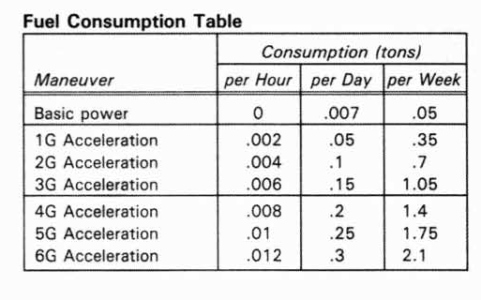
Why not use the fuel consumption rates for LBB:2 power plants from the boxed adventure Beltstrike?
Except ... I DID.
Proof is below.

The numbers are per 100t of hull.

1771886111031.png
This is where I find the fuel consumption rules provided in CT Beltstrike to be FAR more useful.
For simplicity, it basically boils down to this formula that I've worked out:
  • Basic Power: (Hull Tonnage / 2000) tons of fuel consumption by power plant per 7 days
  • Additional Power: (EP * 0.35)tons of fuel consumption by power plant per 7 days
    • Total Fuel Consumption = (Hull Tonnage / 2000) + (EP * 0.35) tons of fuel by power plant per 7 days

So ...

The table you posted ...
  • Basic Power (per week): 0.05 tons per 7 days per 100 tons of hull
  • 1G Acceleration (per week): 0.35 tons per 7 days per 100 tons of hull
  • 2G Acceleration (per week): 0.7 tons per 7 days per 100 tons of hull
Question.
What is 100/2000?

Answer.
100/2000 = 0.05

Question.
How many EPs does it cost to produce 1G/Agility=1 per 100 tons of hull?

Answer.
EP=1 per 1G/Agility=1 per 100 tons of hull.
Therefore ... EP=1 generation consumes 0.35 tons of fuel per 7 days.


So I can either use the table "as is" for a 100 ton Type-S Scout/Courier and/or Type-J Seeker like so:
  • Basic Power: (100/100) * 0.05 = 0.05 tons per week fuel consumption
  • 1G Acceleration: (100/100) * 0.35 = 0.035 tons per week fuel consumption
  • 2G Acceleration: (100/100) * 0.7 = 0.7 tons per week fuel consumption
Therefore ...
  • Basic Power + 0G Acceleration: (100/100*0.05)+(100/100*0.0) = 0.05 tons per week of fuel consumption
  • Basic Power + 1G Acceleration: (100/100*0.05)+(100/100*0.35) = 0.4 tons per week fuel consumption
  • Basic Power + 2G Acceleration: (100/100*0.05)+(100/100*0.7) = 0.75 tons per week fuel consumption


Or you could use the "reorganization" of the exact same information that I demonstrated to run the computation more simply/easily AND accounting for the EP system used by LBB5.80, because the power plant needs to energize more than just the maneuver drive (things like computers, weapons and screens) in a variety of different craft.

So the (usefully refactored) formula I've cited multiple times now that does the exact same job and produces the same results is ...
  • Total Fuel Consumption = (Hull Tonnage / 2000) + (EP * 0.35) tons of fuel by power plant per 7 days
Therefore ... same 100 ton Type-S Scout/Courier and/or Type-J Seeker yields the following computational results ...
  • Basic Power + 0G/Agility=0 Acceleration costing EP=0: (100/2000)+(0*0.35) = 0.05 tons per week fuel consumption
  • Basic Power + 1G/Agility=1 Acceleration costing EP=1: (100/2000)+(1*0.35) = 0.4 tons per week fuel consumption
  • Basic Power + 2G/Agility=2 Acceleration costing EP=2: (100/2000)+(2*0.35) = 0.75 tons per week fuel consumption


Feel free to check my math if you don't believe me. :rolleyes:
Same results ... better/easier formulaic means to achieve results congruent with the previous method, but which can cover more use cases and a broader spectrum of circumstances.

"Six of one, half a dozen of the other!"
- Number 2 to Number 6
 
Note in the above commentary there is talk of a type S with drop tanks so it can do 2J2, but the type S is a 2J2 as designed. It has 40 tonns of fuel per LBB 2 (1981) page 19, LBB2 (1977) page 18, & MT Imperial Encyclopedia page 80. So ?????
A Scout could be 2J2, but it need to be tanked up and it would need to drop the tanks Pre-Jump. That would leave it with 20 tons jump fuel and 20 tons powerplant fuel for one month.

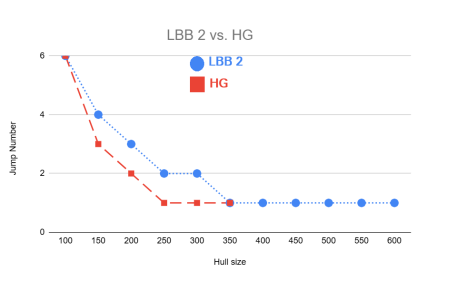
Its worth remembering that LBB2 and HG jump drives scale differently, so a LBB 2 Scout could tank up to 200 dTons, but a HG Scout could only Tank up to 150 dTons. The point at which their respective performances drop below J1.

Of course you could oversize the HG scouts drive to 4 dTons, in which case it could make J1 at 200 dTons, and J2 at 133 dTons.
 
Of course you could oversize the HG scouts drive to 4 dTons, in which case it could make J1 at 200 dTons, and J2 at 133 dTons.
... and J3 at 100 tons. ;)

TL=D LBB5.80 custom drives
  • Jump-3: 4 tons
  • Maneuver-2: 5 tons
  • Power Plant-3: 6 tons
    • Total drives ... 15 tons
Fuel: 33 tons

Your LBB2.81 standard hull of 100 tons with a 15 ton drive bay is waiting for you to fill up the main hull with Stuffs™ ... 😅
 
the very notion that power plant fuel consumption rates CAN VARY is incompatible with the notion that the fuel consumption rate MUST REMAIN FIXED regardless of circumstances or context.

Power Plant fuel allocation required at construction = 4 weeks of endurance "only works" if you assume that the rate of fuel consumption MUST REMAIN FIXED at all times, regardless of what the craft is doing.
We know it can vary, due to the TCS/JTAS#14 power-down rule. Aside from Beltstrike, that's the only variance allowed in CT -- and it's a variance by month (I think going by weeks should be ok, but that's a house rule).

The fundamental problem is the '77 LBB2 non-proportional allocation rule (10Pn), and that the Type S has a 40Td fuel tank because it was built under them and used all of it, every trip, by definition. '81 did not change the allocation, but it did change the rate from 10Pn per (typically, but not actually stated) 2 week trip to 10Pn per 4 weeks.

They removed the cause, but not... the symptom. And if you switch to Beltstrike or LBB5 fuel burn rates, that extra 10Td of power plant fuel (2 weeks supply, very seldom actually needed) becomes a rather silly multi-month supply.

And since it's there for out-of-universe (game balance) reasons, the in-universe reason for it becomes terribly implausible if it's not reflective of that rate. That is, you're forced to carry 18 tons of extra fuel because the government says so. All of the governments, from Aslan to Zhodani are in on it, simply because small ships are supposed to be bad and must be penalized.
 
Last edited:
In the strictest sense HG doesn't let you use LBB2 hulls, only drives. So you'd have to go with a more expensive HG hull, ultimately not a big difference, especially considering you get to take advantage of the 20% HG discount. Single Digit MCR cost difference at worst.

But again, you have the issue of how HG drives scale compared to LLB2. For LBB2 it's simple, a J6 Drive will jump a hull 6x larger at J-1. For HG it's only 3.5x. The LBB2 Scout can tank up to 600 dTon/J1 while the HG Scout can only tank up to 350 dTon. 1771930133164.png


One possible work around is to oversize the drive in the HG Scout, but it is not clear that you can. Assuming your HG ship is allowed to oversize it's drive you would need a 20 dTon Drive at 600 dTons to go J-1, and would hit J-6 at 171 dTons. But the question is what happens below this point, is the ship capped at J6, just with an extra large drive? Or does the drive stall out or mis-jump because it's producing a Jump potential beyond it's capability?

Looking at the LBB2 scout, you build it as C/C/C it would need 20 extra tons of space for Drives, and 60 tons of powerplant fuel. But you can tank up to 600 Dtons and still make J-1. Assuming it carries only a fraction of a months fuel internally, instead of the full month's it can jump out for the return trip, (on drop tank fuel) and still have about 10 days fuel left, which it presumably burns during it's jump. If you're cutting it very close you might have 1-3 days of fuel left on the far end. Depending on jump variance.

The real trick for both ships is trying to fraction out the Jump tanks to get the best range, You either need custom sized tanks for each jump, or a bunch of smaller standard sized stand so you can hit the break point for drive potential step-up.

Of course you could make a Hybrid Scout with a HG powerplant and a LBB2 jump drive. But that's a little min-maxey for my taste. The more I look at it the more I think that HG and LBB should be separate construction systems, to the setting level. HG and LBB are trying to do different things.


... and J3 at 100 tons. ;)

TL=D LBB5.80 custom drives
  • Jump-3: 4 tons
  • Maneuver-2: 5 tons
  • Power Plant-3: 6 tons
    • Total drives ... 15 tons
Fuel: 33 tons

Your LBB2.81 standard hull of 100 tons with a 15 ton drive bay is waiting for you to fill up the main hull with Stuffs™ ... 😅
 
The fundamental problem is the '77 LBB2 non-proportional allocation rule (10Pn), and that the Type S has a 40Td fuel tank because it was built under them and used all of it, every trip, by definition. '81 did not change the allocation, but it did change the rate from 10Pn per (typically, but not actually stated) 2 week trip to 10Pn per 4 weeks.

They removed the cause, but not... the symptom. And if you switch to Beltstrike or LBB5 fuel burn rates, that extra 10Td of power plant fuel (2 weeks supply, very seldom actually needed) becomes a rather silly multi-month supply.

And since it's there for out-of-universe (game balance) reasons, the in-universe reason for it becomes terribly implausible if it's not reflective of that rate. That is, you're forced to carry 18 tons of extra fuel because the government says so. All of the governments, from Aslan to Zhodani are in on it, simply because small ships are supposed to be bad and must be penalized.
What you've said is TRUE ... from a certain point of view ... 🤫

Take real world airliner fuel loading as a proximate analogy.

Let's say that to fly along a particular route, from takeoff to landing, the aircraft will need to burn 50 (metric) tons of fuel ... to keep the point I'm trying to illustrate here simple.

The fuel "demand" for that particular route is going to be be 50,000 kg of fuel.
How much fuel capacity "ought to" be designed into a craft capable of flying that particular route?

If your answer is "50 tons capacity is all that's NEEDED so a 50 ton capacity is what the aircraft should have" ... then you have FAILED at aircraft safety on an extremely fundamental level.

Why do I say that?
Because in the modern day industry, the DESIGNED fuel capacity for such an aircraft will often times need to be 75 tons of fuel (or even more) ... even if in nominal operation modes a significant portion of that fuel load "is unnecessary" and won't be consumed during flight.

So why would that be the case then? :unsure:
SAFETY REGULATIONS.
(Real world) Aircraft need to have enough fuel reserve (above and beyond) their point to point consumption demand to account for a wide latitude of potential delay and/or abort scenarios. You need to have MARGIN available in case not everything goes according to plan.
  • Delays on the tarmac after the engines are spooled up before takeoff, consume fuel
  • Delays in the air waiting for landing clearance at the destination, consume fuel
  • Needing to divert to an alternate destination because the primary is closed, consume fuel
Craft with ZERO reserves above and beyond the "minimum necessary" will have FEWER OPTIONS available to them (due to fuel state) whenever something doesn't go according to plan. Lack of fuel reserve margins means that endurance IS (more) LIMITED in the event of a mishap and/or abort scenario.


In the case of Traveller craft in space ... one of the biggest potential hazards along these lines is ... a damage result (either from collision or combat) that "drains" 1% (or 10 tons, minimum) of fuel from the onboard fuel tankage. Any such "unplanned loss of fuel" creates asymmetric risk issues in smaller craft (up to 200 tons displacement) which will rapidly devolve into a "we need rescue!" condition. Self-recovery after such a mishap will often times REQUIRE additional fuel reserves beyond the absolute bare minimum required by "rules" around construction and "nothing ever goes wrong, ever" scenario planning.
And since it's there for out-of-universe (game balance) reasons, the in-universe reason for it becomes terribly implausible if it's not reflective of that rate. That is, you're forced to carry 18 tons of extra fuel because the government says so. All of the governments, from Aslan to Zhodani are in on it, simply because small ships are supposed to be bad and must be penalized.
From a gamer's min-max view of things ... that is absolutely TRUE. :mad:
The "rules" are insisting that I "waste" scarce tonnage on something I DON'T NEED! 💢
My starship would be BETTERER™ if I didn't have to spend so much tonnage on something I'm not going to use! (n)


But from an in-universe Safety Regulator's perspective, things are very different.
Craft that are DESIGNED to carry more fuel than they "need" to accomplish (mere) point to point transits are more versatile in their operations ... and more resilient once a mishap has occurred, enabling better chances for survival and rescue.

Because, here's the other thing about "living in space" ...


Space is big.
Really big.


Which means that there are going to be a LOT of potential Search & Rescue situations that remarkably few people are going to want to have to reclassify as Salvage Operations (because there were no survivors to rescue). The problem here is the Tyranny Of Distance ... owing to the fact that space is so vastly, hugely. mind bogglingly BIG.

Not all circumstances of low/no fuel states are going to happen conveniently in orbit around a planet with a starport and/or system defense assets nearby to carry out rescue operations. Craft that are DESIGNED with "larger than absolutely necessary" fuel reserves mandated by regulators before construction of them can even begin ... will tend to fare better and result in reduced loss of life during actual operations of those craft over the lifetime of those craft and their crews+passengers+cargoes.

So.
You see +18 tons "wasted" on fuel because of a dumb bit of RAW.
I see +18 tons "mandated" on fuel as a requirement for self-sufficiency in the event of mishap AND and an increased endurance/operational range that will be needed during "extended tours" of exploration and/or survey work ... because Fuel Is Fungible.

The other way to interpret the requirement actually draws upon a notion printed in the text of LBB S7 ... that the (comparitively large percentage of the hull devoted to) fuel tankage is a cheap form of (ablative) "armor" that can be sacrificed, if necessary, under adverse conditions. That way, the fuel tankage can (potentially) "soak" 1+ hit to fuel before the Type-S Scout/Courier has all of its fuel supply vented to space ... at which point the craft becomes a "dead hulk" in need of rescue. Depending on where you are ... that rescue may or may not be able to reach you in time before survival options are all eliminated from the viability list.

From a safety regulator's point of view, having a MANDATE for better fuel margins (above and beyond the bare minimum necessary to get the job done) makes a lot of sense.

It's a little bit like the Electrical Code Regulations that electricians ought to respect.
Why? :unsure:
Because the Electrical Code Regulations are written in FIRE. 🔥
 
I think I've mentioned before that I work in commercial aviation, for Part 121 flights the requirements are generally Trip fuel + 5% plus alternate fuel. If you don't have an alternate it is Trip Fuel plus 2 hours operating fuel.

For Traveller there isn't really going to be an alternate, It's just going to be Jump Fuel plus operating Fuel. Jump Fuel would be 60% of hull plus presumably 8 days powerplant fuel. (168 hours + The question is what is operating Fuel? The drive can be operated at anywhere between 1G and 6G, if operated at 1G your going to need about 60 hours to get from the Sun's jump shadow to Earth. For LBB2 you're looking at less than 1 dTon of fuel to operate those 2-3 days. And presumably, unless the system is very low population there are going to be alternative places you can dock and or fuel, And of course there's Low Berth or Fast Drug if things go sideways.
 
The question is what is operating Fuel?
My personal assumption is that since jump can take 150-175 hours (LBB5.80, p17), the "safest" assumption to make for margins is 175 hours plus the 16 hours of standard procedures checks after breakout (LBB5.80, p17 again) for a total of 175+16=191 hours per jump. Basically, start with a Worst Case Scenario™ and proceed from there.

8 days is 192 hours, so for simplicity of calculations (and to give that extra sliver of margin), I just assume 8 days per jump cycle (maximum) from initiation to breakout. If it's less than that, yay. (y)

So if double jumping, that means a baseline assumption of 8+8=16 days of endurance required to account for jumping.

Then there's maneuver time to/from jump points.
Under most circumstances, it's going to be rare for the required maneuver duration to exceed 1 day, each way. Most gas giants (that are not inside their local star's jump shadow) will have a maneuver acceleration requirement of up to 15 hours (one way). Again, to build in fuel consumption margin expectations, I simply use a "1 day, one way" baseline as a starting point for fuel consumption margins. If the actual amount of maneuver drive time winds up being less than that ... yay! (y)

Therefore, as a matter of "generic" endurance margins, for my own calculation purposes, I like to make sure that my own starship designs have sufficient fuel AFTER accounting for jump consumption of 8 days Basic Power per jump undertaken plus 2 days Basic Power+Max EP generation as the "minimal power plant fuel margin" necessary to undertake most jump transits.
  • 1x Jump = 10 days Basic Power + (8 days Minimum EP + 2 days Max EP)
  • 2x Jump = 18 days Basic Power + (16 days Minimum EP + 2 days Max EP)
  • ... etc. etc. etc. ...
Having "more" fuel margin than this bare minimum amount is still advisable. If the craft is "small enough" (hull tonnage and EP generation capacity) it's possible for this bare minimum fuel amount to add up to 1 ton (or less) of fuel capacity. Having 10.1+ tons of fuel margin is advisable as a "buffer" against potential hits to fuel (-1% or -10 tons, whichever is larger) for any and all reasons (including accidents and combat).

Minimum EP needs to account for things like model/3+ computers which consume EP=1+ ... and which really shouldn't be "shut off" while a starship is in jump (or flight in normal space). This makes model/2 and 2bis computers "valuable" for Fuel Economy in multi-jump capable starships, due to the EP=0 demand of model/2- computers ... which can be an important consideration when fuel margins get tight under certain edge case circumstances.

Small craft, however ... CAN "shut down" a model/3+ computer while cruising to reduce fuel consumption during transits in normal space *IF* the small craft has a bridge (because you need a bridge OR a computer to control a small craft). Computers are required for firing weapons from small craft, and you need a bridge on a small craft or pay a penalty of computer model -1 without a bridge ... but if weapon systems are not energized (because, not in combat), then a small craft does not "require" a computer to be (powered) "ON" if it has a bridge.
 
I wonder about the "Max power" reserve, A ship that can go M-6 shouldn't be required to carry more fuel than one that can only go M-1. It isn't somehow less safe to operate the M-6 ship at M-1 speed, it's just slower. Reserve should only really be based on distance/time. If a ship can get from break-out to port that should be "enough" fuel, Perhaps one week of "emergency reserve" at P-1/M-1

For my money Traveller's fuel requirements are all a bit wonky, a powerplant's fuel and power output should always be based on it's size, period. LBB 2's fuel requirement are quite high, and are fixed to the drive's output, not it's size. It's absurd that a 100 ton scout with Power plant B uses the same amount of fuel as a 5000 ton freighter with powerplant Z.

HG on the other hand has a more reasonable fuel usage at the lower end, but it scales with the hull size, so a 100 ton scout will use 1 ton to make 1 PP and a 5000 ton freighter will use 50 tons to make 1 PP.

I think it would be better to have powerplant consume an amount of fuel based solely on their size, and output a fixed amount of power based on that. A powerplant should make the same amount of power, and burn the same amount of fuel whether its' in a scout, a broadsword or sitting on an asteroid.

I had worked up a system like that quite a few years ago, Powerplants output a fixed number of power points—MEPs or "mega energy points" and Drives consumed a fixed number of MEPS, so you could match a drive to a power plant, and then determine the potential based on the size of the hull it was installed in. It was not unlike T5's EP system, but T5 calculates Fuel usage based on Hull size, not EP production or power plant size.

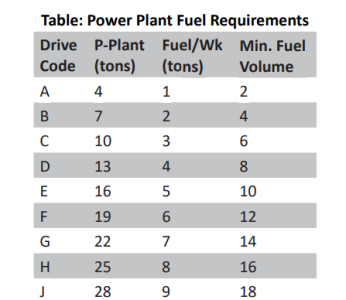
Cepheus does calculate fuel use based solely on powerplant size, not hull size.
1771989701501.png


My personal assumption is that since jump can take 150-175 hours (LBB5.80, p17), the "safest" assumption to make for margins is 175 hours plus the 16 hours of standard procedures checks after breakout (LBB5.80, p17 again) for a total of 175+16=191 hours per jump. Basically, start with a Worst Case Scenario™ and proceed from there.

8 days is 192 hours, so for simplicity of calculations (and to give that extra sliver of margin), I just assume 8 days per jump cycle (maximum) from initiation to breakout. If it's less than that, yay. (y)

So if double jumping, that means a baseline assumption of 8+8=16 days of endurance required to account for jumping.

Then there's maneuver time to/from jump points.
Under most circumstances, it's going to be rare for the required maneuver duration to exceed 1 day, each way. Most gas giants (that are not inside their local star's jump shadow) will have a maneuver acceleration requirement of up to 15 hours (one way). Again, to build in fuel consumption margin expectations, I simply use a "1 day, one way" baseline as a starting point for fuel consumption margins. If the actual amount of maneuver drive time winds up being less than that ... yay! (y)

Therefore, as a matter of "generic" endurance margins, for my own calculation purposes, I like to make sure that my own starship designs have sufficient fuel AFTER accounting for jump consumption of 8 days Basic Power per jump undertaken plus 2 days Basic Power+Max EP generation as the "minimal power plant fuel margin" necessary to undertake most jump transits.
  • 1x Jump = 10 days Basic Power + (8 days Minimum EP + 2 days Max EP)
  • 2x Jump = 18 days Basic Power + (16 days Minimum EP + 2 days Max EP)
  • ... etc. etc. etc. ...
Having "more" fuel margin than this bare minimum amount is still advisable. If the craft is "small enough" (hull tonnage and EP generation capacity) it's possible for this bare minimum fuel amount to add up to 1 ton (or less) of fuel capacity. Having 10.1+ tons of fuel margin is advisable as a "buffer" against potential hits to fuel (-1% or -10 tons, whichever is larger) for any and all reasons (including accidents and combat).

Minimum EP needs to account for things like model/3+ computers which consume EP=1+ ... and which really shouldn't be "shut off" while a starship is in jump (or flight in normal space). This makes model/2 and 2bis computers "valuable" for Fuel Economy in multi-jump capable starships, due to the EP=0 demand of model/2- computers ... which can be an important consideration when fuel margins get tight under certain edge case circumstances.

Small craft, however ... CAN "shut down" a model/3+ computer while cruising to reduce fuel consumption during transits in normal space *IF* the small craft has a bridge (because you need a bridge OR a computer to control a small craft). Computers are required for firing weapons from small craft, and you need a bridge on a small craft or pay a penalty of computer model -1 without a bridge ... but if weapon systems are not energized (because, not in combat), then a small craft does not "require" a computer to be (powered) "ON" if it has a bridge.
 
What you've said is TRUE ... from a certain point of view ... 🤫

Take real world airliner fuel loading as a proximate analogy.

Let's say that to fly along a particular route, from takeoff to landing, the aircraft will need to burn 50 (metric) tons of fuel ... to keep the point I'm trying to illustrate here simple.

The fuel "demand" for that particular route is going to be be 50,000 kg of fuel.
How much fuel capacity "ought to" be designed into a craft capable of flying that particular route?

If your answer is "50 tons capacity is all that's NEEDED so a 50 ton capacity is what the aircraft should have" ... then you have FAILED at aircraft safety on an extremely fundamental level.

Why do I say that?
Because in the modern day industry, the DESIGNED fuel capacity for such an aircraft will often times need to be 75 tons of fuel (or even more) ... even if in nominal operation modes a significant portion of that fuel load "is unnecessary" and won't be consumed during flight.

So why would that be the case then? :unsure:
SAFETY REGULATIONS.
(Real world) Aircraft need to have enough fuel reserve (above and beyond) their point to point consumption demand to account for a wide latitude of potential delay and/or abort scenarios. You need to have MARGIN available in case not everything goes according to plan.
  • Delays on the tarmac after the engines are spooled up before takeoff, consume fuel
  • Delays in the air waiting for landing clearance at the destination, consume fuel
  • Needing to divert to an alternate destination because the primary is closed, consume fuel
Craft with ZERO reserves above and beyond the "minimum necessary" will have FEWER OPTIONS available to them (due to fuel state) whenever something doesn't go according to plan. Lack of fuel reserve margins means that endurance IS (more) LIMITED in the event of a mishap and/or abort scenario.


In the case of Traveller craft in space ... one of the biggest potential hazards along these lines is ... a damage result (either from collision or combat) that "drains" 1% (or 10 tons, minimum) of fuel from the onboard fuel tankage. Any such "unplanned loss of fuel" creates asymmetric risk issues in smaller craft (up to 200 tons displacement) which will rapidly devolve into a "we need rescue!" condition. Self-recovery after such a mishap will often times REQUIRE additional fuel reserves beyond the absolute bare minimum required by "rules" around construction and "nothing ever goes wrong, ever" scenario planning.

From a gamer's min-max view of things ... that is absolutely TRUE. :mad:
The "rules" are insisting that I "waste" scarce tonnage on something I DON'T NEED! 💢
My starship would be BETTERER™ if I didn't have to spend so much tonnage on something I'm not going to use! (n)


But from an in-universe Safety Regulator's perspective, things are very different.
Craft that are DESIGNED to carry more fuel than they "need" to accomplish (mere) point to point transits are more versatile in their operations ... and more resilient once a mishap has occurred, enabling better chances for survival and rescue.

Because, here's the other thing about "living in space" ...


Space is big.
Really big.


Which means that there are going to be a LOT of potential Search & Rescue situations that remarkably few people are going to want to have to reclassify as Salvage Operations (because there were no survivors to rescue). The problem here is the Tyranny Of Distance ... owing to the fact that space is so vastly, hugely. mind bogglingly BIG.

Not all circumstances of low/no fuel states are going to happen conveniently in orbit around a planet with a starport and/or system defense assets nearby to carry out rescue operations. Craft that are DESIGNED with "larger than absolutely necessary" fuel reserves mandated by regulators before construction of them can even begin ... will tend to fare better and result in reduced loss of life during actual operations of those craft over the lifetime of those craft and their crews+passengers+cargoes.

So.
You see +18 tons "wasted" on fuel because of a dumb bit of RAW.
I see +18 tons "mandated" on fuel as a requirement for self-sufficiency in the event of mishap AND and an increased endurance/operational range that will be needed during "extended tours" of exploration and/or survey work ... because Fuel Is Fungible.

The other way to interpret the requirement actually draws upon a notion printed in the text of LBB S7 ... that the (comparitively large percentage of the hull devoted to) fuel tankage is a cheap form of (ablative) "armor" that can be sacrificed, if necessary, under adverse conditions. That way, the fuel tankage can (potentially) "soak" 1+ hit to fuel before the Type-S Scout/Courier has all of its fuel supply vented to space ... at which point the craft becomes a "dead hulk" in need of rescue. Depending on where you are ... that rescue may or may not be able to reach you in time before survival options are all eliminated from the viability list.

From a safety regulator's point of view, having a MANDATE for better fuel margins (above and beyond the bare minimum necessary to get the job done) makes a lot of sense.

It's a little bit like the Electrical Code Regulations that electricians ought to respect.
Why? :unsure:
Because the Electrical Code Regulations are written in FIRE. 🔥
Except that those minimums aren't required to be designed/built into the aircraft. If your plane can't carry the required divert fuel, you use a different airplane on the route, instead.
737-700ER (Wikipedia)
Boeing launched the 737-700ER (Extended Range) on January 31, 2006, with All Nippon Airways as the launch customer. Inspired by the Boeing Business Jet, it features the fuselage of the 737-700 and the wings and landing gear of the 737-800. When outfitted with nine auxiliary fuel tanks, it can hold 10,707 US gallons (40,530 L; 8,915 imp gal) of fuel with a 171,000-pound (78,000 kg) MTOW, but with a cargo payload capacity significantly decreased from 966 to 165 ft3 (27.4 to 4.7 m3), trading payload for increased range of 5,775 nmi (10,695 km; 6,646 mi).[53] The first was delivered on February 16, 2007, to ANA with 24 business-class and 24 premium-economy seats only. A 737-700 can typically accommodate 126 passengers in two classes.[54] It is similar to the Airbus A319LR.
And this, which I didn't see until after I posted:
I think I've mentioned before that I work in commercial aviation, for Part 121 flights the requirements are generally Trip fuel + 5% plus alternate fuel. If you don't have an alternate it is Trip Fuel plus 2 hours operating fuel.

For Traveller there isn't really going to be an alternate, It's just going to be Jump Fuel plus operating Fuel. Jump Fuel would be 60% of hull plus presumably 8 days powerplant fuel. (168 hours + The question is what is operating Fuel? The drive can be operated at anywhere between 1G and 6G, if operated at 1G your going to need about 60 hours to get from the Sun's jump shadow to Earth. For LBB2 you're looking at less than 1 dTon of fuel to operate those 2-3 days. And presumably, unless the system is very low population there are going to be alternative places you can dock and or fuel, And of course there's Low Berth or Fast Drug if things go sideways.
 
For my money Traveller's fuel requirements are all a bit wonky,
I think we all agree on that. The disagreements are about how to deal with it.
a powerplant's fuel and power output should always be based on it's size, period. LBB 2's fuel requirement are quite high, and are fixed to the drive's output, not it's size. It's absurd that a 100 ton scout with Power plant B uses the same amount of fuel as a 5000 ton freighter with powerplant Z.
They're high for small ships. Above 1000Td, they're always lower than the equivalent HG requirements.
HG on the other hand has a more reasonable fuel usage at the lower end, but it scales with the hull size, so a 100 ton scout will use 1 ton to make 1 PP and a 5000 ton freighter will use 50 tons to make 1 PP.
It's still "1 month" for ships that very seldom need more than 2 weeks worth (and in the worst case of a LBB2-rules misjump, have a 1/3 chance of needing more than 4 weeks of fuel to wait out the misjump, let alone providing for jump-fuel for self-recovery).
I think it would be better to have powerplant consume an amount of fuel based solely on their size, and output a fixed amount of power based on that. A powerplant should make the same amount of power, and burn the same amount of fuel whether its' in a scout, a broadsword or sitting on an asteroid.
Yes, but...
1. Changing this messes with any ship designed using LBB2
2. Changing this (depending on how it's done) can seriously unbalance the game because power plant fuel tankage is what served as the space-constraint on maneuver capability. Try building a 100Td 6G non-starship, LBB2'81 rules-as-written (it can even use a 100Td Standard Hull!)
 
I think we all agree on that. The disagreements are about how to deal with it.

They're high for small ships. Above 1000Td, they're always lower than the equivalent HG requirements.

It's still "1 month" for ships that very seldom need more than 2 weeks worth (and in the worst case of a LBB2-rules misjump, have a 1/3 chance of needing more than 4 weeks of fuel to wait out the misjump, let alone providing for jump-fuel for self-recovery).

Yes, but...
1. Changing this messes with any ship designed using LBB2
2. Changing this (depending on how it's done) can seriously unbalance the game because power plant fuel tankage is what served as the space-constraint on maneuver capability. Try building a 100Td 6G non-starship, LBB2'81 rules-as-written (it can even use a 100Td Standard Hull!)
Power plant fuel is still going to be a space constraint when using system where fuel is based on powerplant size. Your bigger ship will need a bigger powerplant to make enough power to fly it around, which leads to a larger fuel requirement.

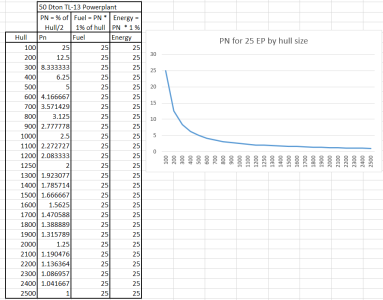
HG does this in a back-handed kind of way, You chose your power plant's Pn and is uses a certain percent of the hull, It's fuel use is then calculated based off the PN and Hull size, it's EP output also based on PN and Hull. It's not readily apparent but fuel consumption and power are always 1 ton per EP because they use the same formula .01*HULL.

There are a few issues with the HG approach, first off is that in order to get similar EP outputs from different sized hull you need different PNs from each Hull, and sometimes the PNs aren't intergers. For example a 100 dTon hull would need a PN of 25 and a 2500 dton would have a PN of 1 but both would have the same EPs and fuel burn.
1771996635156.png
To me it would be more straight forward to have a powerplant that is X size, makes X amount EP, and uses X amount of fuel. Then have the M-Drive and J-Drive consume a certain amount of those EPs based on hull size. A 100 dTon hull might only need 1 EP to go J-1 while a 2500 ton Hull would need 25 EPs to go J-1 (plus jump fuel)
 
Power plant fuel is still going to be a space constraint when using system where fuel is based on powerplant size.
Not to anywhere near the same degree. In HG, it's the maneuver drive itself (18% for 6g) and at lower TLs, the power plant too. (18% for Pn-6 at TLs 9-12). Fuel is 6% for 6g/Pn-6 at all TLs.

Gets a lot better as tech improves power plants, though.

But compare it to the LBB2"81 TL-9 6g 100-ton non-starship...,

Item: Tons
Bridge: 20
Mod/1: 1
Stateroom: 4
M-Drive C: 5
PP C: 10
Fuel: 60

Total:100

That's right -- no cargo, no passengers, no weapons.

Even at TL 9-12, you get 33 tons to play with under LBB5'80. Worst case (TL 7-8) it's still 27 tons... (far more expensive, of course -- but it fits).
 
Last edited:
Back
Top