• Welcome to the new COTI server. We've moved the Citizens to a new server. Please let us know in the COTI Website issue forum if you find any problems.
  • We, the systems administration staff, apologize for this unexpected outage of the boards. We have resolved the root cause of the problem and there should be no further disruptions.

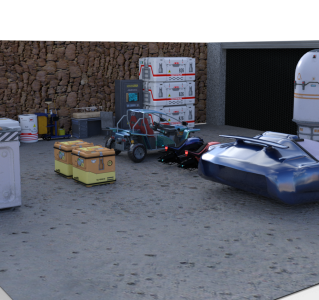
What does your grav bike look like?

whartung

SOC-14 5K

So, this is a marvelous, completely impractical flying machine demonstration. Someone bolted a seat to a jet engine. It's a wonderful demonstration of where automated control is at.

The key issue here is simply the exhaust from the jet. This thing is riding on the thrust from the jet. There's no lift of any kind here, and it's clearly doing a lot of work. As you can see from the debris this kicks up, this isn't going to be near people (or much anything else) at any point in the future. (We won't go into the sounds and such of this machine.)

But it brings up how grav vehicles work in Traveller.

in CT, there's not a lot of detail how AG works. Is there a "gravity force vector" pushing against the gravity of the planet? But how does the residual of that force work? If you're flying around in an air/raft, is there any external effect? Air pushed aside? Dust kicked up? Objects in the gravity field also adopt the AG force vector? Like, maybe as the air/raft is flying, may it collects a cloud of debris. Papers, plastic cups, maybe rocks or whatever, all things that happen to be in the AG field, adopting "AG" properties.

Then there's TNE, with contra-grav. Here, it negates the effect of gravity, negates its pull. But it's not a thrust (well, it is, it's just fixed). Contra-grav can't "push", it cancels/negates. Like standing behind a wall in the wind. The wall resists the wind, but it's not pushing back, per se. It pushes back "just enough".

So, you can't lift on contra-grav alone. You still need an external force to move the vehicle. But you don't need as much. Specifically, contra-grav eliminates (mostly) the "friction" of gravity. You still need 1G of thrust (based on your weight), but you just need it for an instant to get moving. But you will also need 1/100G to maintain that movement (or I should say to counteract the G vector). Because CG reduces gravity 99%.

Back this this jet bike, we can hand wave and say that it weighs 200kg with the rider. That suggest 2kg of downforce thrust to keep it up. Not a whole lot.

But a loaded Free Trader? At 2000 tons, 2Mkg. 20,000kg of force to keep it aloft. Now a Free Trader is roughly 280m in area, so that about .7kg of force per cm^2. THAT isn't too awful. But person, at, say, 2m x .6m, 1200 cm^2, thats 840 kg. I don't think I'd want to be underneath that ship when it took off.

An Air/raft, at 4 tons, 4000kg, 40kg to keep it aloft. Not bad, I wouldn't want it running over my foot. I wonder how close to the front door one of these could land. Because it's going to take more force to slow it down.
 
in CT, there's not a lot of detail how AG works. Is there a "gravity force vector" pushing against the gravity of the planet? But how does the residual of that force work? If you're flying around in an air/raft, is there any external effect? Air pushed aside? Dust kicked up?
Robot Carnival ... Deprive

Granted, the grav bike only lasts a scant 12 seconds(!) on screen ... but it's long enough to get a notion that can be worked with that can answer this question.

 
Malcolm_Smith_1971.jpg


Stealthed.
 
In regards to both drones and grav bikes, I sort of recall distribution of the grav modules mattered.

First, minimum size and performance.

Second, number.

Third, placement.

A single module would have to be at the centre of gravity.

Nominally speaking, should also be the most manoeuvrable.
 
In regards to both drones and grav bikes, I sort of recall distribution of the grav modules mattered.

First, minimum size and performance.

Second, number.

Third, placement.

A single module would have to be at the centre of gravity.

Nominally speaking, should also be the most manoeuvrable.
So, most maneuverable depends entirely on how much RL physics is being tossed into the garbage. You have to toss a bit because Grav modules don't exist in RL and can't because they contradict physics as written. But depending on how much you toss aside, you could as easily observe that one thruster in the center is less agile than two thrusters that are offset because they can generate more torque, adding to the ability to turn more sharply.

The picture seems to show one thruster along the rear left side, presumably mirrored by one on the right. But if that only provides thrust straight forward/aft, then you're going to flip over because with a rider, that's going to have a ton of inertial well above center of mass. On the other hand, if there's some sort of grav stabilization, you can put the engines wherever you like, though balance to some degree will mean you require less power to compensate for whatever balance you lack. As a bonus, you can allow any sort of pilot, and it just changes the details of how much compensation and in which direction.

Generally, grav vehicles (IMTU) can go in any direction they like, so they won't be limited to directly forward and aft. In that case, you'd still generate more turning moment by having the thrust applied farther out from the center of gravity. On the other hand, if you can generate any vector at any angle, then the position of the thruster doesn't really matter, although perhaps too much asymetrical thrust drains power in other components as the bike is kept straight.

I think the bottom line is you can technobabble any solution and call it right.

I apologize for all the Aslan injured by too much RL physics.
 
Aslans will always fall on their feet, so they're likely to survive that experience.

Manoeuvrability is more about the time and space needed to change direction, not acceleration.
 
Manoeuvrability is more about the time and space needed to change direction, not acceleration.
So, from a physics standpoint, any change of direction must be caused by an acceleration. But that acceleration can be caused by actual thrust, or air against an airfoil (in conjunction with the vehicle movement). Since the picture of the grav bike didn't show any control surfaces, I assumed that this was all thruster-based acceleration. How maneuverable you are is based on how much force/acceleration you can apply to your craft to change your course.
 
Depending on how you perceive anti gravitational motivators work in Traveller, whether as a push in the preferred direction, or a field effect.

I tend to believe that multiple examples of gravitational modules working in tandem are subject to certain limitations, such as overlap and latency.

Presumably, solid state, vectoring should be faster and easier from one module.
 
As I do my thinking about these things using FF&S, I assume contra-grav produces no thrust. It just makes everything in a field (either a simple ellipsoid shape or one bounded by a sealed hull) weigh very little (though mass is retained). So alternate sources of thrust and directional control are required to move and to control direction and attitude.

As for what they look like - it depends on manufacturer and exact intended role. Some look like the 'IISS Grav Bike' image above. Others like:
1746632686726.png

And, for a more radical appearance, some are the 'broomsticks' of the Reformation Coalition:
1746632764276.png
 
So, from a physics standpoint, any change of direction must be caused by an acceleration. But that acceleration can be caused by actual thrust, or air against an airfoil (in conjunction with the vehicle movement). Since the picture of the grav bike didn't show any control surfaces, I assumed that this was all thruster-based acceleration. How maneuverable you are is based on how much force/acceleration you can apply to your craft to change your course.
My take on this -- and I'm not too attached to it for anything later than LBB3 -- is that you get weight, but not mass, neutralization, plus 1/10g (1m/sec^2) thrust in any direction from "tacking against the gravity field" at TL-8, but it's some sort of reactionless thruster thingy at TL-9+. You can add other propulsion methods such as rockets, turbojets, or propellers at TL-8, and add wings/fins for aerodynamic maneuvering.

As to what such a vehicle looks like? Just from an aesthetic perspective, they're in a range from Vespas without wheels, to Honda Gold Wings without wheels because that'd be cool. There are probably ones that look like sportbikes too. :)
 
Problem is, if it is one, is that local gravity fields vary.

And fractional gravities, whether on gravitational motors, lifters, or manoeuvre drive, need to be tuned to that field, usually in the Mars to Terra range.
 
Back
Top