
You are using an out of date browser. It may not display this or other websites correctly.
You should upgrade or use an alternative browser.
You should upgrade or use an alternative browser.
Thoughts on T4?
- Thread starter PatriciaJane
- Start date

kilemall
SOC-14 5K
While the criticism of interpreting the Rule of Men by people from a putative Rule of Law has merit, I think it fits as the sort of distinction that suits the agenda of planetary law, keeping the peace and promoting trade by stopping the tendency to serfdom in its tracks.T4 also defined that there are no imperial subjects... all inteligent beings within the imperium are citizens. Something not previously defined.
Totally changed MTU.

This all got changed in MegaTrav, and then again later by MJD in his "grand fleets" fascination.
MegaTrav introduced "named fleets", "numbered fleets" and "reserve fleets". In effect subsector fleets from CT became reserve fleets in this conception, although this wasn't clearly explained.
Rebellion Sourcebook sez...
View attachment 7578
Not quite. This is the thing that people misunderstood (and why others misinterpreted in future products).
Named and Numbered Fleets had already been introduced in Classic Traveller for the Fifth Frontier War.
MegaTraveller is a WARTIME SETTING. Just like the Fifth Frontier War.
In Wartime, the Subsector Navies and Jump-capable Planetary Navies - together comprising the "Colonial Navy" - become "Imperialized" and come under the ultimate authority of the Imperial High Command, and are assigned Imperial Reserve Fleet elements (from the mothball fleet) and formed into Colonial Squadrons. MegaTraveller does NOT depict the situational norm - it depicts a wartime footing. People miss that subtlety, and hence misinterpret the model.
What MJD got wrong is the idea that the Named "Sector Fleet" is an independent Fleet organization from the Numbered "Subsector Fleets", which he takes as the "Reserve Fleets". The Imperial (Named) Sector Fleet is just the administrative designation for all of the combined Imperial Naval elements operating within the Sector, coming under the authority of the Sector Admiral, whatever they may be. Imperial Numbered Fleets are assigned to the Imperial Sector Fleet, normally at one per Subsector (hence Imperial Numbered Fleet = Imperial Subsector Fleet). This is entirely separate from the Imperial Reserve Fleet (which belongs to the Imperial Navy, and is kept in various states of ready reserve for reactivation as necessary based on operational condition - i.e. the "Mothball Fleet").
The Subsector Navy is entirely independent of both the Numbered Regular Imperial Subsector Fleets and the Imperial Reserve Fleet elements, but they are reinforced by the latter elements when they are reactivated during wartime, and then together assigned to Colonial Squadrons.
Last edited:
Cool, could you point to a couple of references in CT for this so I might read more.Not quite. This is the thing that people misunderstood (and why others misinterpreted in future products).
Named and Numbered Fleets had already been introduced in Classic Traveller for the Fifth Frontier War.
MegaTraveller is a WARTIME SETTING. Just like the Fifth Frontier War.
In Wartime, the Subsector Navies and Jump-capable Planetary Navies - together comprising the "Colonial Navy" - become "Imperialized" and come under the ultimate authority of the Imperial High Command, and are assigned Imperial Reserve Fleet elements (from the mothball fleet) and formed into Colonial Squadrons. MegaTraveller does NOT depict the situational norm - it depicts a wartime footing. People miss that subtlety, and hence misinterpret the model.
What MJD got wrong is the idea that the Named "Sector Fleet" is an independent Fleet organization from the Numbered "Subsector Fleets", which he takes as the "Reserve Fleets". The Imperial (Named) Sector Fleet is just the administrative designation for all of the combined Imperial Naval elements operating within the Sector, coming under the authority of the Sector Admiral, whatever they may be. Imperial Numbered Fleets are assigned to the Imperial Sector Fleet, normally at one per Subsector (hence Imperial Numbered Fleet = Imperial Subsector Fleet). This is entirely separate from the Imperial Reserve Fleet (which belongs to the Imperial Navy, and is kept in various states of ready reserve for reactivation as necessary based on operational condition - i.e. the "Mothball Fleet").
The Subsector Navy is entirely independent of both the Numbered Regular Imperial Subsector Fleets and the Imperial Reserve Fleet elements, but they are reinforced by the latter elements when they are reactivated during wartime, and then together assigned to Colonial Squadrons.
Cool, could you point to a couple of references in CT for this so I might read more.
I will have to dig around when I get a chance. But the Numbered Fleets and The Sector Admiral of the Spinward Marches Sector Fleet (and the junior ranks of Admiral, Vice-Admiral, and Rear Admiral - apparently as fighting-command "Fleet Admirals" and Staff Admirals) all appear in the TNS News entries from 1107-1111 in CT-JTAS.

mike wightman
SOC-14 10K
The initial set up for the FFW boardgame showed us.
Some worlds had planetary navies, these squadrons were named for the world that operated them.
The missing link are the subsector navy squadrons. My conjecture is that the subsector duke could command the named squadron of the subsector capital eg the Regina squadron as the subsector navy of the Regina subsector, possibly drafting other planetary navies from within the subsector to provide squadrons, although in Reegina the only other world that has has two squadron counters is Efate.
Another possibility is that the planetary navies are represented by the SDB strength, and that all the planetary named squadrons are commanded during peacetime by the sub-sector fleet authority.
Then we have the Imperial regular squadrons.
We know the ranks of the fleet commanders, and there was no "sector fleet" for the Marches although there is a sector fleet counter for Corridor
Some worlds had planetary navies, these squadrons were named for the world that operated them.
The missing link are the subsector navy squadrons. My conjecture is that the subsector duke could command the named squadron of the subsector capital eg the Regina squadron as the subsector navy of the Regina subsector, possibly drafting other planetary navies from within the subsector to provide squadrons, although in Reegina the only other world that has has two squadron counters is Efate.
Another possibility is that the planetary navies are represented by the SDB strength, and that all the planetary named squadrons are commanded during peacetime by the sub-sector fleet authority.
Then we have the Imperial regular squadrons.
We know the ranks of the fleet commanders, and there was no "sector fleet" for the Marches although there is a sector fleet counter for Corridor
Traveler works best when the Imperium, or other Central Government is either distant and unseen or when the setting is small and limited in scope. Early Traveller hard the Imperium, but it set the adventures on a sort of frontier, the Sword Worlds. Adventures like the Imperial Fringe served to highlight the distant, laissez-faire nature of the Imperium.
OTU was Vanilla, but it was also not really the focus of CT.
Megatraveller did finally give us a full view of the Imperium, but it also limited the Imperium by breaking it into squabbling groups. And that was fantastic, not only did it reduce Imperial medaling, it allowed the frontier/borderlands play style to be set in in number of places throughout the Imperium. In effect the players were in their own Pocket Empire. Alot of the official products supported this tighter more focused playstyle, with Hard Times, Assignment Vigilante, and the Astrogators Guide to the Disapora Sector focusing heavily on the local effects rather than the distant Imperium or courtly intrigues. And the game was much better for it.
In my first exposure to Traveller I bounced of the game, I played in a few different games, and every time too much of the focus was on skullduggery, profiteering or climbing the social ladder and rubbing elbows with Duke and Barons. Most of these games where in the era after Megatraveller's release, and usually set somewhere in the 1110 era. They problem was that they all used the central Imperium setting without using the central conceit that limited the Imperium's worst narrative qualities. It's overbearing, omnipresence and it's banality.
Megatraveller and TNE on the other hand were more goal oriented, evacuating a failing colony, finding replacement part, crossing the wild to get to another world. And there were a number of polities to Travel thru, interact with and explore. It felt much more like one ship could tip the scales.
OTU was Vanilla, but it was also not really the focus of CT.
Megatraveller did finally give us a full view of the Imperium, but it also limited the Imperium by breaking it into squabbling groups. And that was fantastic, not only did it reduce Imperial medaling, it allowed the frontier/borderlands play style to be set in in number of places throughout the Imperium. In effect the players were in their own Pocket Empire. Alot of the official products supported this tighter more focused playstyle, with Hard Times, Assignment Vigilante, and the Astrogators Guide to the Disapora Sector focusing heavily on the local effects rather than the distant Imperium or courtly intrigues. And the game was much better for it.
In my first exposure to Traveller I bounced of the game, I played in a few different games, and every time too much of the focus was on skullduggery, profiteering or climbing the social ladder and rubbing elbows with Duke and Barons. Most of these games where in the era after Megatraveller's release, and usually set somewhere in the 1110 era. They problem was that they all used the central Imperium setting without using the central conceit that limited the Imperium's worst narrative qualities. It's overbearing, omnipresence and it's banality.
Megatraveller and TNE on the other hand were more goal oriented, evacuating a failing colony, finding replacement part, crossing the wild to get to another world. And there were a number of polities to Travel thru, interact with and explore. It felt much more like one ship could tip the scales.
That's because in a sense, it is.
The original premise of the OTU in CT was the "Frontiers", "Borders", and "Backwaters" of the Empire. The Central Empire was left fairly nebulous, because it was there only to give background flavor and cohesion to the "Frontier setting", and the largely free-handed development potential of a scattering of loosely held worlds and their semi-autonomous existence under the watchful eye of an over-taxed/thinly-stretched Imperial overlordship, abutting non-Imperial controlled space and polities. Hence the original lightly detailed Spinward Marches, Reaver's Deep, Gateway Domain, etc., and the more politically turbulent Solomani Rim border/demilitarized Zone.
The Imperium what was meant to be a backdrop for loosely-detailed frontiers and special locales for use by referees, not a thoroughly detailed uniform environment.
Book 4: Mercenary has the statement that . . .
Traveller assumes a remote centralized government (referred to in this volume as the Imperium), possessed of great industrial and technological might, but unable, due to the sheer distances and travel times involved, to exert total control at all levels everywhere within its star-spanning realm. On the frontiers, extensive home rule provisions allow planetary populations to choose their own forms of government, raise and maintain armed forces for local security, pass and enforce laws governing local conduct, and regulate (within limits) commerce. Defense of the frontier is mostly provided by local indigenous forces, stiffened by scattered Imperial naval bases manned by small but extremely sophisticated forces. Conflicting local interests often settle their differences by force of arms, with Imperial forces looking quietly the other way, unable to effectively intervene as a police force in any but the most widespread of conflicts without jeopardizing their primary mission of the defense of the realm. Only when local conflicts threaten either the security or the economy of the area do Imperial forces take an active hand, and then it is with speed and overwhelming force.
And both Book 5: High Guard & Supplement 03: Spinward Marches, develop this for the nascent Third Imperium
The lmperium is a strong interstellar government possessed of great industrial and technological might, but unable, due to the sheer distances and travel times involved, to exert total control at all levels everywhere within its star-spanning realm. It encompasses 281 subsectors and approximately 11,000 worlds. Approximately 1100 years old, it is the third human empire to control this area, the oldest, and the strongest. Nevertheless, it is under strong pressure from its neighbouring interstellar governments and does not have the strength nor the power which it once had.On the frontiers the lmperium allows a large degree of autonomy to its subject worlds calling only for some respect for its overall policies, and for a united front against outside pressures. Extensive home rule provisions allow planetary populations to choose their own forms of government, raise and maintain armed forces for local security, pass and enforce laws governing local conduct, and regulate (within limits) commerce. To monitor the space lanes, the lmperium maintains a Navy (re: The Imperial Navy). Because these forces can never be everywhere at once, local provinces (subsectors) also maintain navies (re: Subsector Navies), as do individual worlds (re: Planetary Navies).
mike wightman
SOC-14 10K
The original Spinward Marches was a true frontier, with subsectors beyond its borders never explored... then they started to change it.
The Imperium had a 1,000 year history in the Marches, and the idea that there would be unexplored subsectors beyond its borders became laughable.
The Imperium had a 1,000 year history in the Marches, and the idea that there would be unexplored subsectors beyond its borders became laughable.

We know the ranks of the fleet commanders, and there was no "sector fleet" for the Marches although there is a sector fleet counter for Corridor
I always have thought this is because the SM fleet is the whole Imperial player's order of battle, but dispersed in several fleets, and its HQ is the Imperial player, while the Corridor one represents the reinforcements coming (more or less) "en masse" from this sector, and the counter represents its HQ.
mike wightman
SOC-14 10K
That is not the way the fleets are organised though. The IN SM squadrons are assigned to the numbered regular fleets, the Corridor fleet token could be assigned to just one tanker squadron...
the fleet is the basic maneuvering unit for warfare in FFW, there is no Spinward Marches fleet token. Could it be off board, defending Mora... possible, but the IN squadrons on board are not assigned to it.
the fleet is the basic maneuvering unit for warfare in FFW, there is no Spinward Marches fleet token. Could it be off board, defending Mora... possible, but the IN squadrons on board are not assigned to it.
The four CT sources for the Imperial Navy organisation I know of:
High Guard
FFW boardgame
Marc Miller's article in JTAS No.9 The Battle Fleets of the Marches
Spinward Marches Campaign
Plus the TNS (canonicity arguable): https://calormen.com/tns/
Miller says:
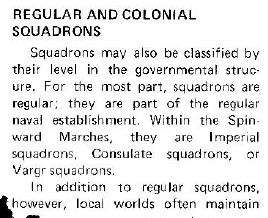
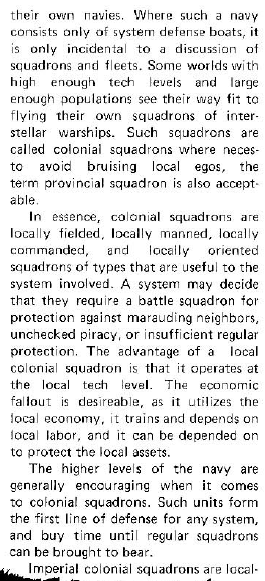
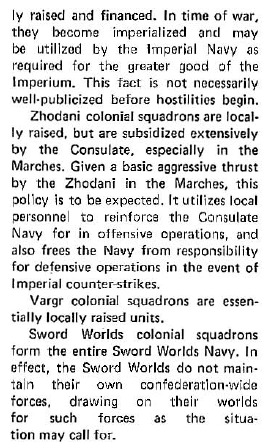
High Guard
FFW boardgame
Marc Miller's article in JTAS No.9 The Battle Fleets of the Marches
Spinward Marches Campaign
Plus the TNS (canonicity arguable): https://calormen.com/tns/
Miller says:
mike wightman
SOC-14 10K
There was also CT S:9 Fighting Ships.
Back to T4 Imperial Squadrons is heavily based on FFW, but gives you the rules to design your own squadron counters and admirals.
Back to T4 Imperial Squadrons is heavily based on FFW, but gives you the rules to design your own squadron counters and admirals.
How do they define the Admiral's factors?but gives you the rules to design your own squadron counters and admirals.
One of the flaws I always found in T4 is that the Navy career has no possibility to give the Tactics skill (Naval Academy aside), despite the skill description also talks about spaceships (and I guess it includes starships, though not specified)...
mike wightman
SOC-14 10K
You roll them randomly using two tables and a third roll.
For precedence roll 3d-3
For tactics roll 1d on the table (results are -2, -1, 0, 0, +1, +2)
For planning factor roll 2d on the table (results are 0,2,3,4,5,5,5,4,3,2,1)
For precedence roll 3d-3
For tactics roll 1d on the table (results are -2, -1, 0, 0, +1, +2)
For planning factor roll 2d on the table (results are 0,2,3,4,5,5,5,4,3,2,1)
Please drop the CT tangents... or make a separate thread for them.
New Thread posted:
T4/CT/MT: OTU Naval & Fleet Structure
I could never work out why in Imperial Squadrons the Scout Rons were neutered when compared with those in FFW boardgame (where they have useful planetary bombardment factors). Do you happen to know what the thinking was in this regard?There was also CT S:9 Fighting Ships.
Back to T4 Imperial Squadrons is heavily based on FFW, but gives you the rules to design your own squadron counters and admirals.

I chalked that up to differences in the tech base due to retaining FF&S as the design sequence, and the low yields of bomb pumped lasers, under FF&S/BL design paradigms. Plus just different design philosophies at opposite ends of the 3I...I could never work out why in Imperial Squadrons the Scout Rons were neutered when compared with those in FFW boardgame (where they have useful planetary bombardment factors). Do you happen to know what the thinking was in this regard?
You roll them randomly using two tables and a third roll.
So you cannot convert a character created by CharGen to such an admiral?
Similar threads


- Replies
- 1
- Views
- 978


- Replies
- 2
- Views
- 397


- Replies
- 108
- Views
- 4K