• Welcome to the new COTI server. We've moved the Citizens to a new server. Please let us know in the COTI Website issue forum if you find any problems.
  • We, the systems administration staff, apologize for this unexpected outage of the boards. We have resolved the root cause of the problem and there should be no further disruptions.

New materials for life support scrubbers

Spinward Flow

SOC-14 5K

I'm thinking that the "library" of Metal Oxide Frameworks (MOFs) will eventually get developed into engineering that makes a difference to how life support technologies operate. Research in this area is only in its infancy, but I can easily imagine materials of this sort being used as "molecular sponges" for unwanted life support byproducts (CO2 being merely one of them) which would require periodic "purges" using starport berthing services to ... reinitialize ... for repeated use. So basically another type of chemical scrubber, but one which can be "tuned" to capture and release specific molecules into and from the sealed environment in spacecraft/starships.
 
That had been recommended to me somewhat earlier.


I drew two conclusions:

1. Life support has to remove toxic elements from the atmosphere.

2. It has to liberate the oxygen from the carbon.

The carbon could be sequestered, and used as three dimensional printing material.
 
Not a good time to bring up Jump Message Torpedoes?:unsure::eek::D
🤨

I remember some of the threads & posts on this subject. Although they don't need any life support, the ships carrying them do.

I've always wondered, were Jump Message Torpedoes 100 dton torpedoes? (I know, they were under 100 dtons)

Because of them, I decided that it opened the door for 99- dton ships with jump capability, but with handicaps(?). They wouldn't be commercially viable, except for smuggling, maybe.
 
Functionally they aren't that different from Zeolite, I'm not sure how they compare performance wise.


I'm thinking that the "library" of Metal Oxide Frameworks (MOFs) will eventually get developed into engineering that makes a difference to how life support technologies operate. Research in this area is only in its infancy, but I can easily imagine materials of this sort being used as "molecular sponges" for unwanted life support byproducts (CO2 being merely one of them) which would require periodic "purges" using starport berthing services to ... reinitialize ... for repeated use. So basically another type of chemical scrubber, but one which can be "tuned" to capture and release specific molecules into and from the sealed environment in spacecraft/starships.
 
🤨

I remember some of the threads & posts on this subject. Although they don't need any life support, the ships carrying them do.

I've always wondered, were Jump Message Torpedoes 100 dton torpedoes? (I know, they were under 100 dtons)

Because of them, I decided that it opened the door for 99- dton ships with jump capability, but with handicaps(?). They wouldn't be commercially viable, except for smuggling, maybe.
They could be a sub-type of the x-boat. And so large that only really large starships could afford carry one. That and BB/BC might need one or two.
 
After some reading it seems like Metal Oxide Frameworks offer better performance than Zeolite. It looks like Nasa is looking at them as a possible replacement for the Zeolite they use on the ISS.
Functionally they aren't that different from Zeolite, I'm not sure how they compare performance wise.

I'm thinking that the "library" of Metal Oxide Frameworks (MOFs) will eventually get developed into engineering that makes a difference to how life support technologies operate. Research in this area is only in its infancy, but I can easily imagine materials of this sort being used as "molecular sponges" for unwanted life support byproducts (CO2 being merely one of them) which would require periodic "purges" using starport berthing services to ... reinitialize ... for repeated use. So basically another type of chemical scrubber, but one which can be "tuned" to capture and release specific molecules into and from the sealed environment in spacecraft/starships.
 
eba8fd4151547a4f7b42c65439d3e9cd_high.webp


Incense candle.
 
Not a good time to bring up Jump Message Torpedoes?:unsure::eek::D
It's always a good time to bring up j-torps! (They're only plausible in LBB2'77, and maybe MgT but I'm unsure of the latter).

Basically they only work when everything about Jump happens at or before Jump initiation (that is, when you can get away without having a bridge, computer, or power to keep the jump bubble intact -- just load the message and the jump plot, and hit the button).

In short, unless you can use the computer and bridge of the launching vessel to work it all out beforehand, it gets big and expensive enough -- especially at high jump numbers -- to be not worth it,
 
Last edited:
You'd need to have a stated rational why anything below fourteen hundred cubic metres destabilizes the jump process, in order to figure out how to legally lower the driving tonnage.
 
I've always wondered, were Jump Message Torpedoes 100 dton torpedoes? (I know, they were under 100 dtons)
They are variants of the standard ship missile, so 50kg

"Missiles: Missiles for missile launch racks are expended when they are fired;
replacements must be obtained for reloading purposes when the situation warrants.
Basically, a missile is of the homing type, costing about CR 5000 each. Such missiles
are committed to a specific target when fired, and after launch, home towards that
target until either the missile or the target is destroyed. Other types of missiles are
possible (for example, jump capable message torpedoes, or bombs for attacks
against planetary surfaces), but such require either specific alterations to ordinary
torpedoes, or location of an arms supplier who deals in such items. Specific
attributes of such non-standard missiles are the realm of the referee."
 
They are variants of the standard ship missile, so 50kg
"I'm breakin' the rules, in all the wrong places ...!" 🎶🤪

Personally, I just love the absurdity of the notion that a 50kg missile ordnance can contain the engineering needed for jump capable message torpedoes ... that might need to jump more than 1 parsec (multiple times! :eek:) in order to deliver their message.

Note also that if such a system "worked" ... there would be no NEED for the Express Boat Network.
Instead, there would be a Jump Torpedo Network. :unsure:

This is not mind control.
Think about it! 😆
 
They are variants of the standard ship missile, so 50kg
Now, an alternative interpretation that I COULD support would be the notion of using "missiles" as data recorders ... left behind for later pickup by subsequent company craft. Sort of a "message in a bottle" kind of thing for any follow up expeditions to find.

No jump involved, but plenty of, "Captain's Log, Supplemental..." type stuff in the data records.

So rather than being a jump torpedo (no jump!) ... it's more of a "trail of breadcrumbs" that can be left behind when venturing out into the unknown. Improves the chances of any kind of rescue expedition being able to find you with less time wasted searching (in all the wrong places) ... :unsure:
 
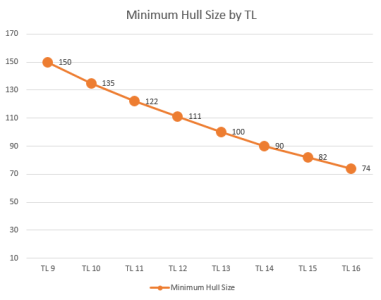
When you have a minimum jump drive tonnage of ten, plus ten percent volume per parsec, plus power plant, virtual bridge, you'd still need thirteen tonnes.
 
You'd need to have a stated rational why anything below fourteen hundred cubic metres destabilizes the jump process, in order to figure out how to legally lower the driving tonnage.
One of my rationales is that jump on ships 99- dtons causes the jump bubble to be slightly unstable due to going below the point at which a jump bubble becomes stable, at 100+ dtons.

One way I thought to limit 99- dton jump ships is to have a chance to mis-jump, similar to the chance to mis-jump when using unfiltered fuel. Another limit is that a jump unit can't be less volume than what is used for 100+ dton ships, so like a ships bridge, it takes up more volume the smaller the ship is, putting a limit on just how small a jump capable ship can be.

Would it be safe to say that a 50kg missile is 0.05 cubic meters? (based on water as a reference material using Google search with A.I. overview.)
 
Last edited:
Back
Top