• Welcome to the new COTI server. We've moved the Citizens to a new server. Please let us know in the COTI Website issue forum if you find any problems.
  • We, the systems administration staff, apologize for this unexpected outage of the boards. We have resolved the root cause of the problem and there should be no further disruptions.

Material Science Question....

Quint

SOC-13
Baronet
In the (now ancient) article by Christopher Thrash on material science and limitations on starship size (here), there's a set of tables for the Material Density in 1ton/m3, 3tons/m3, and 8tons/m3 - and I have no idea what the heck he's talking about.

Could somebody please explain this to me as if I have a doctorate in a very soft science?

Grognard I may be, but this is the part I like least about many editions of Traveller...

Thanks in advance!

D.
 
In the (now ancient) article by Christopher Thrash on material science and limitations on starship size (here), there's a set of tables for the Material Density in 1ton/m3, 3tons/m3, and 8tons/m3 - and I have no idea what the heck he's talking about.

Could somebody please explain this to me as if I have a doctorate in a very soft science?

Grognard I may be, but this is the part I like least about many editions of Traveller...

Thanks in advance!

D.
So, the short version is that as we understand things at TL7, there are limits to how much thrust you can put on a hull before the simple act of maneuvering or accelerating twists a ship apart under its own inertia. It makes a ton of assumptions about how future tech materials will perform. They are reasonable assumptions and extrapolations based on game stats, but they assume we don't learn anything about material science in the next 3500 years. They specifically don't include things like artificial gravity and reactionless thrusters, so feel free to take the whole article with a grain of sodium chloride.
 
I believe I’ve met Thrash in RL. He would have an interest in armor.

Skipping over the ductility vs. hardened bits. Advanced hulls would probably have some future chobham mix coupled with what is best for structure.

The distinction between the densities would be for unarmored, light armored and heavily armored ships.
 
I would suppose, that if the inertial compensation field extends to beyond the interior of the spacecraft, to the exterior shell, there is no stress on the hull due to acceleration.
 
In the (now ancient) article by Christopher Thrash on material science and limitations on starship size (here), there's a set of tables for the Material Density in 1ton/m3, 3tons/m3, and 8tons/m3 - and I have no idea what the heck he's talking about.

Could somebody please explain this to me as if I have a doctorate in a very soft science?

Grognard I may be, but this is the part I like least about many editions of Traveller...

Thanks in advance!

D.
I suspect this is about how the atoms in something are arranged and how closely they're packed. For example, today, there are methods to increase the density of some material, alloy, etc., by as much as about 10%. A typical method for doing this in industry currently is:


I've installed a couple of these HIP presses. They're insane with the temperatures and pressures they go to. You could run one at say, 1800 C and 100,000 psi. This is one method for making artificial diamonds for example.

So, in Traveller terms, with more advanced manufacturing methods, you could create something like say a metal-ceramic composite that has been put under such heat and pressure as to double the natural density of the material. This could increase its hardness and toughness to a point where penetration requires absurd velocities and hardness of the penetrator as to make it nearly impossible to penetrate.

Atoms can be arranged in different patterns. Some are far stronger than others. By forcing atoms into some more dense and tightly bonded pattern you increase the toughness and hardness of a material. That's what is happening here.

In a game example, you might have a TL 6 tank of some sort. The armor plate on the front is 100 mm thick and made of alloy steel. The same basic tank at TL 12 has some composite metal-ceramic armor that has been increased in density and now is just 25mm thick but has superior resistance to kinetic penetration over that TL 6 tank's armor.

Or if the two were still alloy steel the TL 6 tank's armor might weigh 160 lbs. per sq ft while the TL 12 tank for the same armor thickness now weighs 320 lbs. per sq ft due to the steel having its atoms packed far closer together by some manufacturing process. This would mean that I could--for this example, cut the thickness of the TL 12's tank's armor in half and have the same resistance to penetration at the same weight of material.

I hope that helps.
 
So, in Traveller terms, with more advanced manufacturing methods, you could create something like say a metal-ceramic composite that has been put under such heat and pressure as to double the natural density of the material. This could increase its hardness and toughness to a point where penetration requires absurd velocities and hardness of the penetrator as to make it nearly impossible to penetrate.

Atoms can be arranged in different patterns. Some are far stronger than others. By forcing atoms into some more dense and tightly bonded pattern you increase the toughness and hardness of a material. That's what is happening here.

In a game example, you might have a TL 6 tank of some sort. The armor plate on the front is 100 mm thick and made of alloy steel. The same basic tank at TL 12 has some composite metal-ceramic armor that has been increased in density and now is just 25mm thick but has superior resistance to kinetic penetration over that TL 6 tank's armor.

Or if the two were still alloy steel the TL 6 tank's armor might weigh 160 lbs. per sq ft while the TL 12 tank for the same armor thickness now weighs 320 lbs. per sq ft due to the steel having its atoms packed far closer together by some manufacturing process. This would mean that I could--for this example, cut the thickness of the TL 12's tank's armor in half and have the same resistance to penetration at the same weight of material.
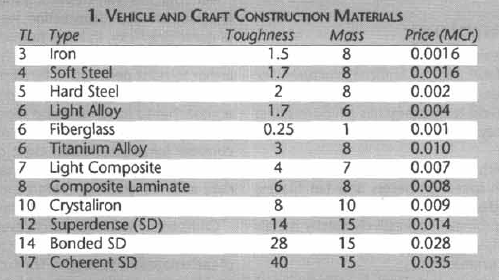
That would be superdense at TL12, bonded superdense at TL14, and so on. From FF&S:
1775986277477.png

As you can see, SD and BSD are about double the density of steel, and many times harder to penetrate for a given thickness.
 
The fact remains that toughness does not equate to the strength parameter to resist stress and strain. Are internal bulkheads and load bearing structures made out of hull armour material? Unlikely.

We can invent any numbers we like for the strength of these advanced materials to give the outcomes we want.
 
The fact remains that toughness does not equate to the strength parameter to resist stress and strain. Are internal bulkheads and load bearing structures made out of hull armour material? Unlikely.

We can invent any numbers we like for the strength of these advanced materials to give the outcomes we want.

I agree and disagree.

The toughness in terms of armor effect is not optimal for structure, the material is crystallized for different purposes.

But building material likely is made out of these advanced materials or at least the superstructure is. Not likely 1:1 of toughness vs support but the ratios are going to be in the ballpark.
 
Real world numbers suggest otherwise. Structural steel has vet different properties to armour steel. There may well be structural superdense, but we are just making up numbers since toughness is not necessarily in the same ratio as structural strength, and even if it is we can apply whatever co-efficient we want to get the results we want.
 
In materials science, toughness is a measure of durability, and hardness is a measure of resistance to deformation.

A tough material has a degree of elasticity and plasticity so that stresses will not cause failure, but rather will cause elastic or eventually a plastic response (i.e. strain) over a certain desired range. In other words they are pliable.

Hardness resists elastic and plastic response, remaining rigid (i.e. it is elastic and plastic over a very small range prior to failure). In other words, hardness goes hand in hand with brittleness.

Hardness and toughness are generally opposed properties. The art of armor (or swordcraft) is that you need BOTH toughness and hardness to do the job. Vehicle amor needs to be hard, but it can't shatter from a blow (it needs elastic and plastic response). A sword needs a hard edge, but needs to be able to flex from a hard shock or blow, and not shatter. That is why wall hanger swords can't actually be used - they are generally made of stainless steel, which is not only corrosion resistant, but super hard and takes a fine edge - and the moment it receives a shock or blow (especially with a narrow tang), it shears or shatters.

Low carbon steels tend to be tough, but not hard. High carbon steels tend to be hard, but not tough.

Swords and vehicle armoring generally need face hardening on the exterior, and a tough/durable backing or core to receive shock and blows.

The Travellér numbers are measuring hardness, and specifically face-hardness, and average density, and abstracting durability factors.
 
Last edited:
For a game that takes place, as I understand it, about 3500 years in the future of our RL, I find the discussion of our current technological capabilities and understanding amusing. My assumption has always been, with scifi games, that any conflict with RL science/engineering is due to the world having overcome that RL limitation at some point in those 3500 years.

It might be more fruitful if I was involved in a campaign based on a TL7 Red-zone world. I would indeed be kind of amused to see what spacecraft and vehicles can be designed at TL7, and have a few amusing ideas courtesy of the vehicle design chapters in MgT1 book 6.
 
In the (now ancient) article by Christopher Thrash on material science and limitations on starship size (here), there's a set of tables for the Material Density in 1ton/m3, 3tons/m3, and 8tons/m3 - and I have no idea what the heck he's talking about.

Could somebody please explain this to me as if I have a doctorate in a very soft science?

Grognard I may be, but this is the part I like least about many editions of Traveller...

Thanks in advance!

D.
You know that everything has a stress point at which it breaks, that is where the mass of the material, and stress point cross, so that it essentially breaks itself if any force is acted upon it.
 
Back
Top