• Welcome to the new COTI server. We've moved the Citizens to a new server. Please let us know in the COTI Website issue forum if you find any problems.
  • We, the systems administration staff, apologize for this unexpected outage of the boards. We have resolved the root cause of the problem and there should be no further disruptions.

Creation of Sub/Sectors: Bottom-up or Top-down?

Hello!

I have been working for like two weeks to make an entire Sector  map that I was satisfied with. Expand and create sole basic lore (for the polities and natives, basically). Now that I'm satisfied with the map, is the moment to start populating it with factions, NPCs, cultures and general hooks.

I wanted to ask and see how other people approach to this and why they prefer it that way.


Starting from the bottom, with one NPC, one planetary faction, even one object and from it expand to the Sub/Sector scale or start from the top with mega corporations, intersystem faction or the Sub/sector organization and then detail it with small things. And anything in between.
 
If you already have a history, then just put them where they belong.

If you're looking for something more organic, you can place the Great Powers in reasonable "start positions", in good systems in their respective corners or sections, and then they can "play risk" to work their way out and start claiming neighboring systems. Just give each one a turn, try to keep track of time in some reasonable way, and let them explore and colonize the stars as the starts lay.
 
Well, you've got the systems mapped already.
And, for each system, you have created a UWP already.
So you have locations, populations, tech and governments with legal systems.

"Now" they question you have is "Why?"
Why are the people and governments there?

The first answers should come from standing back and looking at the patterns you "accidentally" created.

Are there any large Mains, which work their way across the sector in varied directions?
Those would be how the region was first explored and settled. Largely explored by J-1 and J-2 ships and settled the same way.
Later, J-3 and perhaps J-4 liners would bring in bulk settlers if there is a larger polity (Like the Imperium or Consulate) to further settle places with resources delivering minders, workers, etc...

Are there worlds strung out across empty spaces like the Lanth passage from the Equus cluster to the Regina cluster?
If so, those systems are transit based systems serving more modern J-3, J-4 + ships that started serving the new, growing or established regional economy which grew after settlement was well in progress or established.

And those new way points, like D'ganzio to Lanth to Ghandi to Dinomn to Regina support mega-freighters while cutting the legs from the J-1/J-2 smaller traders who used to use the main from Celepina to Regina.
Why?
Because the massive J-3 and J-4 freighters can bring higher tech and better quality goods to Regina and then Jewell faster and in massive quantities. So, the old Jump-1 / Jump-2 routes start dying. Just like the Eisenhower Highway systems killed off much of the Route 66 local highway system and the businesses and towns along the way. This also happened when the railroads came west and killed off caravans and the towns they supported.

So, next, you have to ask yourself.....why did they make large ports on worlds separated by J-4 gulfs???
One answer is a story the game designers very obviously created: D'Ganzio
They said, "This will be the HQ for InstellArms in the Spinward Marches."
They looked at the map and said to themselves, "Self! The corporations are gonna come here and want chunks of rock where they can write the rules." So, they asked "What corporations first?" and the answer was "Guns and ships". So, they looked for where InstellArms would want to be?

Out in the middle of nowhere but close to everywhere.
So, they spent huge cash to buy the D'Ganzio system, build a port supporting mega-Freighters and ADVERTISED "Visit Here!!!"

So, now you see how the story starts to form.
This is what informs you on how the region you're building will grow stories.

A key prompt you should be seeing in what I've posted is to investigate history.
Look for places where societies formed, from modern (IE: the growth of the US West to classic histories like "Where did the original Egyptians come from and how did Pharaonic Egypt come to be?" You don't have to have worked with Dr. Hawass like I did. All this is now on the internet.

So, you have to explain why each population is there?
Is there a massive population at the end of a line of transit worlds because there "are" resources and they are miners, refiners, etc???
Or "was there" mining that played out and are the people there simply stranded and unable to get out of the system? Do they not have the money to get anywhere else or is there no where else that wanted them or would let them in?

Is there a world with almost no population and a high tech because they came and settled with high-tech machines to create and maintain robotics? Or, is this a recent settlement where some corporation expects a boom town to spring up around this sudden addition of a high-tech port?

What stories can you then create to support the numbers in the UWP?
How then can you connect the dots once you start creating the local stories with the systems next door?
What systems - which have no water or air - will HAVE TO create trade lines to places with excess food and water?
What high tech worlds will be forced to forge trade links with lower tech worlds which will need their products?

Again, all of this is part of the history of Terra.
It's all there for you on the internet
 
As above, I always recommend looking at what your government(s) are going to be, and remember each world has its own flavor, which is why I suggest fleshing out your main subsector first, then moving out one at a time. Always leave room for the "Place of Mystery" even if the mystery turns out to be a McGuffin. Develop a few people that are important, they do not have to be major players, they can be a reporter, an ore miner, a ship captain, or just a ruthless merchant. These help the sector become a real place. Consider a newsletter of things going on in the sector, it will help immensely in developing its life, and as a setting for adventures.

Shameless plug, check out my Far Frontiers thread for ideas, and please feel free to use or abuse any of them that you want.
 
One of the things I forgot to mention in my post above...
Look for systems with a Government code "6"
Those are all captive governments, meaning "colonies controlled by homeworld", "prison worlds", "invaded worlds", etc....

So, there is automatically some level of story dictated by such governments and that will help you write the story for your parcel of space
 
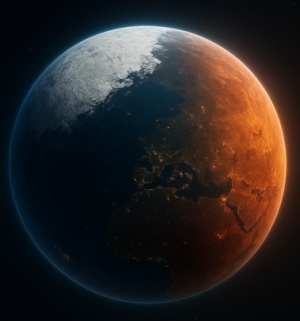
I just looked at the world Images for Extolay and wasn't impressed, because the world is tidally locked.
IMO, It should have burn and ice plates covering large parts of the world's surface.

So, I used this prompt and got the below picture
"Using images from NASA exoplanet research, create the image of a world which has a diameter of 4,000 miles, a thin atmosphere and 50% covered by fluids, but which is also tidally locked, so one pole is frozen and the other baked, with an equatorial temperate zone from which the lights modern cities can be seen in the night-zone"
1756917652113.png
 
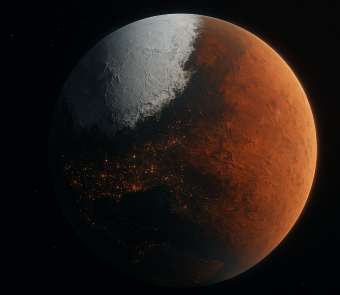
Also, just as a curiosity, I gave the application "Copilot" the same prompt and it came up with this, which looks exactly the same as ChatGPT...
I wonder who is feeding who?
1756934330293.png
 
Also, just as a curiosity, I gave the application "Copilot" the same prompt and it came up with this, which looks exactly the same as ChatGPT...
I wonder who is feeding who?
they are all feeding from other real people's art pretty much. But the LLMs also feed from each other which produces all sorts of inane things.

Oddly my master's thesis was on ethical implications of AI. but that was almost 30 years ago and not sure I'd agree with my conclusions now. Not sure I agreed with it then either TBH.
 
I used to design at the Sector level and bullseye in. But I realized that strategy results in a lot of design work that never gets in front of the players' eyeballs. So, I start at the Subsector, and I design to the adventure I'm running. If the group never leave the system, there is no real need to design the next Parsec over, but you can detail out some of the planets and moons that the group might visit.

I think that this principle has already been detailed in several places, but Only Design What You Need When You Need it!
If you need larger scale things, like trading mains and the locations of X-Boat Routes, you only need to expand your scope until the structure becomes apparent.

I agree however, that rolling up systems and parsecs and subsectors is fun, and allows for a solo means of playing Traveller. Keep those places in your back pocket and drop them on the players when you need to. I guess what I'm saying is, if the players haven't interacted with a place, then doesn't exist. "Schrödinger's Parsec"
 
I first used Sectormaker to generate the sector and sub-sectors, then decided on how many planets would remain in each subsector. Then I decided upon a name for each sub-sector to begin the task of determining how each sub-sector should look in terms of human occupation. This is the current layout for the sector. The Sword sector has a cluster of Space Viking planets, based on H. Beam Piper's book, Space Viking. Attached is a PDF of the sector and sub-sector planets. The sector is called the Piper-Norton sector, as some of the planets are derived from the writings of H. Beam Piper and Andre Norton.

Here are a some short planet description for the sector.
0506 Vinland C868534-4
An agricultural planet with a low Technology level, but highly productive with the very long growing seasons resulting from the planet’s long orbital period with respect to the A primary. The Mennonites and Amish that settled the planet take the attitude that men have to eat, regardless of what they do, and trade actively through intermediary traders with the Space Vikings, along with Megin-giord. Much of the agriculture is carried out using horses and oxen. The settlements are concentrated on one of the larger continental islands that has a good water transportation system.

0610 Wit’s End E756324-3
Settled by a Utopian group that despised technology, the colony struggles to survive on its cold planet. The scattered settlements are concentrated in the warmer equatorial regions, which have a climate similar to Ireland and England, moderately warm to cool and wet. The inhabitants have discovered that the northern forested regions are the home to several fur-bearing animals, which are their primary source of interstellar trade goods. Trade is intermittently carried out with El Paso and New Texas.

0302 Iarn-greiper B988673-B Space Viking
Both a Space Viking naval base and multiple military bases are present. The high hydrographic percentage has led to Balkanization among the fiercely independent Space Vikings so that the ground fighters have a tendency to practice on each other. They will cooperate against outsiders however.

0601 Flamberge B989753-C Space Viking
Both a Space Viking naval base and military base are present. Men from Flamberge are eagerly sought by other Space Viking ships for their superior strength as ground troops. The principal problem is acclimatizing the men to lower air pressure than normal which can affect their endurance in a negative way. Residents of Flamberge are normally uncomfortable in environments with standard air pressure, and experience acute discomfort on planets with a Thin atmosphere.

0609 New Britain D769474-4
A Rim Scout base is present, monitoring the planet’s interesting flora and fauna, and also training Scouts in dealing with hot, tropical planets. The limited number of settlers struggle to maintain the low technology level due to the separation of the island settlements. One of the major items of flora is a tree similar to the mangroves of Terra growing along a large portion of the island coasts. Trade is quite sporadic, and the Rim Scout base is a major source of off-world funding.

0708 Machu Picchu D678223-9
Machu Picchu represents an enigma to investigators. In the jungles and vegetation covering its lower elevations, ruins have been discovered, but the presence of a combination mold and fungus taint from the high humidity makes investigating them quite difficult. The planet’s population is concentrated around the small Rim Scout base which maintains the star port, and survives by providing equipment to the intrepid adventurers probing the lowlands. At the higher elevation of the plateau where the base is located, the taint is no longer a problem. Trade with El Paso, Nagegling, and Olifant is carried out on a sporadic basis, with the primary source of trade being El Paso.

0810: El Paso D767444 TL 4 (see remarks) Trade Classification: Non-Industrial Gas Giant present, along with asteroid belt. No bases, Hazard Potential: Moderate (The local population has been known to “shoot first and apologize later”.)
El Paso was settled about 100 years ago by a disgruntled group from New Texas. Feeling the independent spirit of the Texan was being eroded by the frivolities and glitter of higher Tech civilization, this group wished to return more to the spirit of the Old West (of North American Earth circa 1880). As such, the population represents the most independent of an already highly independent group. They are choosing to live at Tech Level 4, although they are aware of what higher Tech Levels have to offer, and have strong restrictions on what can and cannot be imported.

Another planet, Kelpie, has been given a write-up in the September-October issue of Freelance Traveller. That is a bit longer write-up.

 

Attachments

Responding to OP, my take on it is that it's going to depend on what sort of stories you want to tell (and adventures are just interactive storytelling, in my book).

All stories are personal, in that they are about individual characters and their actions, interactions, conflicts, ambitions, etc., but each of those characters' personal stories may (or may not) have repercussions at higher levels, and if they do, you need to have some idea of the environment that those repercussions are going to occur in.

If the denouement of a story is specifically to change something at a higher level - for example, your story is about a diplomatic incident, resulting in a [hot or cold] war between polities - then you'll need to work out the higher level of the polities before you can set the story, so that the repercussions are consistent with the "background" that it will be affecting.

On the other hand, if you're telling a first-contact scenario, you might not need to work out more than the basics of the policies of the polity that the explorers work for; unless you want to write a story like Turtledove's NonInterference, where the first-contact is not itself the focus of the story, but instead the catalyst for a story about the polity's politics, you can get away with only working out that bottom-most level.
 
Back
Top