• Welcome to the new COTI server. We've moved the Citizens to a new server. Please let us know in the COTI Website issue forum if you find any problems.
  • We, the systems administration staff, apologize for this unexpected outage of the boards. We have resolved the root cause of the problem and there should be no further disruptions.

Alternate Loan Terms

spank

SOC-13
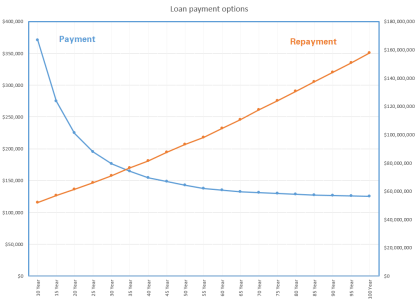
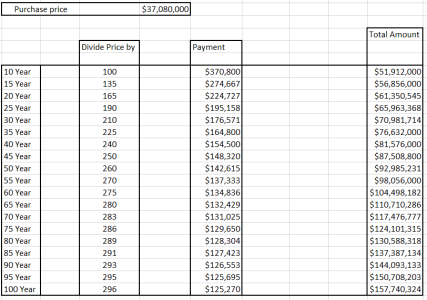
I posted this idea many years ago, but didn't include any information about the economics of it. The basic 40 year loan is 20% down plus the full purchase price financed at ~4% (3.9795365%) But the term is fixed at 40 years regardless. However a different term length might afford the Players some more flexibility. With that in mind I came up with terms for loans from 10 years to 100 years.
1766027721463.png


1766027952912.png
 
My Beltstrike characters deal in loans regularly - this is helpful, thank you.
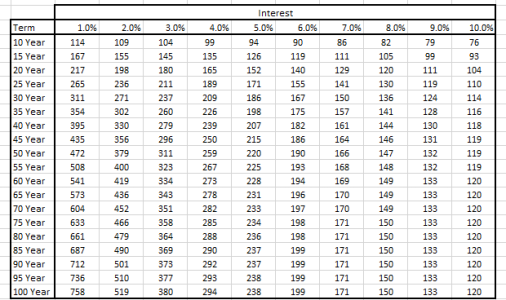
If you want to do variable interest rates I worked up a chart for that too, At higher interest rates payment doesn't drop with a longer term, this is due to the fact that I rounded the divisor to the nearest whole number.
I could add another place, but I figured whole numbers are close enough.

1766653901149.png
 
There's a component here that's not being mentioned, and it's significant.

It's passed over in the books.

But, simply, a starship loan is not a car loan or a house loan.

Car loans are lousy. A collateral backed loan against a depreciating asset. Make sure you get your interest up front, its ok for the buyer to be upside down in the loan, but not the bank. A house loan is against an (ideally) appreciating (if not at least keeping with inflation) asset, so a much less riskier product for the bank. That's what the 20% down is for on the house loan, to eat some potential depreciation or damages if the bank has to liquidate the asset, they're, again ideally, always in the black on the loan.

A starship loan is against the BUSINESS that the starship is part of. Not the ship itself. The bank really doesn't care about the ship, they care about the cash flow of the business. It's not really a secured loan (the asset is too dangerous in this case -- space travel, pirates, depreciation, etc.) But show a business plan that works and is profitable in that environment? Then, yea, you can get a loan from a bank to run the business (of which the ship is a capital expense for).

 
If you want to do variable interest rates I worked up a chart for that too,
That works well with the variable interest rates in JTAS 13.

A starship loan is against the BUSINESS that the starship is part of. Not the ship itself. The bank really doesn't care about the ship, they care about the cash flow of the business.
That's how I've always played it. In my Belstrike game, one of the characters got a short-term loan for an expensive cargo because the projected return would cover the loan and because it was backed by their asteroid mine, which was a going concern, producing ore for sale in multiple systems.
 
There's a component here that's not being mentioned, and it's significant.

It's passed over in the books.

But, simply, a starship loan is not a car loan or a house loan.

Car loans are lousy. A collateral backed loan against a depreciating asset. Make sure you get your interest up front, its ok for the buyer to be upside down in the loan, but not the bank. A house loan is against an (ideally) appreciating (if not at least keeping with inflation) asset, so a much less riskier product for the bank. That's what the 20% down is for on the house loan, to eat some potential depreciation or damages if the bank has to liquidate the asset, they're, again ideally, always in the black on the loan.

A starship loan is against the BUSINESS that the starship is part of. Not the ship itself. The bank really doesn't care about the ship, they care about the cash flow of the business. It's not really a secured loan (the asset is too dangerous in this case -- space travel, pirates, depreciation, etc.) But show a business plan that works and is profitable in that environment? Then, yea, you can get a loan from a bank to run the business (of which the ship is a capital expense for).
The way I thread it is the bank is charging profit only first 20 years, and during that time they are carrying insurance for the likely sell price. As the sell price drops they carry less insurance. Equity only builds on the back end of the mortgage.

If the ship is lost the owner operators are not on the hook, but likely will have a tough time getting a new loan.
 
Back
Top