• Welcome to the new COTI server. We've moved the Citizens to a new server. Please let us know in the COTI Website issue forum if you find any problems.
  • We, the systems administration staff, apologize for this unexpected outage of the boards. We have resolved the root cause of the problem and there should be no further disruptions.

All Things Vargr

Vargr: Military Organization

V. I think we could generally divide Vargr society into three general classes, which may sound familiar.

W. Citizens, freewolves, and slaves.

X. Now, you might be thinking, slaves, really?

Y. Besides the similarity with Hellenic social structures, they might not be technically property.

Z. Just Vargr, with very limited personal and professional options.
 
Vargr: Military Organization

1. Wageslave underclass would explain the large percentage of corsairs.

2. As the most convenient way to escape their constrained lifestyle.

3. Freewolves would, or should, have no obstacle to their exit of a Vargr polity.

4. Entrance might be another issue.

5. While migration tends to be a rather prominent Vargr characteristic.

6. Not all Vargr polities are welcoming to migrants.

7. But, usually freewolves have the means to move.

8. Wageslaves do not.

9. Thus, joining a corsair pack both scratches a wanderlust itch, and poses a potential windfall within reach.
 
Vargr: Military Organization

A. Wageslaves don't have the vote, and technically, don't pay income tax.

B. Freewolves pay taxes, but can't vote.

C. Citizens pay taxes and have the vote.

D. Rich freewolves probably could buy citizenship.

E. Most won't, since citizenship includes the obligation to bear arms for the city state.

F. Probably the primary reason that citizens vote to allocate funds to finance corsairs to do that, in their stead.
 
Vargr: Military Organization

G. If for some reason the leadership of the city state feel that they are over populated, they could scout out some suitable site to set up a daughter colony.

H. Or, it's has some strategic reason, like a nearby resource, to place settlers there, in order to control access and exploit it.

I. While initially supported, it eventually has to become self sustaining.

J. After which, direct control is withdrawn.

K. Though, the assumption is that cultural imperialism will keep the daughter colony within the mother city state's orbit.
 
Vargr: Military Organization

G. If for some reason the leadership of the city state feel that they are over populated, they could scout out some suitable site to set up a daughter colony.

H. Or, it's has some strategic reason, like a nearby resource, to place settlers there, in order to control access and exploit it.

I. While initially supported, it eventually has to become self sustaining.

J. After which, direct control is withdrawn.

K. Though, the assumption is that cultural imperialism will keep the daughter colony within the mother city state's orbit.
Er, doesn’t Travellermap show a hodgepodge of local government types?

Perhaps the various interstellar polities operate as you outline or at least open to that interpretation, but I don’t know if the Greek pack state follows all the way through.
 
As I mentioned above, the city state model allows Vargr equilibrium in the politco socio economic sense.

But, all things pass, and internal and external pressures will force it to evolve into something else.
 
Vargr: Military Organization

L. At some point, the leaders in a city state realize that trying to physically conquer costs more than it's worth.

M. The method of imperialistic control they will adopt is that of hegemony.

N. All other polities, Vargr or otherwise, within their sphere of influence, will have limited autonomy.

O. The primary city state will dictate defence and foreign policy, and extract tribute.

P. Internal affairs and security are considered the tributary's problems, unless they aren't.
 
Vargr: Military Organization

Q. Having identified the ideal Vargr polity, we can, supposedly, figure out the ideal Vargr military (organization).

R. If you assume one in two hundred are in a military that is professionalized.

S. With corsairs making up ten percent of the population, you could siphon off the best one tenth of that.

T. Balanced by mandatory military service, as opposed to conscription.

U. Which I figure would be potentially from the remaining seventy percent, being the working population, and both genders.
 
During the Age of Pericles (461–429 BC), Athens had an estimated total population of 250,000–300,000 people, with only about 40,000 to 60,000 adult male citizens who could vote. The majority of the population consisted of women, resident foreigners (metics), and slaves, none of whom had political rights. The demographic makeup was structured with citizens at the top, followed by a large population of metics and even more slaves, but only the adult male citizens could participate in the direct democracy.

Athenian population breakdown (c. 430 BC)

  • Total Population: Estimates vary, but the total population in Athens and its surrounding region, Attica, was between 250,000 and 300,000.
  • Adult Male Citizens: Approximately 40,000 to 60,000 adult males could participate in government through the Assembly.
    • Citizenship required both parents to be Athenian, a law passed during Pericles' time.
    • Citizenship was restricted to adult males over 18, excluding women and children.
  • Metics (Resident Foreigners): This group consisted of non-citizens living in Athens, likely numbering around 50,000.
    • They were a significant part of the population but were denied political rights.
  • Slaves: This was the largest segment of the population, estimated to be at least 100,000.
    • Slaves had no rights and performed the majority of the labor in the city.

Implications for democracy and society

  • Despite Athens being the "birthplace of democracy," the "people" who held power were a small minority of the total population.
  • Pericles' reforms, such as implementing payment for jury service, made it possible for poorer citizens to participate in government, but only male citizens were ever eligible.
  • Women, slaves, and foreigners were entirely excluded from political life, although they constituted the vast majority of the population.
  • The strict citizenship law of 451/450 BC, which required both parents to be Athenian, reduced the number of citizens over time, weakening Athens politically and militarily, especially after the subsequent plague and Peloponnesian War.

Or so artificial intelligence tells us.

So, let's say twenty percent military age male citizens.

Let's match that with twenty percent female citizens.

Forty percent foreign residents.

Twenty percent underclass.

Let's say that's the ideal Vargr demographics.
 
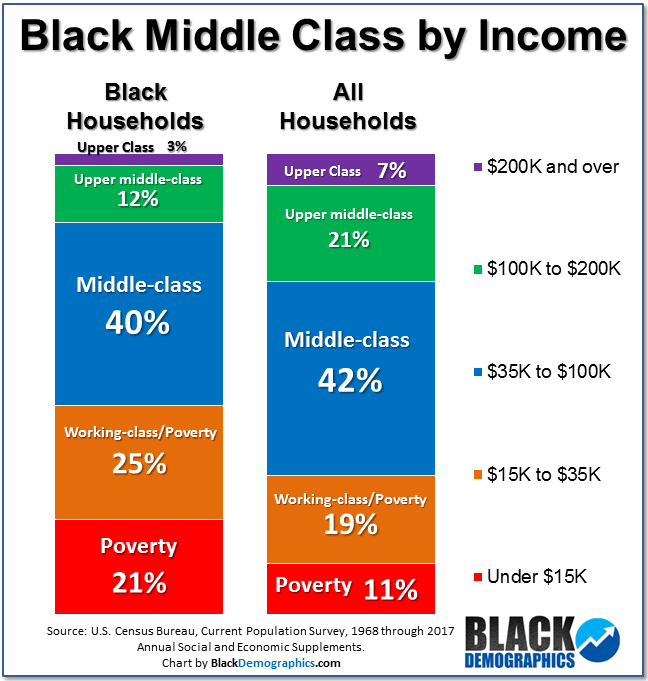
2016-Black-Middle-class-by-Income.png


The previous post posits my view as to the ideal Vargr demographics.

This probably is closer to our reality in a rather rich nation state.

Ratios skew to twenty eight, forty two, and thirty percent.

We're using the middle class to represent Vargr nomads and transients, who aren't legally tied to the state that they are currently residing in, and have the means to move on
 
Vargr: Military Organization

V. Corsairs don't originate from one class or demographic.

W. Or mostly, since we'll assume that itch is approximately the same for all Vargr.

X. What likely would be a major factor would be economic pressure as to actually seeking a career as such.

Y. I'd say that one fifth, one twentieths of citizens, and two fiftieths, one tenth of residents, are corsairs.

Z. The remaining two fifths, one fifth thereof, are drawn from the working demographic.
 
Vargr: Military Organization

1. I'm going to get sidetracked by something that isn't in the rules.

2. Charisma, distance, and span of control.

3. I don't think I've seen a mechanism that mechanically calculates the optimal number a pack leader can lead, based on his charisma, and related skills.

4. I tend to think this is further exasperated by the Peter Principle.

5. Not in the sense that a series of failures would lower the charisma characteristic.

6. Rather, that the pack leader is leading more Vargr than his charisma characteristic can actually effect positively.

7. Pack leaders can lead overpacked packs, which dilutes the effect of his charisma, and let's say he gets a bane of minus two modifier when using his charisma on his pack, as a whole.

8. He could deliberately keep the size of his pack a tier lower, and get a positive plus one modifier when influencing his smaller pack

9. And, of course, you can imagine how that works over Zoom.
 
Vargr: Military Organization

A. Rizz is a colloquial noun, used when describing possession of charisma. As a verb, rizz can be used to describe using charisma to attract someone, as to "rizz up" a person.[4][3] It is believed that the second syllable of the word charisma was taken from the it to create the word rizz, though this belief is not universal.[5] Oxford University Press described this formation pattern for a word as "unusual", however, this formation pattern can be seen in the shortening of words such as refrigerator (fridge), and influenza (flu).[4]

B. To be most effective, it needs close, actual physical presence.

C. Persuasion tends to be psychological, enforced either through intimidation, logic, demonstrated competence, and so on.

D. Basically, personal competence.

E. Adjusted by third party halo effect.

F. Vargr want to be him, and Vargresses want to be with him; or her.


st,small,507x507-pad,600x600,f8f8f8.u2.jpg


hq720.jpg


Rizzle Khan
 
2. Charisma, distance, and span of control.

3. I don't think I've seen a mechanism that mechanically calculates the optimal number a pack leader can lead, based on his charisma, and related skills.
The size of any of the polities in the Vargr Extents should help with #2.

As far as #3 goes, a loose comparison against Soc for the Nobility in the Imperium might also help with figuring out a mechanism that mechanically calculates the optimal number a pack leader can lead. The thing is, I don't think there should be an 'optimal' number for Charisma when used for Leadership. I say this, because if there were 'Optimal' Charisma Leaders, it would go against the Vargr lifestyle of leaving a low Charisma loser(?) for a high Charisma winner(?). Besides, wouldn't Optimal for Vargr be from the viewpoint of those being led, not the leader?
 
I am not offering this as a serious mechanic, just back of the envelope scatter thinking.

Let’s say the mechanic for charisma span of control was charisma equals number of subleaders possible, at least one less CHA stat.

Then those subleaders have subleaders that hew to them.

So a CHA 10 leader can have 10 subleaders of CHA 9, who each can have 9 subleaders at CHA 8.

Already we are at 1+10+90=101 and that’s just two levels.

Starting at CHA 12 and assuming perfect distribution, one can get a 479 million member mega pack.

Of course no such thing is reasonable but even at say 10% it works to give a picture of larger than pack state cities.

And mega packs might cooperate within a polity.

Maybe call it delegated feudal charisma.
 
Last edited:
The size of any of the polities in the Vargr Extents should help with #2.

As far as #3 goes, a loose comparison against Soc for the Nobility in the Imperium might also help with figuring out a mechanism that mechanically calculates the optimal number a pack leader can lead. The thing is, I don't think there should be an 'optimal' number for Charisma when used for Leadership. I say this, because if there were 'Optimal' Charisma Leaders, it would go against the Vargr lifestyle of leaving a low Charisma loser(?) for a high Charisma winner(?). Besides, wouldn't Optimal for Vargr be from the viewpoint of those being led, not the leader?

Context would be required.

This is, as always, half groping in the dark, as to how fictional space race civilization functions, even with the canine connection.

At the micro level, we're dealing with a platoon sized bunch of wolves, who require direction, and the mechanism for that is confidence in a charismatic character.

I forget where, but the pack is supposedly between twenty four to fifty individuals.

The more charisma a pack leader has, the more confidence the pack has in him, and the larger the pack would, or could, become; this is balanced by diluting the effect that the increased charisma has more more packmembers.

At the same time, if the numbers are a tier below at subpack level, the charisma is more concentrated, and loyalty could become fanatical.

Adjust and modify by any number of circumstances and skills.

At micro level, this should be rather simple to calculate.

Optimal being more of a yardstick, for when the pack grows too large to effectively control; personal circumstances for a packmember would decide if he stays or goes, part of which would be the pack leader's charismatic effect.

 
I am not offering this as a serious mechanic, just back of the envelope scatter thinking.

Let’s say the mechanic for charisma span of control was charisma equals number of subleaders possible, at least one less CHA stat.

Then those subleaders have subleaders that hew to them.

So a CHA 10 leader can have 10 subleaders of CHA 9, who each can have 9 subleaders at CHA 8.

Already we are at 1+10+90=101 and that’s just two levels.

Starting at CHA 12 and assuming perfect distribution, one can get a 479 million member mega pack.

Of course no such thing is reasonable but even at say 10% it works to give a picture of larger than pack state cities.

And mega packs might cooperate within a polity.

I had a go at squaring Charisma, and didn't quite like where that led.

Let's start with the megapack.

The megapack would be more of an identity, whether that of a Vargr polity, or religion, or Magic Card players.

How large is a megapack, and how do you lead it?

Circumstantial.

However, I do have the superpack, which would consist only of pack leaders, which would be led by either a warchief, or a banner leader.

This would allow the banner leader to imprint his charisma directly on the pack leaders.

How that would work on civilian packs, is still somewhat vague.

Extending control with the use of subleaders would be the most practical method.

I'm going to try the following example.

Family pack - male pack leader, appoints female mate as subpack leader; eleven cubs, appoints eldest daughter as subpack leader.


a13cf04f-1884-4680-8600-fa45f9651ba4
 
In a way, you have to come to terms with what a pack is, to the Vargr personally, and in gaming terms.

I'd say it's who the Vargr is hanging out with, most of the time, at that moment.

Assuming a third of the time is spent sleeping, half of the (week) day, the Vargr is at home with his family.

The other half the time the Vargr is at work, or commuting there.

That's basically two (separate) packs.

Inbetween, the Vargr might be on social media; potentially, one or more packs.

Weekend, playing golf with his country club buddies, another pack.

If he's playing interstellar pirate, that seems a twenty four hour, seven day commitment.

So gamewise, the Vargr's current major commitment, outside of family.
 
Vargr: Military Organization

G. A military pack functions like a company.

H. Despite sized like a platoon.

I. The pack leader acts as a captain, not a lieutenant.

J. The pack strives to be self sufficient, and independent.

K. At a minimum, semi independent, with attached elements to successfully complete their mission(s).
 
Vargr: Military Organization

L. And now we move on to Vargr military sub pack leaders.

M. You could think of them as being either sergeants or lieutenants, possibly both.

N. Lieutenants extend control, are reflections of the pack leader's charisma, especially if the pack leader leaves line of sight.

O. Sergeants distinguish themselves with competence, usually technical.

P. Both provide supervision by proxy.
 
Back
Top