Re the air raft in every garage, not necessarily.
This is also my interpretation, but for a different reason.
You don't need a "personal" vehicle in every garage once autonomous driving becomes a "solved" technology stack.
Instead, the (grav) transportation network becomes a subscription "robotaxi" type service.
So instead of each household buying their own (personal) vehicle(s) ... instead, there's a company that owns a fleet of (autonomous grav) vehicles which can be hired/chartered for nominal fees on top of a subscription price, enabling transportation on demand. The utilization rate per vehicle in the fleet goes up ... while the cost to each participant in the service goes down (relative to the alternative of individual ownership for each vehicle). What you wind up with is a sort of "communal public transport" business model that is autonomous software driven which has more in common with a public utility cooperative service, rather than a personal ownership (and capital investment required) by each household yielding minimal utilization per day.
Wealthier households could still purchase and own/operate their own personal vehicle(s) ... but for most of the middle and lower (social standing) classes, it's simply "cheaper" to subscribe to a "robotaxi" type of autonomous service than personally owning a vehicle.
I look at the CT air raft as less a personal car and more a personal helicopter. Expeditionary cargo truck tool.
This is a better way to think of the air/raft.
It's really more of a "3D pick up" vehicle.
With the appearing of the fusion power, as well as other (mostly renewable) power sources (solar satellites, wind, geothermic, etc,), the problem of hydrogen supply, that, as you say, is mostly power dependent, becomes moot. You can obtain as much as you need, as long as you have water (and probably other sources).
With large/plentiful bodies of water under atmosphere, fusion power makes (hydrogen) fuel "refining" something of a non-issue (technologically speaking). However, not all planetary bodies HAVE plentiful supplies of hydrogen fuel precursors just lying around waiting to be snatched up and used.
Think about Hydrographics: 0 type Desert Worlds (in their star's habitable zone).
Think about Atmosphere: A-C type worlds with Fluid Oceans that are not composed of H
2O, but from other molecular substances.
Once you're dealing with more than a single type of planetary environment (Size: 8, Atmosphere: 6, Hydrographics: 7) but a whole RANGE of UWP code combinations ... sources for liquified H
2 can potentially go from being "just add water" to being "ah ah, GO GET your own water!" (or local equivalent of convenience).
In some star systems, the "closest" source of convenient H
2 won't be on the mainworld at all

... meaning you'll need to set up a logistics supply chain of scooper/tankers running all the way out to the nearest gas giant.
And in some star systems in the Spinward Marches ... the "nearest gas giant" CAN MEAN "interstellar travel required" in order to close the loop on that supply chain.
In extreme cases, you're looking at Deep Space Stations that are J4 from the nearest source of H
2 fuel parked out in the
Great Rift between the Third Imperium and the
Islands Cluster in the Reft sector. Try to imagine the "revenue tonnage fraction" for a starship tanker that needs to devote 40+40=80% of its tonnage to jump fuel, just to make the round trip to those Deep Space Stations.

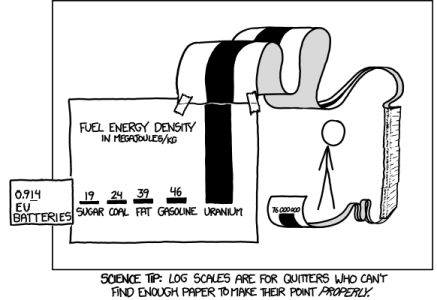
Current electric cars have (to may knowledge, this may have improved since last time I checked it) quite low autonomy, and take time to recharge.
Your information is out of date.
Tesla vehicles (basically ALL OF THEM) are capable of autonomy RIGHT NOW ... it's just a matter of "perfecting the software" rather than a hardware limitation.
In case people don't believe me on this point ... 9 months ago (as of this posting), Tesla FSD navigated the Arc de Triomphe roundabout in Paris, functionally flawlessly. Here's a 54 second video clip of that happening.
Spoiler alert: that was 9+ months ago ... and Tesla FSD has improved
by orders of magnitude (PLURAL!) since then ...

It's "still not perfect" ... but it's reaching "superhuman skill levels" by the time that I am writing this. The statistical data shows that Tesla FSD is already "safer than the average human" ... and Tesla keeps improving the system, aiming for 10x safer than human as a first order threshold for the widespread adoption of autonomy in driving.
To give you an example, to go from Barcelona to Madrid (just over 600 km) with an electric car, you will have probably to spend the night in Zaragoza (about half way) to recharge the batteries, while to make the same trip with a gasoline (or hybrid) car you take about 6-8 hours.
Zaragoza, Spain you say?

Tesla Supercharger station
LINK (english language lookup)
8 Superchargers: up to 250kW max
Access Hours: available 24/7
This Supercharger is Open to Tesla and Other EVs with CCS compatibility
7 Tr.ª de los Jardines Reales
Zaragoza, Aragon 50021
You no longer need to make an overnight stay in Zaragoza at a (low power) destination charger before completing your road trip between Barcelona and Madrid. Simply plan for a 30 minutes (or less) charging session at the Supercharger station (get out of the vehicle, stretch your legs, use the water closet, get a drink, etc.) before resuming your journey. So ... 6-8 hours in an electric vehicle too.
Even if you have to refuel, it takes only a few minutes (and I guess refuelling hydrogen will be likewise quick). There exist quick recharging batteries, but for what I know their useful life is quite reduced.
Hydrogen is NOT quick to refuel. It's also ridiculously expensive (in the real world).
Take your usual petroleum fuel price and multiply it by 6-10x (or more!) and that's the typical hydrogen refueling station price.
Furthermore, current (real world tech) hydrogen stations for public passenger cars can only supply hydrogen to about ~50 vehicles before needing a resupply from a tanker truck.
There's a reason why the hydrogen fueling stations that have been built keep failing economically ... and it's because of the hydrogen as fuel logistical issues.
Battery fast charging is now a substantially "solved" problem with battery management systems marching along the Tech Curve and getting better all the time. Also, BEV battery systems are lasting longer than anticipated ... a LOT longer ...
So, I guess what now you call Fool Cells may be really useful in higher TLs, where the obtaining and storage problems for hydrogen have been so solved, as an alternative to batteries when fusion power is too powerful, expensive and large to be used.
Fuel Cells have their niche roles, including Air Independent Propulsion (AIP) in non-nuclear power submarines(!) while submerged ... but they aren't a panacea and they aren't "best in slot" for every single use case where you need power. However, those use cases tend to be in "challenging environments" (such as in space or submerged in the ocean) rather than in terrestrial vehicles (cars, busses, trains, etc.).



 ) cycle with supercritical CO2 (which doesn't need to change phase states between gas and liquid) as the working fluid for converting heat energy into mechanical work is already underway in the real world.
 ...
...